$C^*$-simplicity and boundary actions of discrete quantum groups
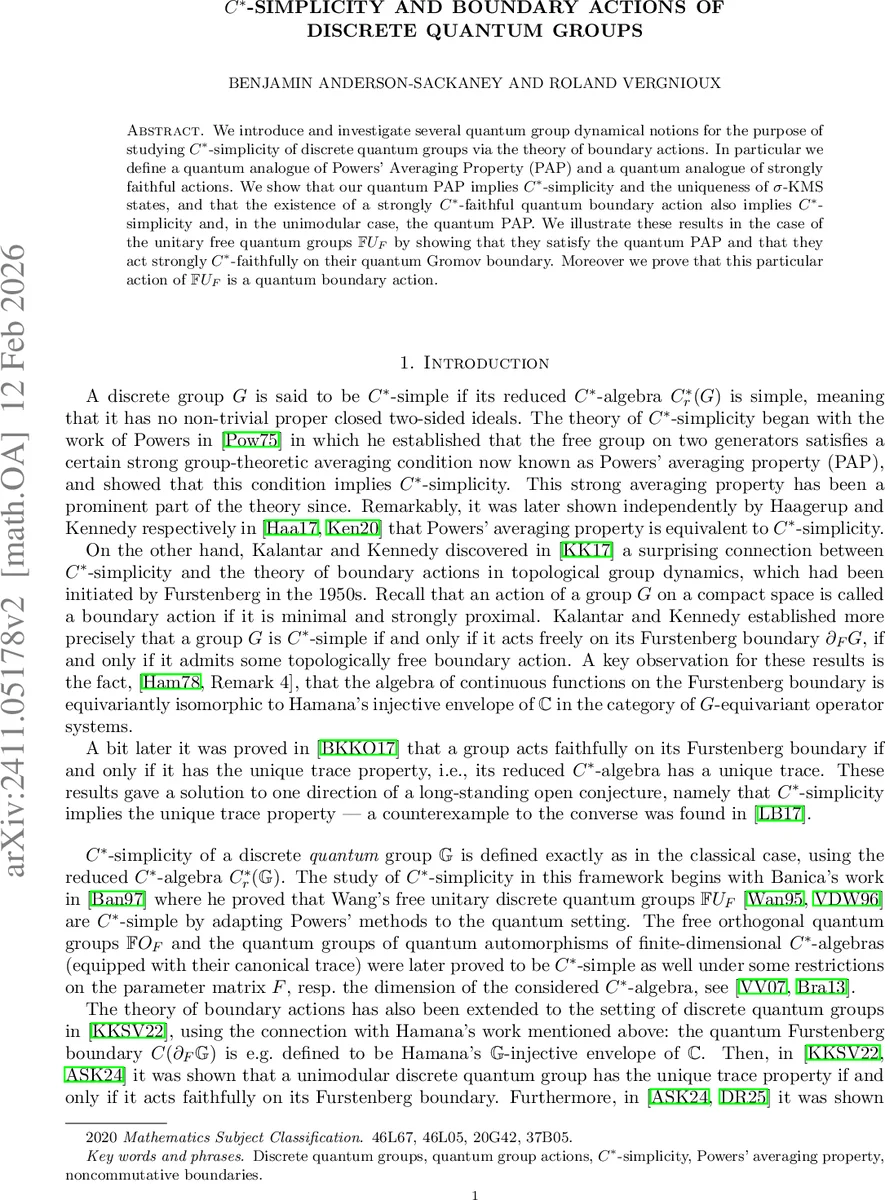
We introduce and investigate several quantum group dynamical notions for the purpose of studying $C^$-simplicity of discrete quantum groups via the theory of boundary actions. In particular we define a quantum analogue of Powers’ Averaging Property (PAP) and a quantum analogue of strongly faithful actions. We show that our quantum PAP implies $C^$-simplicity and the uniqueness of $σ$-KMS states, and that the existence of a strongly $C^$-faithful quantum boundary action also implies $C^$-simplicity and, in the unimodular case, the quantum PAP. We illustrate these results in the case of the unitary free quantum groups $\mathbb{F} U_F$ by showing that they satisfy the quantum PAP and that they act strongly $C^*$-faithfully on their quantum Gromov boundary. Moreover we prove that this particular action of $\mathbb{F} U_F$ is a quantum boundary action.
💡 Research Summary
This paper addresses a notable gap in the theory of C*‑simplicity for discrete quantum groups by introducing quantum analogues of two classical dynamical notions: Powers’ Averaging Property (PAP) and strong C*‑faithful actions. The authors first define two versions of a quantum PAP: the basic PAP and a stronger variant denoted PAP h. Both are formulated in terms of averaging operators built from finite‑dimensional corepresentations of the quantum group G, but PAP h additionally requires that every G‑equivariant unital completely positive (ucp) map from the reduced C*‑algebra C*_r(G) into the quantum Furstenberg boundary C(∂_F G) factor through the Haar state. They prove that PAP guarantees C*‑simplicity of G, while PAP h further forces the uniqueness of σ‑KMS states on C*_r(G). In the unimodular case the two properties coincide.
The second major contribution is a quantum notion of a “strongly C*‑faithful” boundary action. Building on the identification of the Furstenberg boundary with Hamana’s G‑injective envelope, the authors require that every G‑equivariant ucp map C*_r(G) → A (where A is the C*‑algebra on which G acts) be faithful. This condition generalizes the classical concept of a topologically free action but is tailored to work also for non‑unimodular quantum groups, where the usual freeness notion fails. They show that the existence of a G‑boundary with a strongly C*‑faithful action implies PAP, and consequently C*‑simplicity (Theorem 4.20 and Corollary 4.21).
The theory is then applied to the free unitary quantum groups F U_F. Banica’s earlier work is re‑interpreted as establishing PAP h for these groups. The authors verify that F U_F indeed satisfies both PAP and PAP h. They then turn to the quantum Gromov boundary A = C(∂_G F U_F) introduced by Vaes, Vergnioux, and others. While it was known that A is a boundary for the Drinfeld double D(F U_F), the paper proves that A is already a boundary for F U_F itself. The key step is Theorem 5.5, which shows that the “nearest‑neighbour” quantum random walk on F U_F admits a unique stationary state; this state is non‑atomic even in the non‑unimodular regime. Using the uniqueness of the stationary state together with results from KKSV22, the authors conclude that A is an F U_F‑boundary and that the action is strongly C*‑faithful. Consequently, the C*‑simplicity of F U_F (for matrices F∈GL_N(ℂ), N≥3) follows from the new dynamical framework rather than Banica’s original averaging arguments.
Overall, the paper establishes a robust bridge between quantum dynamical properties (quantum PAP, strong C*‑faithfulness) and operator‑algebraic simplicity. It demonstrates that these properties are not merely sufficient but, in the unimodular setting, essentially equivalent to C*‑simplicity. By treating the free unitary quantum groups as a test case, the authors illustrate the practicality of their approach and open the way for similar analyses of other quantum groups, such as free orthogonal quantum groups or quantum automorphism groups. The work also highlights the pivotal role of the Haar state, modular structure, and stationary states in the interplay between quantum dynamics and C*‑algebraic rigidity, suggesting promising directions for future research in quantum group theory, non‑commutative boundary theory, and quantum statistical mechanics.
Comments & Academic Discussion
Loading comments...
Leave a Comment