Chemically Regulated Conical Channel Synapse for Neuromorphic and Sensing Applications
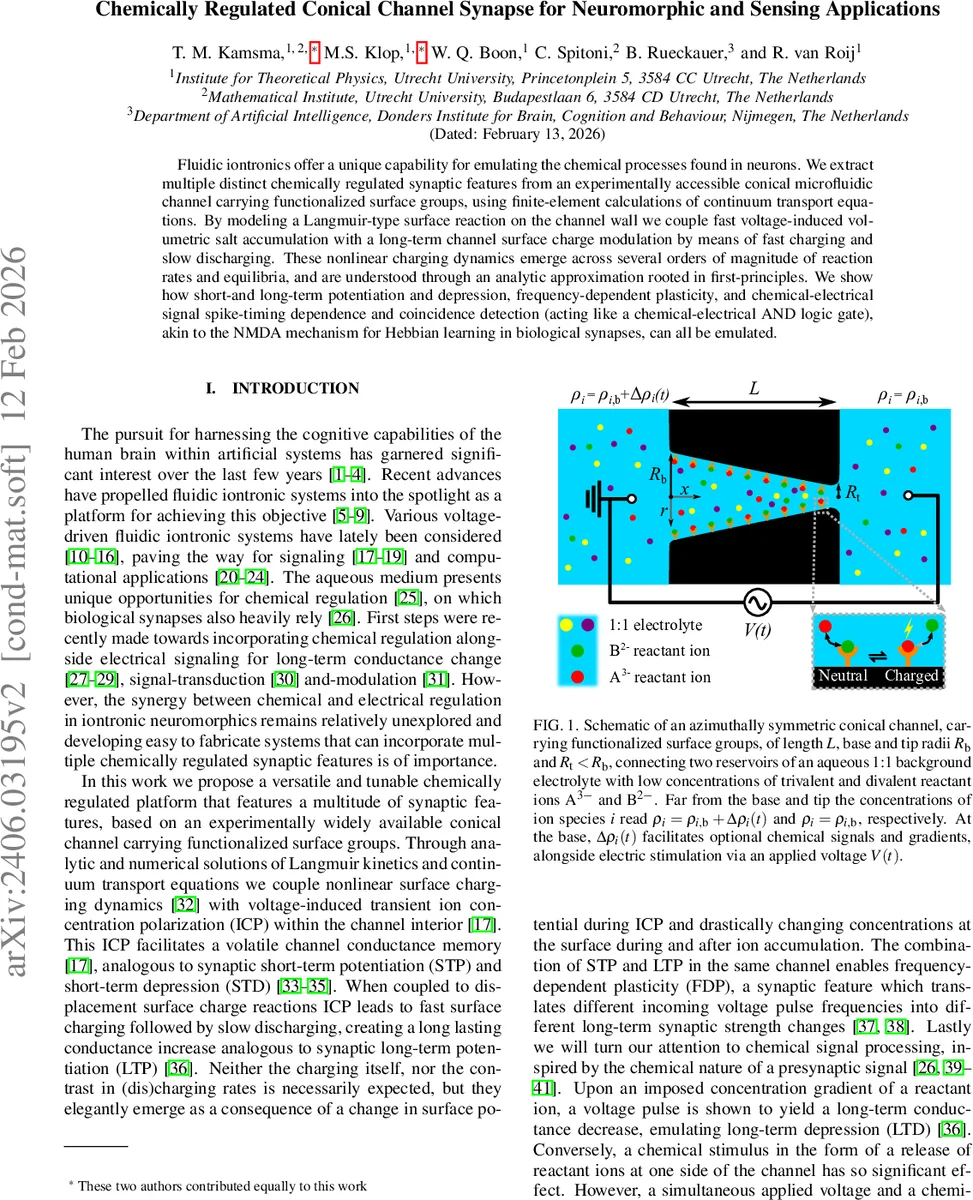
Fluidic iontronics offer a unique capability for emulating the chemical processes found in neurons. We extract multiple distinct chemically regulated synaptic features from an experimentally accessible conical microfluidic channel carrying functionalized surface groups, using finite-element calculations of continuum transport equations. By modeling a Langmuir-type surface reaction on the channel wall we couple fast voltage-induced volumetric salt accumulation with a long-term channel surface charge modulation by means of fast charging and slow discharging. These nonlinear charging dynamics emerge across several orders of magnitude of reaction rates and equilibria, and are understood through an analytic approximation rooted in first-principles. We show how short-and long-term potentiation and depression, frequency-dependent plasticity, and chemical-electrical signal spike-timing dependence and coincidence detection (acting like a chemical-electrical AND logic gate), akin to the NMDA mechanism for Hebbian learning in biological synapses, can all be emulated.
💡 Research Summary
The authors present a chemically regulated neuromorphic device based on a conical microfluidic channel (10 µm long, base radius 120 nm, tip radius 30 nm) functionalized with surface groups that undergo a Langmuir‑type displacement reaction between trivalent anions (A³⁻) and divalent anions (B²⁻). By solving the coupled Poisson‑Nernst‑Planck‑Stokes equations with finite‑element simulations and an analytic approximation, they show that a voltage pulse induces rapid ion‑concentration polarization (ICP) inside the channel, which temporarily raises the surface potential ψ₀ and dramatically increases the local concentration of A³⁻ at the wall. This drives fast charging of the surface charge σ (≈ 1 s⁻¹). When the pulse ends, the bulk ion concentration relaxes quickly, but the repulsion of B²⁻ from the positively charged surface slows the reverse reaction, giving a discharging rate ≈ 0.01 s⁻¹. The resulting asymmetry yields a volatile conductance increase (short‑term potentiation, STP) followed by a long‑lasting conductance boost (long‑term potentiation, LTP). By varying pulse frequency, cumulative ICP leads to larger σ and stronger LTP, reproducing frequency‑dependent plasticity (FDP). Introducing a chemical stimulus (a transient increase of A³⁻ concentration at the base) together with an electrical pulse creates a synergistic conductance rise, functioning as a chemical‑electrical AND gate. Moreover, the timing between chemical and electrical inputs controls the magnitude and sign of the conductance change, mimicking spike‑timing‑dependent plasticity (STDP) akin to the NMDA‑receptor mechanism in biological synapses. Parameter sweeps demonstrate that the effect is robust across orders of magnitude in reaction rates, channel dimensions, and electrolyte concentrations. Because conical channels are readily fabricated and surface functionalization is already common in sensing applications, the proposed architecture offers a practical route to integrate multiple synaptic functionalities—STP, STD, LTP, LTD, FDP, STDP, and coincidence detection—within a single, tunable iontronic element, opening new possibilities for neuromorphic computing and chemically sensitive signal processing.
Comments & Academic Discussion
Loading comments...
Leave a Comment