Krylov space perturbation theory for quantum synchronization in closed systems
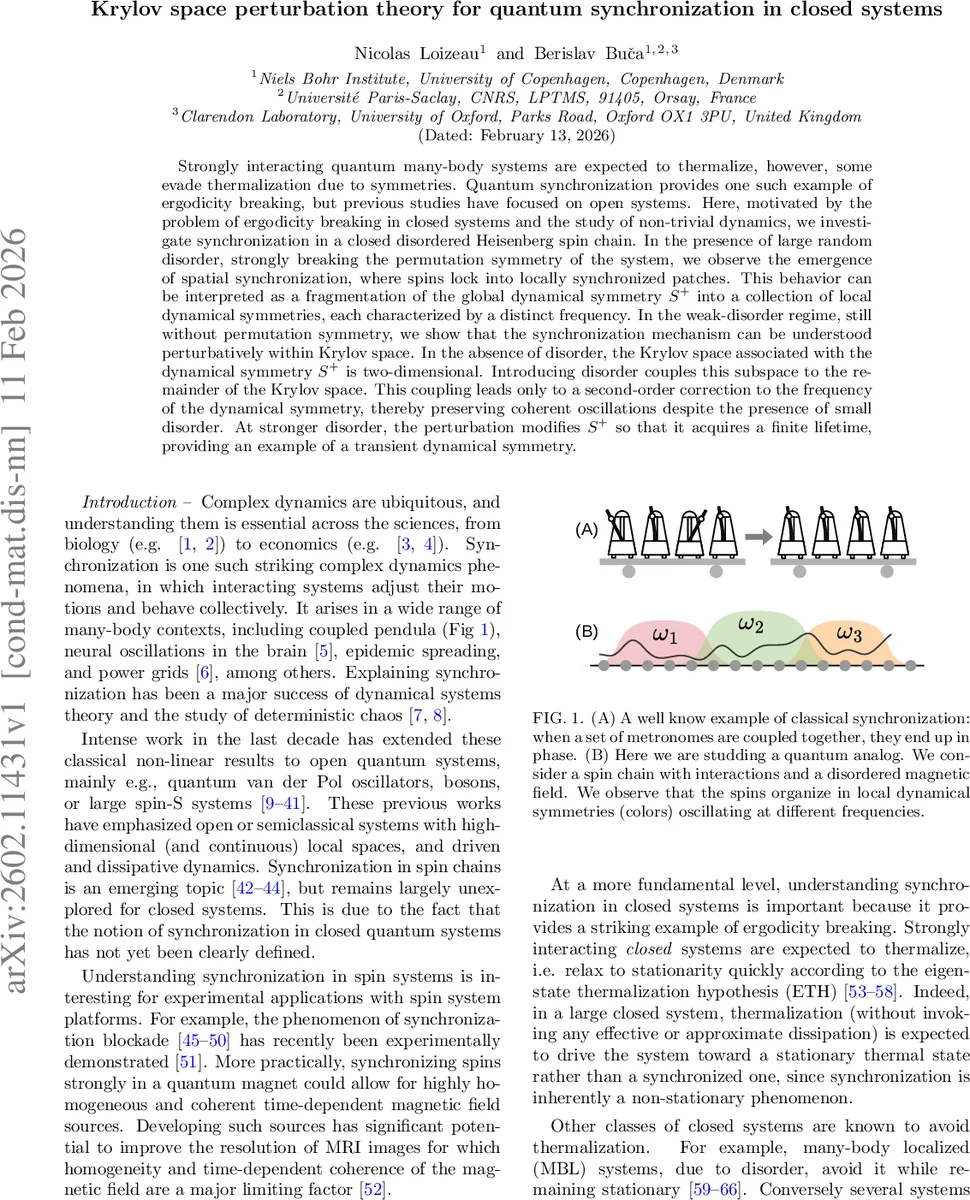
Strongly interacting quantum many-body systems are expected to thermalize, however, some evade thermalization due to symmetries. Quantum synchronization provides one such example of ergodicity breaking, but previous studies have focused on open systems. Here, motivated by the problem of ergodicity breaking in closed systems and the study of non-trivial dynamics, we investigate synchronization in a closed disordered Heisenberg spin chain. In the presence of large random disorder, strongly breaking the permutation symmetry of the system, we observe the emergence of spatial synchronization, where spins lock into locally synchronized patches. This behavior can be interpreted as a fragmentation of the global dynamical symmetry $S^+$ into a collection of local dynamical symmetries, each characterized by a distinct frequency. In the weak-disorder regime, still without permutation symmetry, we show that the synchronization mechanism can be understood perturbatively within Krylov space. In the absence of disorder, the Krylov space associated with the dynamical symmetry $S^+$ is two-dimensional. Introducing disorder couples this subspace to the remainder of the Krylov space. This coupling leads only to a second-order correction to the frequency of the dynamical symmetry, thereby preserving coherent oscillations despite the presence of small disorder. At stronger disorder, the perturbation modifies $S^+$ so that it acquires a finite lifetime, providing an example of a transient dynamical symmetry.
💡 Research Summary
In this paper the authors address the largely unexplored problem of quantum synchronization in closed many‑body systems. While synchronization has been extensively studied in classical nonlinear dynamics and in open quantum systems (where dissipation can enforce phase locking), it has rarely been considered for isolated Hamiltonian dynamics. The work focuses on a disordered Heisenberg spin‑½ chain described by
\
Comments & Academic Discussion
Loading comments...
Leave a Comment