$X$-ADM Mass and $X$-Positive Mass Theorem
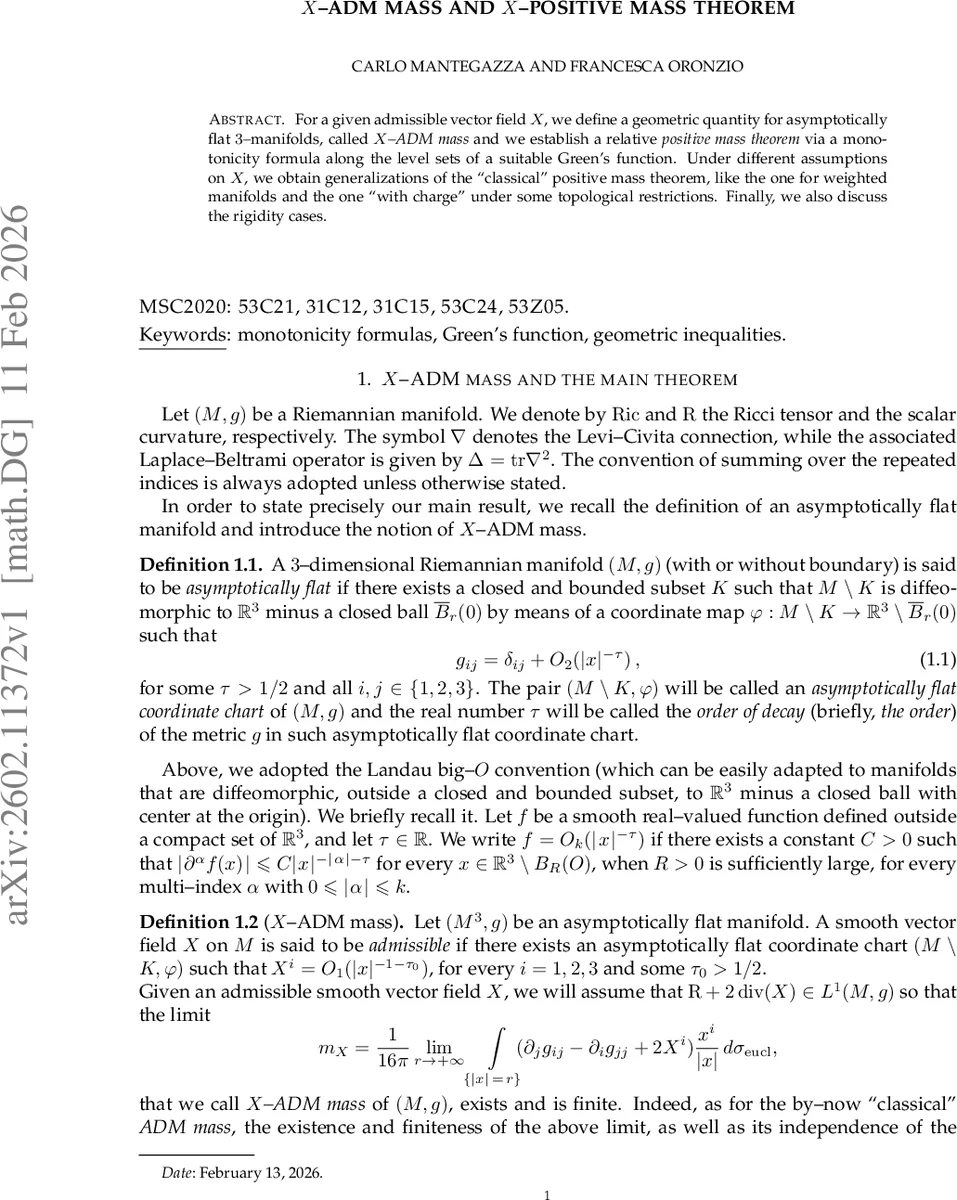
For a given admissible vector field $X$, we define a geometric quantity for asymptotically flat $3$–manifolds, called $X$–ADM mass and we establish a relative positive mass theorem via a monotonicity formula along the level sets of a suitable Green’s function. Under different assumptions on $X$, we obtain generalizations of the classical'' positive mass theorem, like the one for weighted manifolds and the one with charge’’ under some topological restrictions. Finally, we also discuss the rigidity cases.
💡 Research Summary
The paper introduces a new geometric invariant for three‑dimensional asymptotically flat manifolds, the X‑ADM mass, which depends on a chosen admissible vector field X. An admissible X is required to decay like |x|^{‑1‑τ₀} (τ₀ > ½) in an asymptotically flat chart and to satisfy R + 2 div X ∈ L¹(M). The X‑ADM mass is defined by the surface integral
m_X = (1/16π) lim_{r→∞} ∫_{|x|=r} (∂j g{ij} − ∂i g{jj} + 2 X_i) x^i/|x| dσ,
which reduces to the classical ADM mass when X decays faster (or X≡0).
The central result, the X‑Positive Mass Theorem, asserts that under two hypotheses the X‑ADM mass is non‑negative:
- A modified scalar curvature condition
R_X^{(k)} = R + 2 div X − (1 + 1/k) |X|² ≥ 0
holds for some k ∈ ℝ \ (‑2, 0] (or k ∈
Comments & Academic Discussion
Loading comments...
Leave a Comment