Interpretive Cultures: Resonance, randomness, and negotiated meaning for AI-assisted tarot divination
While generative AI tools are increasingly adopted for creative and analytical tasks, their role in interpretive practices, where meaning is subjective, plural, and non-causal, remains poorly understood. This paper examines AI-assisted tarot reading, a divinatory practice in which users pose a query, draw cards through a randomized process, and ask AI systems to interpret the resulting symbols. Drawing on interviews with tarot practitioners and Hartmut Rosa’s Theory of Resonance, we investigate how users seek, negotiate, and evaluate resonant interpretations in a context where no causal relationship exists between the query and the data being interpreted. We identify distinct ways practitioners incorporate AI into their interpretive workflows, including using AI to navigate uncertainty and self-doubt, explore alternative perspectives, and streamline or extend existing divinatory practices. Based on these findings, we offer design recommendations for AI systems that support interpretive meaning-making without collapsing ambiguity or foreclosing user agency.
💡 Research Summary
This paper investigates how generative artificial intelligence (AI) tools are incorporated into a fundamentally non‑causal, interpretive practice: tarot divination. In a typical tarot reading, a querent poses a question, shuffles and draws cards at random, and then interprets the symbolic imagery of the cards. Because the randomization deliberately severs any causal link between the question and the data, meaning emerges through personal, cultural, and spiritual resonance rather than logical inference.
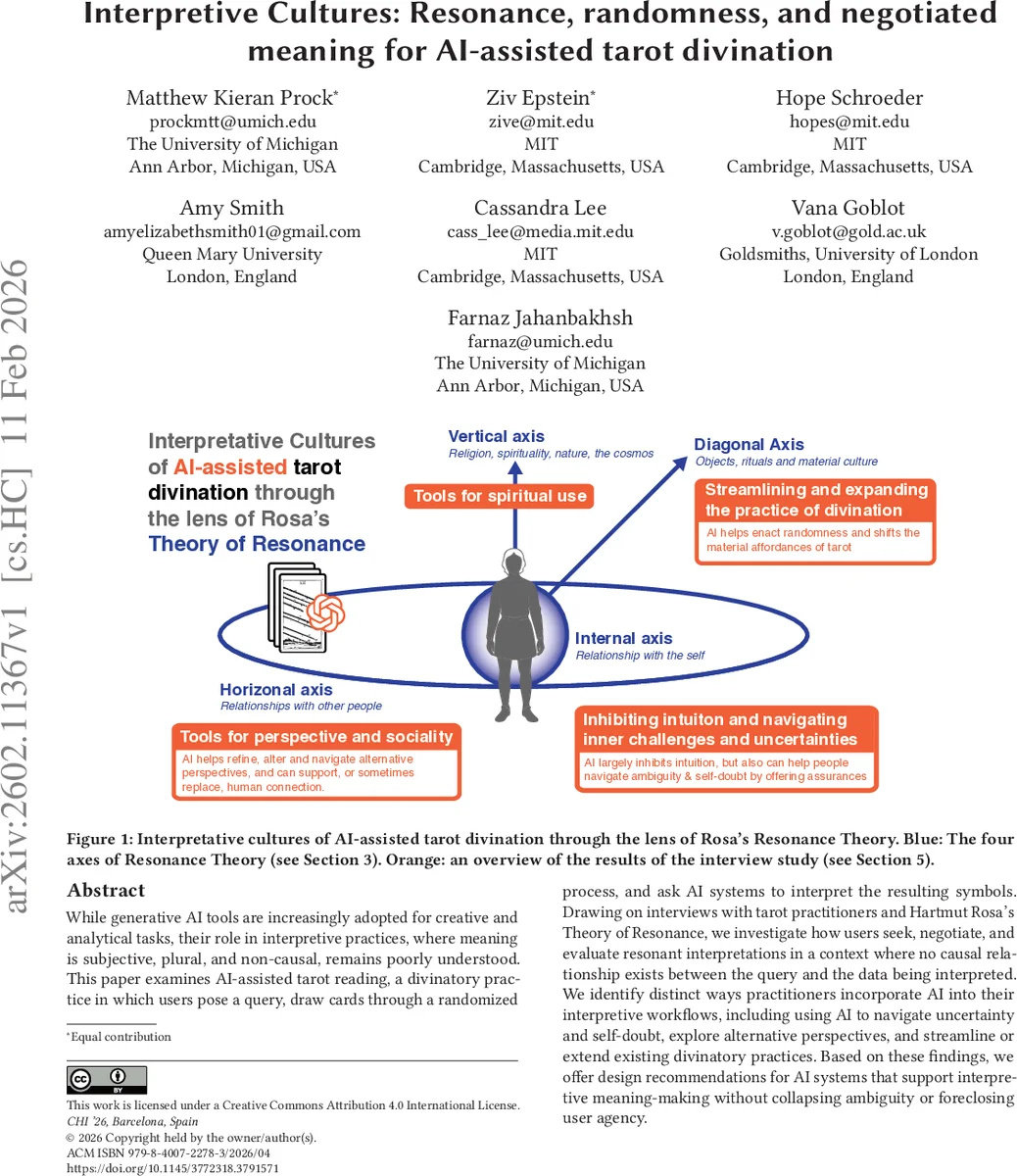
To make sense of users’ experiences with AI‑assisted tarot, the authors adopt Hartmut Rosa’s Theory of Resonance, which describes four axes of meaningful contact with the world: internal (self‑relationship), horizontal (relationships with others), diagonal (cultural and tradition‑based connections), and vertical (spiritual or cosmological orientation). The study combines this theoretical lens with an empirical investigation consisting of semi‑structured interviews with twelve tarot practitioners who regularly use large language models (LLMs) such as ChatGPT to generate card interpretations.
The qualitative analysis reveals three dominant ways in which AI is woven into the interpretive workflow. First, AI serves as a confidence‑boosting scaffold: participants report that the rich, coherent prose generated by the model helps them overcome self‑doubt, reduce anxiety, and feel a stronger internal resonance with the reading. Second, AI functions as a source of alternative perspectives. By drawing on a vast corpus of cultural, psychological, and mythological knowledge, the model offers interpretations that differ from traditional guidebooks, prompting users to negotiate, re‑frame, and enrich their own meanings. This expands resonance along the horizontal and diagonal axes. Third, AI streamlines and extends the ritual: it automates card‑shuffling, layout generation, and baseline symbolism, freeing practitioners to focus on deeper intuition while also providing optional narrative layers that connect the reading to spiritual or cosmological themes (vertical axis).
Participants also voiced concerns that AI could “flatten intuition” when it supplies overly definitive answers. To mitigate this risk, the authors identify design strategies that preserve ambiguity and user agency: (1) present multiple plausible interpretations rather than a single “correct” reading; (2) offer context‑sensitive prompt templates that help users articulate their emotional state and intent; (3) embed a conversational feedback loop that allows users to edit, reject, or elaborate on AI output; and (4) provide modular “meaning‑layer” plugins so users can opt into spiritual, cultural, or therapeutic frames as desired.
The paper contributes (1) a novel interdisciplinary framework that merges cultural studies with Rosa’s resonance theory to analyze non‑causal meaning‑making; (2) an empirical map of a newly emerging interpretive culture surrounding AI‑assisted tarot, highlighting how practitioners negotiate, co‑construct, and evaluate resonant meanings; and (3) concrete design recommendations for AI systems intended for symbolic, ambiguous, or ritualized domains. The authors argue that future HCI work must balance the computational power of generative AI with the preservation of interpretive freedom, ensuring that technology amplifies rather than suppresses the rich, multi‑layered resonance that characterizes practices like tarot divination.
Comments & Academic Discussion
Loading comments...
Leave a Comment