How to check in continually over 4,000 days on an online learning platform? An empirical experience and a practical solution
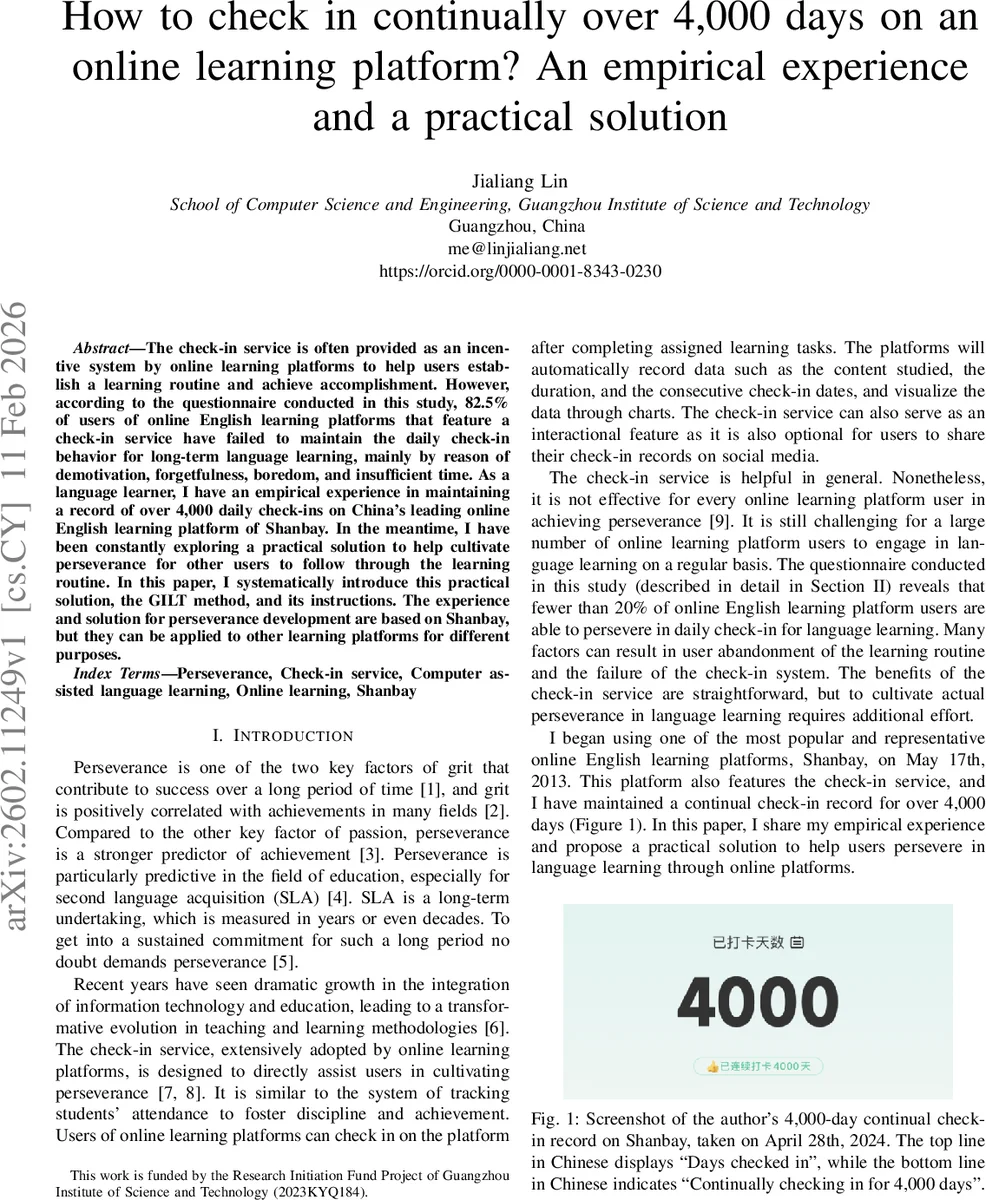
The check-in service is often provided as an incentive system by online learning platforms to help users establish a learning routine and achieve accomplishment. However, according to the questionnaire conducted in this study, 82.5% of users of online English learning platforms that feature a check-in service have failed to maintain the daily check-in behavior for long-term language learning, mainly by reason of demotivation, forgetfulness, boredom, and insufficient time. As a language learner, I have an empirical experience in maintaining a record of over 4,000 daily check-ins on China’s leading online English learning platform of Shanbay. In the meantime, I have been constantly exploring a practical solution to help cultivate perseverance for other users to follow through the learning routine. In this paper, I systematically introduce this practical solution, the GILT method, and its instructions. The experience and solution for perseverance development are based on Shanbay, but they can be applied to other learning platforms for different purposes.
💡 Research Summary
The paper investigates why most users of online English‑learning platforms with a check‑in feature abandon the habit despite its intended role as a motivation booster. A questionnaire of 389 respondents revealed that 82.5 % of users eventually stop checking in, citing four primary reasons: demotivation, forgetfulness, boredom, and insufficient time. The author, who has personally maintained a continuous check‑in streak of over 4,000 days on Shanbay, uses this experience to develop a practical framework called the GILT method, which stands for Goal‑Setting, Incentive‑Planning, Light‑Starting, and Team‑Learning.
Goal‑Setting emphasizes specific, challenging yet attainable objectives. Vague goals such as “improve English” are ineffective; instead, measurable daily targets (e.g., learn 15 new words, review 30) provide clear direction and enable progress tracking. The paper references goal‑setting theory and suggests periodic renewal of goals to sustain motivation.
Incentive‑Planning addresses the boredom factor by introducing both direct and indirect incentives. Direct incentives involve varying learning materials, modes, or tasks to keep the experience fresh. Indirect incentives include points, badges, or other reward mechanisms that give immediate feedback on short‑term achievements, reinforcing perseverance before the habit becomes automatic.
Light‑Starting advocates beginning with a minimal daily workload—approximately 10‑15 minutes—so that learners can reliably complete the task without feeling overwhelmed. The author cites habit‑formation research indicating a median of 66 days to solidify a new routine, and recommends a light‑starting regimen for the first two months: 15 new words and 30 review words per day, drawn from a list slightly above the learner’s current level. This approach reduces early‑stage frustration and builds a sense of accomplishment that fuels continued engagement.
Team‑Learning leverages social accountability and peer support. Forming small study groups (5‑10 members) creates a network for encouragement, shared goals, and friendly competition. The paper draws on social influence theories and empirical findings that team‑based learning improves performance and persistence compared with solitary study. Regular reminders, collective progress tracking, and inter‑team challenges help mitigate forgetfulness and time‑management issues.
The GILT method integrates these components into a coherent instructional roadmap. Early‑stage learners are instructed to use Shanbay’s “Word Meaning” mode with a curated vocabulary list of no more than 300 words, ensuring the task remains light yet meaningful. Incentives are structured as weekly badges and monthly leaderboard points, while team dynamics are fostered through dedicated chat groups or platform‑based study circles. Upon achieving a goal, learners set a new, slightly more demanding target, and incentives are refreshed accordingly.
Overall, the study argues that a check‑in service alone is insufficient to sustain long‑term language learning. Effective perseverance requires a combination of clear goals, varied incentives, manageable initial workloads, and social support. The GILT framework offers a scalable, evidence‑based solution that can be adapted to other online learning environments beyond English language acquisition. Future work should test the method across diverse subjects and platforms, and quantitatively assess its impact on retention rates, learning outcomes, and user satisfaction.
Comments & Academic Discussion
Loading comments...
Leave a Comment