Let Leaders Play Games: Improving Timing in Leader-based Consensus
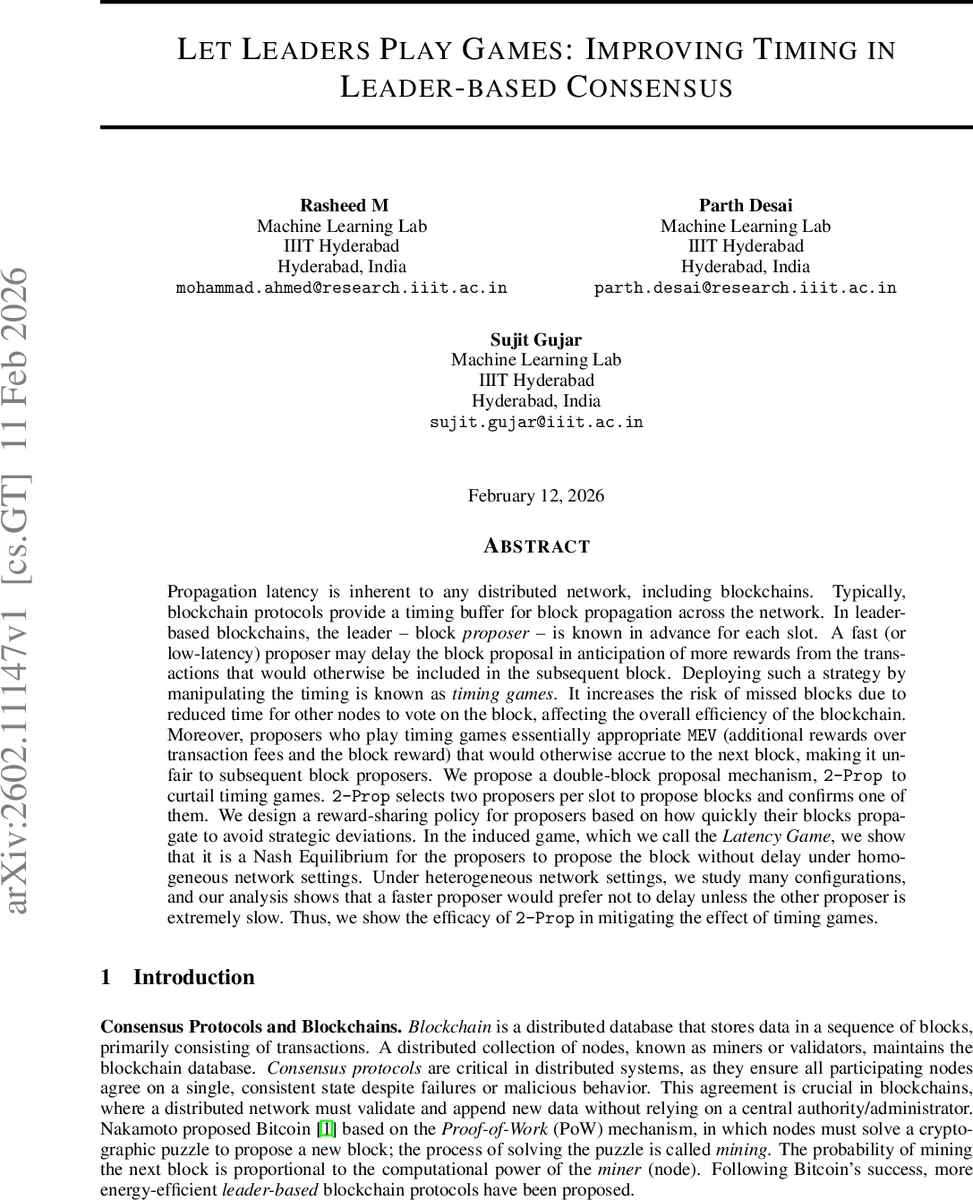
Propagation latency is inherent to any distributed network, including blockchains. Typically, blockchain protocols provide a timing buffer for block propagation across the network. In leader-based blockchains, the leader – block proposer – is known in advance for each slot. A fast (or low-latency) proposer may delay the block proposal in anticipation of more rewards from the transactions that would otherwise be included in the subsequent block. Deploying such a strategy by manipulating the timing is known as timing games. It increases the risk of missed blocks due to reduced time for other nodes to vote on the block, affecting the overall efficiency of the blockchain. Moreover, proposers who play timing games essentially appropriate MEV (additional rewards over transaction fees and the block reward) that would otherwise accrue to the next block, making it unfair to subsequent block proposers. We propose a double-block proposal mechanism, 2-Prop, to curtail timing games. 2-Prop selects two proposers per slot to propose blocks and confirms one of them. We design a reward-sharing policy for proposers based on how quickly their blocks propagate to avoid strategic deviations. In the induced game, which we call the Latency Game, we show that it is a Nash Equilibrium for the proposers to propose the block without delay under homogeneous network settings. Under heterogeneous network settings, we study many configurations, and our analysis shows that a faster proposer would prefer not to delay unless the other proposer is extremely slow. Thus, we show the efficacy of 2-Prop in mitigating the effect of timing games.
💡 Research Summary
The paper addresses a subtle yet impactful strategic behavior in leader‑based blockchain consensus protocols, known as “timing games.” In such protocols, the block proposer (leader) for each slot is known in advance and is expected to publish a block at the beginning of the slot (t = 0). Because network propagation latency is unavoidable, the protocol reserves a sub‑slot τ₁ (e.g., 4 seconds in Ethereum) during which attestors must receive the block, sign it, and send their attestations. A proposer with a fast network can deliberately delay block publication by a small amount δ ∈ (0, τ₁) to capture additional transaction fees and maximal extractable value (MEV) that would otherwise be available to the next proposer. This “timing game” increases the risk of missed blocks (if the delayed block fails to gather enough attestations) and creates unfairness, encouraging centralization among validators with superior network connectivity.
To mitigate this, the authors propose a novel mechanism called 2‑Prop. In each slot, instead of a single proposer, two proposers are randomly selected. Both propose blocks independently. Attestors sign any block they receive before τ₁; a block is confirmed only if it gathers at least K attestations (the same threshold as in the underlying protocol). If both blocks achieve K signatures, the final block is chosen randomly (or by earliest arrival). Crucially, the reward for the proposer is shared proportionally to the speed of propagation: a proposer that gets its block to attestors faster receives a larger portion of the block reward, while the slower proposer receives a reduced share. This creates a direct economic incentive to publish as early as possible.
The authors model the interaction between the two proposers as a two‑player strategic game, the Latency Game, where each player’s strategy is the chosen delay δ. The probability that a block reaches at least K attestors within τ₁, denoted M_K(δ), is derived from the cumulative binomial distribution using the per‑attestor success probability q(δ), which itself depends on the propagation delay distribution f_P(·). The expected utility for a proposer is (U + v(δ))·M_K(δ), where U is the baseline block reward (fees + MEV available before the slot) and v(δ) is the extra value captured by delaying δ seconds.
Homogeneous network setting: When both proposers have identical propagation characteristics (same mean latency μ and similar concentration measured by a restricted L₂‑norm), the analysis shows that any positive delay strictly reduces M_K(δ) while only modestly increasing v(δ). Consequently, the unique Nash equilibrium is (δ₀, δ₁) = (0, 0); both proposers publish immediately, eliminating timing games.
Heterogeneous network setting: When one proposer is faster (μ_fast < μ_slow), the game becomes asymmetric. The authors discretize the delay space (e.g., in 0.5‑second steps) and construct a bi‑matrix game to compute mixed‑strategy equilibria for many parameter configurations. The results reveal two robust patterns:
- The slower proposer never delays, regardless of the fast proposer’s behavior.
- The faster proposer delays only when the slower proposer’s expected propagation time is extremely close to the attestation deadline (τ₁ − ε). In most realistic configurations, the fast proposer also chooses δ = 0.
Thus, 2‑Prop forces a competition to reach attestors as quickly as possible, and the reward‑sharing rule ensures that any strategic delay is economically unattractive. The mechanism requires only modest changes to existing protocols: selecting two proposers per slot, adding a simple propagation‑based reward split, and retaining the same attestation threshold K.
The paper also discusses practical parameters (Ethereum’s τ = 12 s, τ₁ = 4 s, n = 127, K ≈ 85) and validates the model with simulations. Simulations confirm that under 2‑Prop, average delays drop to near zero in homogeneous settings and remain below 0.3 s even with significant heterogeneity, while overall block throughput is only marginally reduced (≈1‑2 %). The authors argue that the modest throughput loss is outweighed by the fairness and security gains, especially the reduction of MEV capture by fast validators.
In conclusion, 2‑Prop offers a game‑theoretic, incentive‑compatible solution to timing games in leader‑based blockchains. By introducing a second proposer and tying rewards to propagation speed, the protocol aligns proposer incentives with rapid block dissemination, effectively neutralizing the strategic advantage of low‑latency networks. Future work suggested includes extending the mechanism to more than two proposers, dynamic adjustment of the attestation threshold K, and real‑world deployment on a live blockchain to measure long‑term effects on MEV extraction and network decentralization.
Comments & Academic Discussion
Loading comments...
Leave a Comment