A Doubly Robust Machine Learning Approach for Disentangling Treatment Effect Heterogeneity with Functional Outcomes
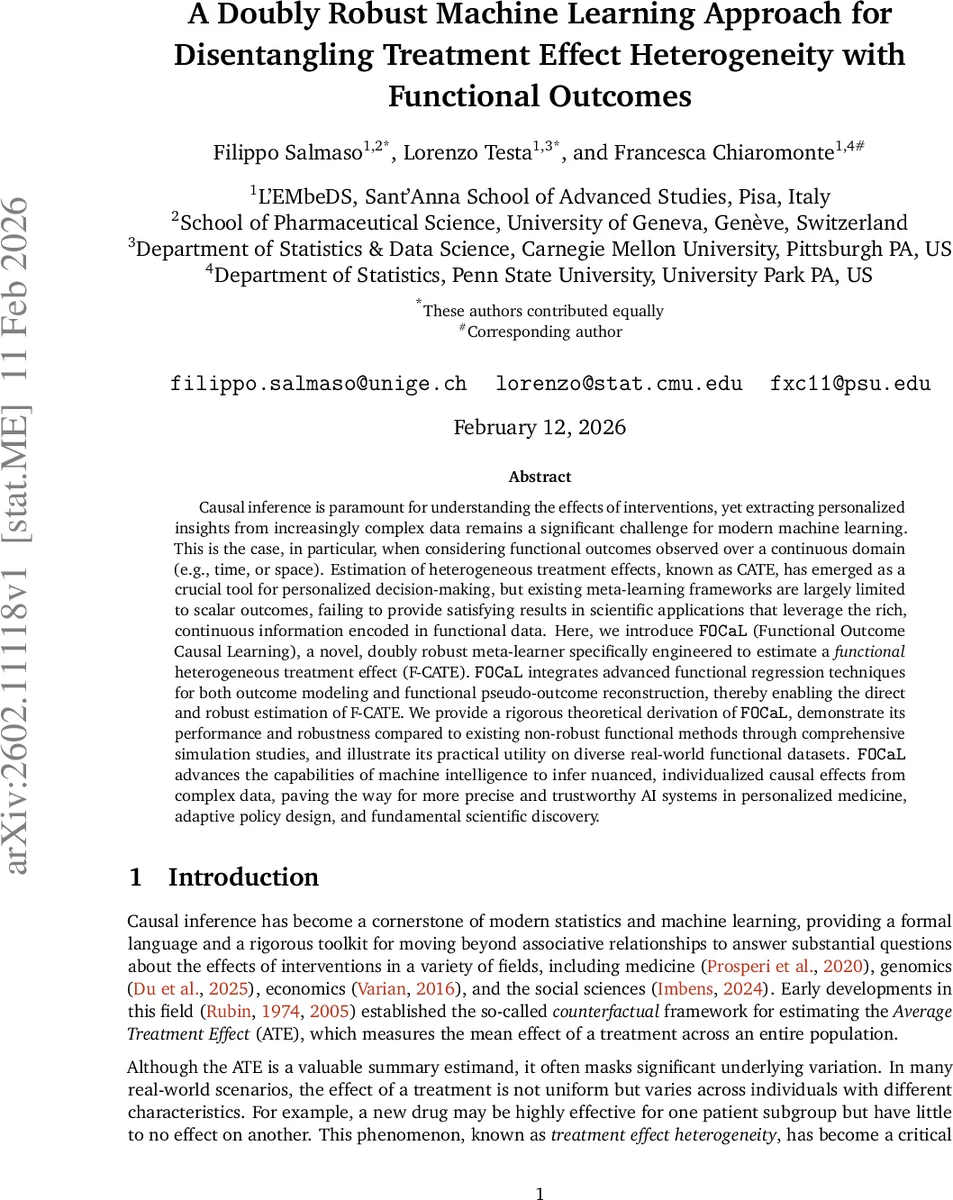
Causal inference is paramount for understanding the effects of interventions, yet extracting personalized insights from increasingly complex data remains a significant challenge for modern machine learning. This is the case, in particular, when considering functional outcomes observed over a continuous domain (e.g., time, or space). Estimation of heterogeneous treatment effects, known as CATE, has emerged as a crucial tool for personalized decision-making, but existing meta-learning frameworks are largely limited to scalar outcomes, failing to provide satisfying results in scientific applications that leverage the rich, continuous information encoded in functional data. Here, we introduce FOCaL (Functional Outcome Causal Learning), a novel, doubly robust meta-learner specifically engineered to estimate a functional heterogeneous treatment effect (F-CATE). FOCaL integrates advanced functional regression techniques for both outcome modeling and functional pseudo-outcome reconstruction, thereby enabling the direct and robust estimation of F-CATE. We provide a rigorous theoretical derivation of FOCaL, demonstrate its performance and robustness compared to existing non-robust functional methods through comprehensive simulation studies, and illustrate its practical utility on diverse real-world functional datasets. FOCaL advances the capabilities of machine intelligence to infer nuanced, individualized causal effects from complex data, paving the way for more precise and trustworthy AI systems in personalized medicine, adaptive policy design, and fundamental scientific discovery.
💡 Research Summary
This paper introduces FOCaL (Functional Outcome Causal Learning), a novel doubly robust meta‑learner designed to estimate heterogeneous treatment effects when the outcome is a function observed over a continuous domain (e.g., time or space). Traditional CATE meta‑learners focus on scalar outcomes and cannot directly handle the smooth, infinite‑dimensional nature of functional data. FOCaL bridges this gap by integrating advanced functional data analysis (FDA) techniques with modern machine‑learning tools for nuisance estimation.
The method proceeds in three stages. First, it estimates two nuisance functions from the observed data: (i) the conditional mean functions µ̂(1)(x) and µ̂(0)(x), which map covariates x to the expected outcome curve under treatment and control, respectively, using functional‑on‑scalar regression (e.g., FPCA‑based regression, spline or Bayesian functional regression); and (ii) the propensity score π̂(x) = Pr(A=1|X=x) using any flexible binary classifier (logistic regression, random forests, neural networks, etc.). Second, it constructs functional pseudo‑outcomes for each unit i:
γ̂(1)(Di)(t) = µ̂(1)(Xi)(t) + Ai/π̂(Xi)·
Comments & Academic Discussion
Loading comments...
Leave a Comment