RADAR: Benchmarking Vision-Language-Action Generalization via Real-World Dynamics, Spatial-Physical Intelligence, and Autonomous Evaluation
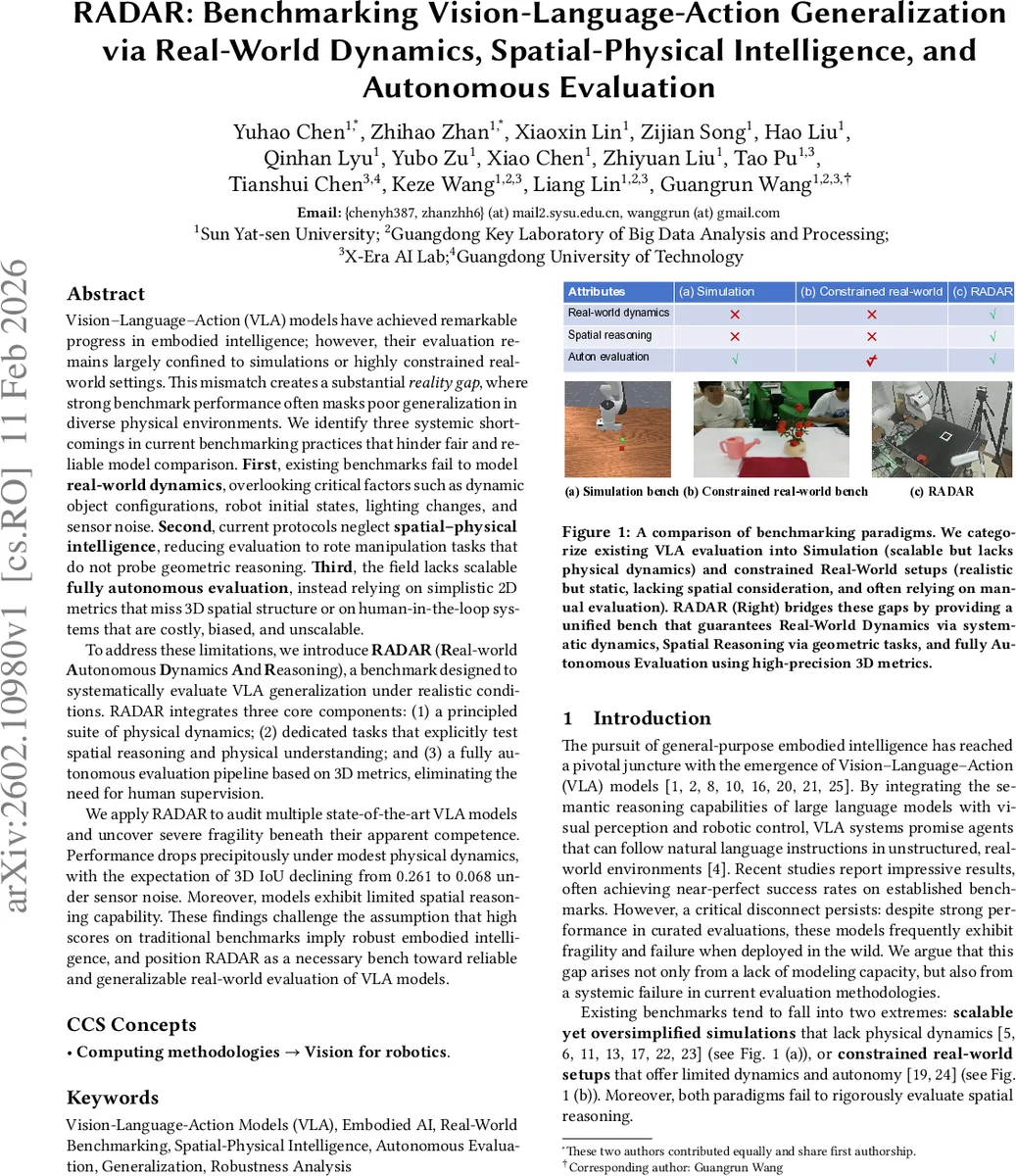
VLA models have achieved remarkable progress in embodied intelligence; however, their evaluation remains largely confined to simulations or highly constrained real-world settings. This mismatch creates a substantial reality gap, where strong benchmark performance often masks poor generalization in diverse physical environments. We identify three systemic shortcomings in current benchmarking practices that hinder fair and reliable model comparison. (1) Existing benchmarks fail to model real-world dynamics, overlooking critical factors such as dynamic object configurations, robot initial states, lighting changes, and sensor noise. (2) Current protocols neglect spatial–physical intelligence, reducing evaluation to rote manipulation tasks that do not probe geometric reasoning. (3) The field lacks scalable fully autonomous evaluation, instead relying on simplistic 2D metrics that miss 3D spatial structure or on human-in-the-loop systems that are costly, biased, and unscalable. To address these limitations, we introduce RADAR (Real-world Autonomous Dynamics And Reasoning), a benchmark designed to systematically evaluate VLA generalization under realistic conditions. RADAR integrates three core components: (1) a principled suite of physical dynamics; (2) dedicated tasks that explicitly test spatial reasoning and physical understanding; and (3) a fully autonomous evaluation pipeline based on 3D metrics, eliminating the need for human supervision. We apply RADAR to audit multiple state-of-the-art VLA models and uncover severe fragility beneath their apparent competence. Performance drops precipitously under modest physical dynamics, with the expectation of 3D IoU declining from 0.261 to 0.068 under sensor noise. Moreover, models exhibit limited spatial reasoning capability. These findings position RADAR as a necessary bench toward reliable and generalizable real-world evaluation of VLA models.
💡 Research Summary
The paper “RADAR: Benchmarking Vision-Language-Action Generalization via Real-World Dynamics, Spatial-Physical Intelligence, and Autonomous Evaluation” addresses a critical disconnect in embodied AI: while Vision-Language-Action models show impressive results, their evaluation remains largely confined to simulations or highly constrained real-world settings, creating a significant “reality gap.” The authors identify three fundamental shortcomings in current benchmarking practices that hinder fair and reliable assessment of true generalization capabilities.
First, existing benchmarks insufficiently model real-world dynamics, overlooking critical stochastic factors like dynamic object configurations, varying robot initial states, lighting changes, and sensor noise. This leads to models that overfit to static laboratory conditions. Second, current evaluation protocols neglect spatial-physical intelligence, reducing tasks to rote manipulation that doesn’t probe genuine 3D geometric reasoning. Third, the field lacks scalable, fully autonomous evaluation, relying instead on human-in-the-loop systems (costly, biased) or simplistic 2D metrics that cannot verify 3D outcomes.
To bridge these gaps, the authors introduce RADAR, a novel benchmark designed to systematically stress-test VLA generalization under realistic conditions. RADAR integrates three core innovations: 1) A principled suite of physical dynamics that introduces controlled perturbations across four axes: manipulated objects, robot initial states, task instructions, and environmental conditions. 2) Dedicated spatial reasoning tasks that require an understanding of geometry, occlusion, and relative positioning, moving beyond simple semantic instruction following. 3) A fully autonomous evaluation pipeline based on precise 3D metrics (e.g., 3D Intersection over Union), eliminating human supervision and enabling large-scale, reproducible testing.
The RADAR system is implemented as a centralized automation platform using a client-server-worker architecture. Users submit policies to a central server, which manages task queuing and dispatches jobs to physical “Worker” nodes. Each Worker is a self-contained robotic cell featuring a collaborative robot arm with a wrist-mounted camera, external stereo vision systems, and an actuated stage, all orchestrated by a host PC. This setup enables 24/7 autonomous operation, including task execution, state reset, and multi-perspective data collection.
Applying RADAR to audit several state-of-the-art VLA models reveals severe fragility beneath their apparent competence. Key findings include: a dramatic sensitivity to physical dynamics, where performance plummets under modest perturbations (e.g., the expectation of 3D IoU drops from 0.261 to 0.068 under sensor noise), and a limited capability for spatial reasoning, indicating that current models rely more on 2D pattern matching than true 3D scene understanding.
In conclusion, the paper argues that high scores on traditional benchmarks do not imply robust embodied intelligence for real-world deployment. RADAR serves as a necessary correction, pushing evaluation towards realism, rigor, and autonomy. It provides a unified framework to assess robustness against environmental stochasticity, spatial-physical intelligence, and enables scalable testing, positioning itself as an essential tool for developing truly generalizable VLA models.
Comments & Academic Discussion
Loading comments...
Leave a Comment