Deriving and Validating Requirements Engineering Principles for Large-Scale Agile Development: An Industrial Longitudinal Study
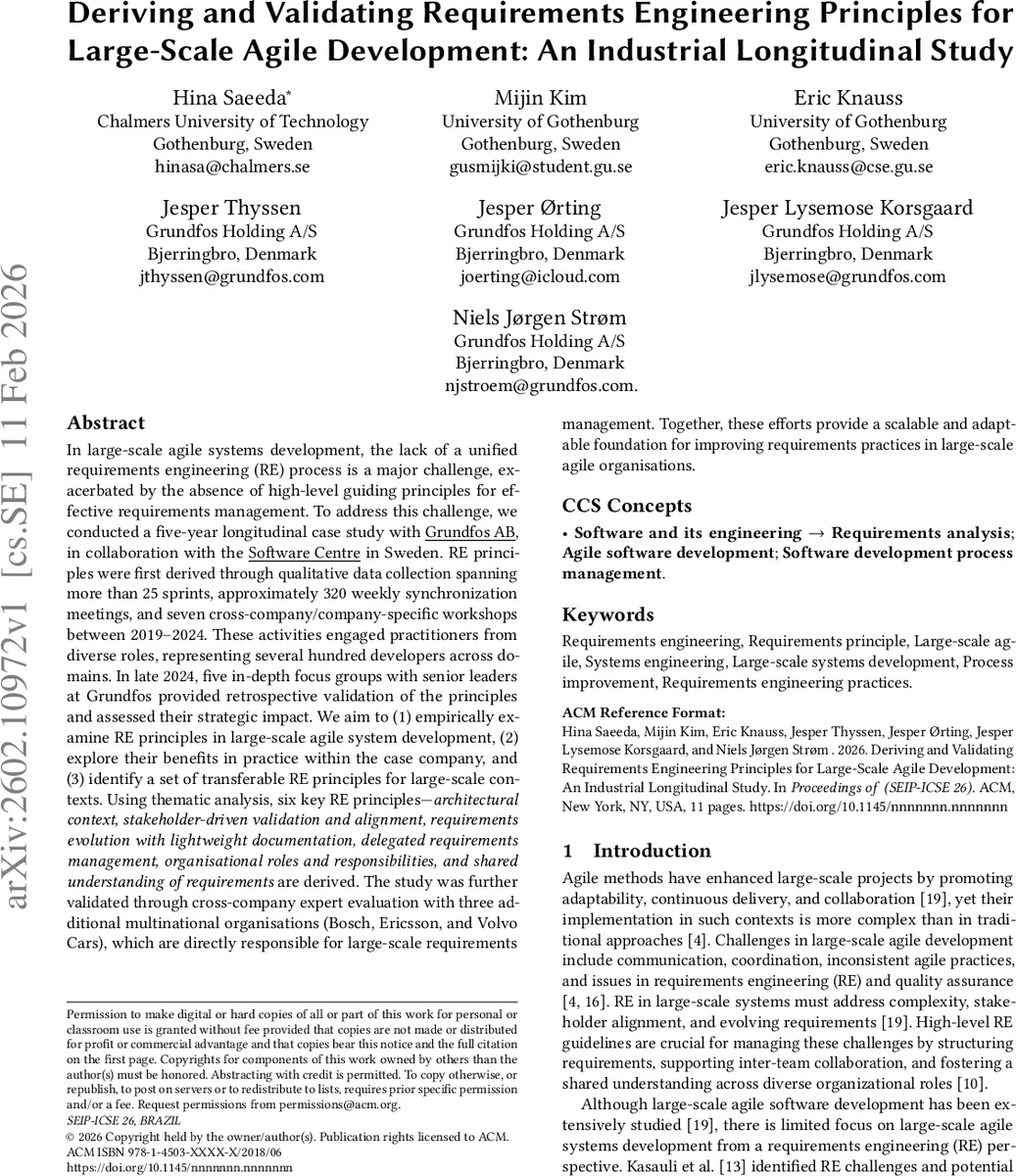
In large scale agile systems development, the lack of a unified requirements engineering (RE) process is a major challenge, exacerbated by the absence of high level guiding principles for effective requirements management. To address this challenge, we conducted a five year longitudinal case study with Grundfos AB, in collaboration with the Software Centre in Sweden. RE principles were first derived through qualitative data collection spanning more than 25 sprints, approximately 320 weekly synchronisation meetings, and seven cross-company, company-specific workshops between 2019 and 2024. These activities engaged practitioners from diverse roles, representing several hundred developers across domains. In late 2024, five in depth focus groups with senior leaders at Grundfos provided retrospective validation of the principles and assessed their strategic impact. We aim to (1) empirically examine RE principles in large scale agile system development, (2) explore their benefits in practice within the case company, and (3) identify a set of transferable RE principles for large scale contexts. Using thematic analysis, six key RE principles architectural context, stakeholder-driven validation and alignment, requirements practices in large-scale agile organisations. evolution with lightweight documentation, delegated requirements management, organisational roles and responsibilities, and a shared understanding of requirements are derived. The study was further validated through crosscompany expert evaluation with three additional multinational organisations (Bosch, Ericsson, and Volvo Cars), which are directly responsible for largescale requirements management. Together, these efforts provide a scalable and adaptable foundation for improving requirements practices in largescale agile organisations.
💡 Research Summary
The paper tackles a well‑known gap in large‑scale agile system development: the absence of a unified, high‑level requirements engineering (RE) framework that can guide diverse, distributed teams without imposing rigid processes. To fill this gap, the authors conducted a five‑year longitudinal case study with Grundfos AB, a global pump manufacturer that has been transitioning from a stage‑gate model to agile practices since 2019. Data were collected continuously across more than 25 development sprints, roughly 320 weekly synchronization meetings, and seven cross‑company workshops, involving hundreds of developers, product owners, architects, and managers. In late 2024, five in‑depth focus groups with senior Grundfos leaders were held to retrospectively validate the emerging RE principles, and three additional multinational firms (Bosch, Ericsson, and Volvo Cars) contributed expert feedback to assess transferability.
The research follows the case‑study methodology of Runeson et al., employing methodological triangulation that combines empirical observations, a semi‑systematic literature review, and cross‑company expert validation. The literature review anchored the work in the International Requirements Engineering Board (IREB) nine‑principle model and the taxonomy of RE challenges for large‑scale agile systems proposed by Kasauli et al. (2020). By mapping empirical findings onto these established frameworks, the authors ensured that their contributions were both grounded in prior knowledge and extended to address the specific complexities of large‑scale, multidisciplinary system development.
Through iterative thematic coding of interview transcripts, meeting minutes, and workshop artefacts, six overarching RE principles were distilled:
- Architectural Context – Explicitly define system boundaries, architectural layers, and interface contracts to prevent inter‑team requirement conflicts.
- Stakeholder‑Driven Validation and Alignment – Place validation responsibility with stakeholders, creating rapid feedback loops and ensuring that evolving requirements stay aligned with business goals.
- Requirements Evolution with Lightweight Documentation – Adopt minimal, automated documentation (e.g., traceability links in version‑control or ALM tools) that supports continuous evolution while avoiding documentation overload.
- Delegated Requirements Management – Distribute ownership of requirements to the most appropriate agile team, clarifying responsibility and eliminating central bottlenecks.
- Organisational Roles and Responsibilities – Formalise RE‑related roles (e.g., Requirements Manager, Architect, Product Owner) and define clear hand‑off points, improving collaboration across functional silos.
- Shared Understanding of Requirements – Establish a common terminology, shared models, and a “definition of ready” that all teams use, fostering a unified mental model of the system.
Each principle directly addresses challenges identified in prior work, such as maintaining system‑level consistency while preserving team autonomy, handling long product lifecycles and regulatory constraints, and ensuring traceability across hardware‑software‑cloud boundaries. The focus‑group discussions revealed that senior leaders perceive these principles as enabling better strategic alignment, faster time‑to‑market, and higher product quality. The external experts from Bosch, Ericsson, and Volvo Cars confirmed the relevance of the principles but emphasized the need for contextual tailoring to fit differing corporate cultures, regulatory environments, and domain‑specific constraints.
The paper’s contributions are threefold: (1) it provides an empirically derived, industry‑validated set of RE principles tailored for large‑scale agile systems; (2) it demonstrates a robust multi‑method research design that combines long‑term field observation with cross‑company validation; and (3) it bridges the gap between high‑level RE theory (IREB) and practical agile implementation, offering actionable guidance without prescribing a one‑size‑fits‑all process.
Limitations include the primary reliance on a single case organization for the bulk of the data, potential bias inherent in interview‑based qualitative analysis, and the absence of quantitative performance metrics (e.g., productivity gains, defect reduction) to measure the impact of the principles after adoption. Future work should (a) test the principles in a broader set of domains and organisational sizes, (b) develop KPI‑based evaluation frameworks to assess ROI, and (c) explore tool‑supported automation for traceability and lightweight documentation to further reduce overhead.
In summary, the study delivers a scalable, adaptable foundation for improving requirements practices in large‑scale agile organisations, offering both scholarly insight and practical guidance for industry practitioners seeking to harmonise agility with rigorous requirements engineering.
Comments & Academic Discussion
Loading comments...
Leave a Comment