Note on the trace of random walks on pseudorandom graphs
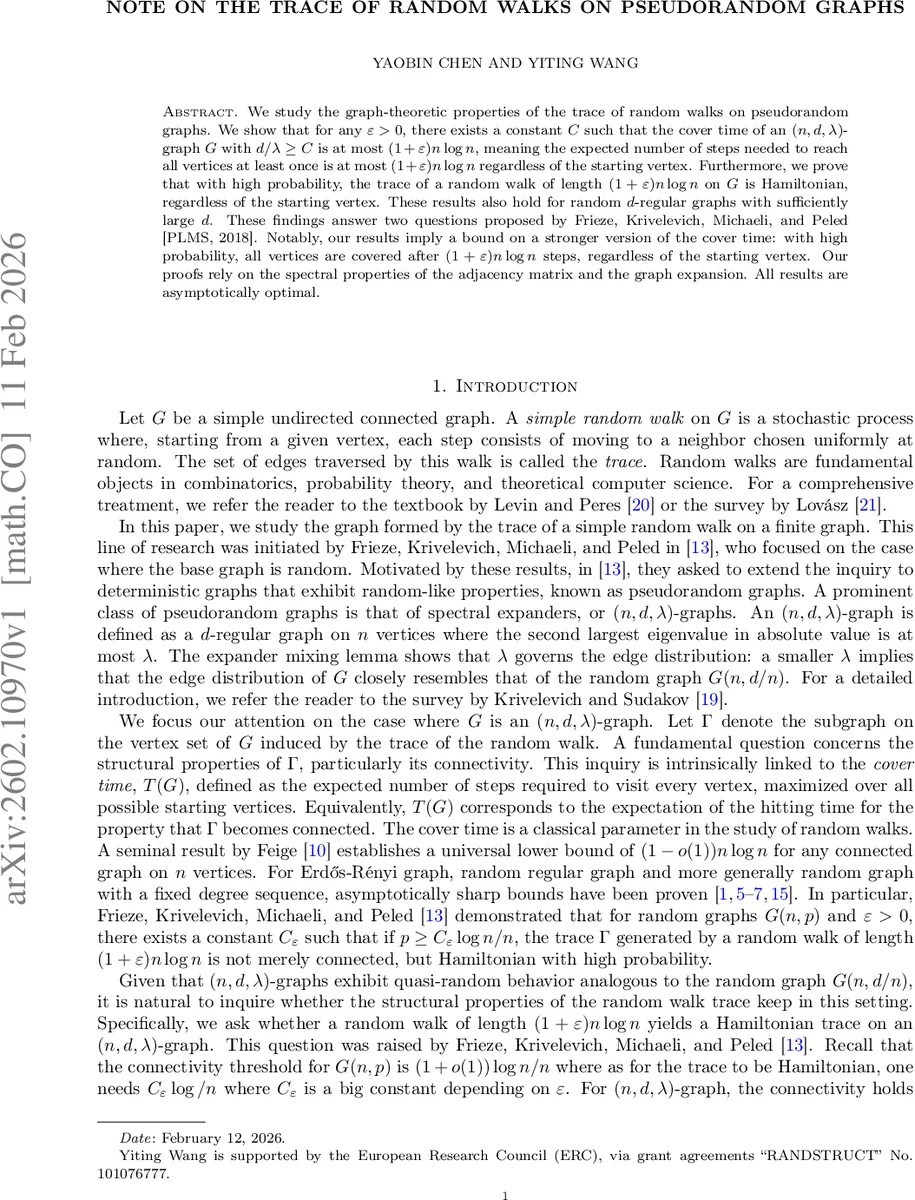
We study the graph-theoretic properties of the trace of random walks on pseudorandom graphs. We show that for any $\varepsilon>0$, there exists a constant $C$ such that the cover time of an $(n,d,λ)$-graph $G$ with $d/λ\ge C$ is at most $(1+\varepsilon)n\log n$, meaning the expected number of steps needed to reach all vertices at least once is at most $(1+\varepsilon)n\log n$ regardless of the starting vertex. Furthermore, we prove that with high probability, the trace of a random walk of length $(1+\varepsilon)n\log n$ on $G$ is Hamiltonian, regardless of the starting vertex. These results also hold for random $d$-regular graphs with sufficiently large $d$. These findings answer two questions proposed by Frieze, Krivelevich, Michaeli, and Peled [PLMS, 2018]. Notably, our results imply a bound on a stronger version of the cover time: with high probability, all vertices are covered after $(1+\varepsilon)n\log n$ steps, regardless of the starting vertex. Our proofs rely on the spectral properties of the adjacency matrix and the graph expansion. All results are asymptotically optimal.
💡 Research Summary
The paper investigates structural properties of the trace of a simple random walk on pseudorandom graphs, focusing on (n,d,λ)-graphs—d‑regular graphs whose second largest eigenvalue in absolute value does not exceed λ. The authors address two questions raised by Frieze, Krivelevich, Michaeli, and Peled (2018): (i) how fast does a random walk cover all vertices in such graphs, and (ii) does the trace of a walk of length roughly n log n become Hamiltonian?
The main contributions are fourfold. First, Proposition 1.1 shows that for any ε>0 there exists a constant C(ε) such that if d/λ≥C then the expected cover time T(G) is at most (1+ε)n log n. This refines the classical Θ(n log n) bound for expanders to an asymptotically optimal (1+ε) factor. Second, Theorem 1.2 introduces the “strong cover time” ST(G), defined as the smallest integer t for which a walk of length t visits every vertex with high probability, uniformly over all starting points. Under the same spectral ratio condition, ST(G) ≤ (1+ε)n log n, establishing a high‑probability analogue of the cover‑time bound.
The third result, Theorem 1.3, proves that the trace Γ of a random walk of length L=(1+ε)n log n is Hamiltonian with high probability, again assuming d/λ≥C(ε). The proof proceeds by first showing (Lemma 3.1) that after L steps each vertex is visited at least ρ log n times for some ρ=ρ(ε)>0. This guarantees that Γ has minimum degree Ω(log n) and, more importantly, satisfies the expansion properties of a C′‑expander for a sufficiently large constant C′. The authors then invoke the recent breakthrough of Draganić, Montgomery, Munhá Correia, Pokrovskiy, and Sudakov (2022), which states that any C‑expander with large enough C is Hamiltonian. Consequently, Γ inherits a Hamiltonian cycle.
Finally, Corollary 1.4 extends the Hamiltonicity result to random d‑regular graphs. Since a random d‑regular graph is, with high probability, an (n,d,λ)-graph with λ=O(√d), the same spectral ratio condition holds for sufficiently large d, and the trace of a walk of length (1+ε)n log n is whp Hamiltonian.
The technical backbone relies on spectral analysis of the transition matrix P = D⁻¹A. By bounding the second eigenvalue away from d, the authors obtain rapid mixing (τ(1/n) ≤ 10 log n) and control over transition probabilities after t steps. They also use effective resistance bounds (R_{u,v} ≥ 1/(d_u+1)+1/(d_v+1)) and the connection between resistance, hitting times, and cover times (via Lemmas 2.3 and 2.4) to translate spectral information into concrete time estimates. The blanket time concept is discussed: the authors’ results imply that for some δ=δ(ε) the δ‑blanket time satisfies t_bl(G,δ) ≤ (1+ε)n log n, matching the cover time up to a (1+o(1)) factor.
Overall, the paper demonstrates that strong expansion (large d/λ) not only guarantees optimal cover times but also forces the trace of a relatively short random walk to be highly connected and Hamiltonian. The results are asymptotically optimal, match known lower bounds, and unify the behavior of deterministic expanders with that of random regular graphs. The work opens avenues for studying trace properties in broader classes of sparse pseudorandom graphs and for exploring algorithmic applications where rapid coverage and Hamiltonicity of walk‑induced subgraphs are desirable.
Comments & Academic Discussion
Loading comments...
Leave a Comment