Chromatic Number of Grassmann Graphs and MRD codes
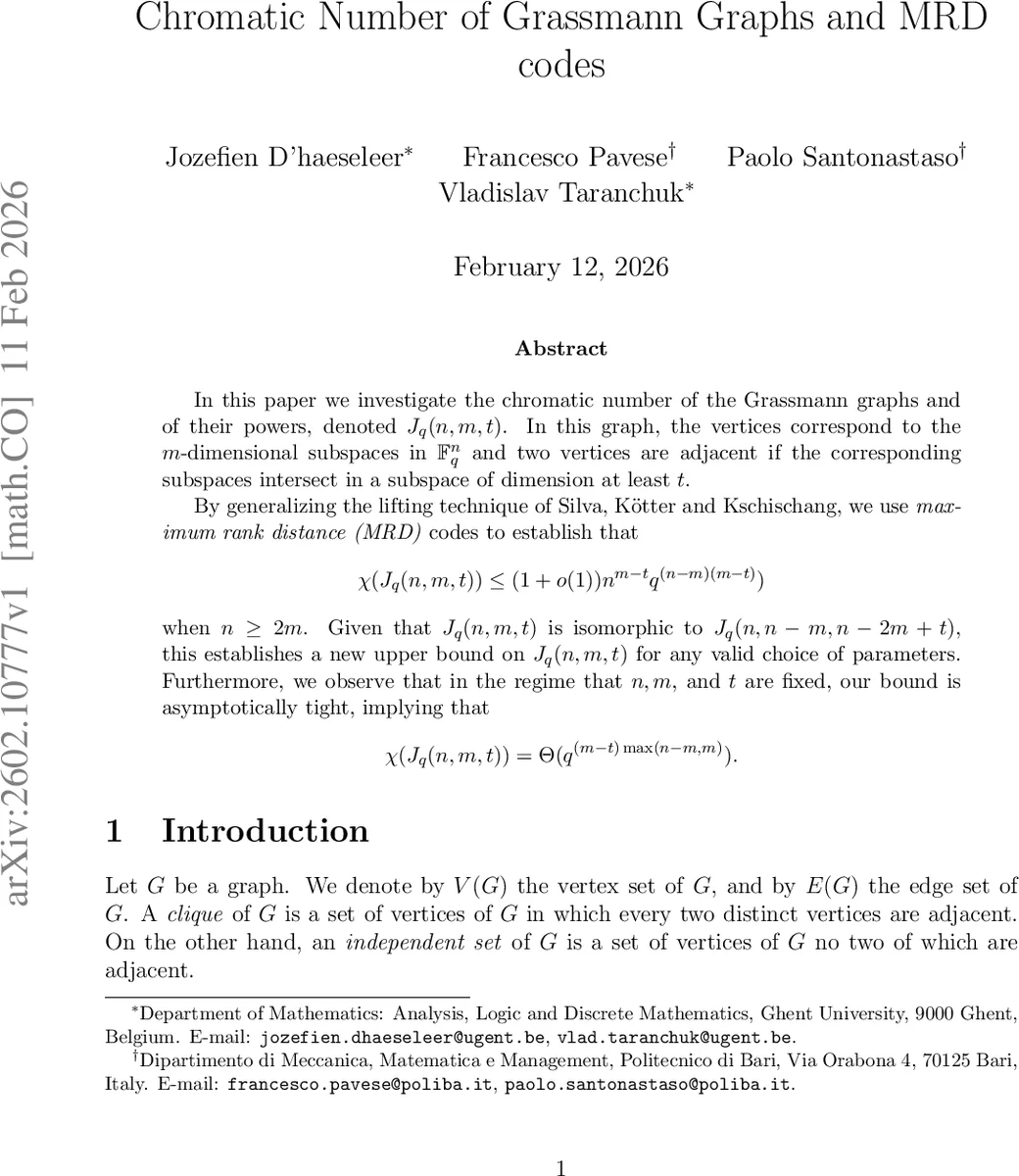
In this paper we investigate the chromatic number of the Grassmann graphs and of their powers, denoted $J_q(n,m,t)$. In this graph, the vertices correspond to the $m$-dimensional subspaces in $\mathbb{F}_q^n$ and two vertices are adjacent if the corresponding subspaces intersect in a subspace of dimension at least $t$. By generalizing the lifting technique of Silva, Kötter and Kschischang, we use \emph{maximum rank distance (MRD)} codes to establish that $χ(J_q(n, m, t)) \leq (1 +o(1))n^{m-t}q^{(n-m)(m-t)})$ when $n \geq 2m$. Given that $J_q(n, m, t)$ is isomorphic to $J_q(n,n-m,n-2m+t)$, this establishes a new upper bound on $J_q(n, m, t)$ for any valid choice of parameters. Furthermore, we observe that in the regime that $n, m $, and $t$ are fixed, our bound is asymptotically tight, implying that $ χ(J_q(n, m, t)) = Θ(q^{(m-t)\max(n-m, m)}). $
💡 Research Summary
This paper studies the chromatic number χ of Grassmann graphs over a finite field 𝔽_q and of their powers, denoted J_q(n,m,t). The vertices of J_q(n,m,t) are the m‑dimensional subspaces of 𝔽_q^n; two vertices are adjacent when their intersection has dimension at least t (so J_q(n,m,m‑1) is the ordinary Grassmann graph). The authors first recall known bounds for the ordinary Grassmann graph and note that, apart from a few special cases (mainly m=2), only the trivial bound χ ≤ Δ+1 is available.
A key structural observation is the duality J_q(n,m,t) ≅ J_q(n,n‑m,n‑2m+t), which allows the analysis to be split into two regimes: n ≥ 2m and m < n < 2m. A simple clique‑size argument yields a lower bound χ ≥ max{⎛n‑t⎞_q / ⎛m‑t⎞_q , ⎛2m‑t⎞_q / ⎛m‑t⎞_q}, where ⎛a⎞_q denotes the Gaussian binomial coefficient. This lower bound is tight up to a factor depending only on m and t when the field size grows.
The main contribution is an upper bound obtained via a novel colouring scheme based on maximum rank‑distance (MRD) codes. For any admissible parameters, Delsarte–Gabidulin theory guarantees the existence of an MRD code C ⊂ M_{m×(n‑m)}(𝔽_q) with minimum rank distance d = m‑t+1 and cardinality |C| = q^{(n‑m)(m‑t)}. Fix a binary “identifying vector” u of Hamming weight m (i.e., a choice of m coordinate positions). For each matrix A ∈ C, construct an m‑dimensional subspace L_u(A) ⊂ 𝔽_q^n by inserting the columns of the identity matrix I_m into the positions indicated by the 1‑entries of u and filling the remaining positions with the columns of A. Two subspaces built from the same u but from distinct cosets of C intersect in exactly a t‑dimensional space, so they form a coclique (independent set) in J_q(n,m,t). Different u’s give disjoint cocliques.
Thus, assigning a distinct colour to each coset of C for a fixed u yields a proper colouring of all vertices sharing that u. The remaining task is to colour the different u’s. This reduces to colouring the ordinary Johnson graph J(n,m), for which Graham–Sloane’s Bose‑Chowla construction provides a colouring using (1+o(1)) n^{m‑t} colours. Consequently, χ(J_q(n,m,t)) ≤ (1+o(1)) n^{m‑t} q^{(n‑m)(m‑t)} for n ≥ 2m, and, by duality, the analogous bound for m ≤ n < 2m with ⎛2m‑t⎞_q in place of ⎛n‑t⎞_q.
Theorem 1.3 summarises the results:
- If n ≥ 2m, ⎛n‑t⎞_q ≤ χ ≤ (1+o(1)) n^{m‑t}⎛n‑t⎞_q.
- If m ≤ n < 2m, ⎛2m‑t⎞_q ≤ χ ≤ (1+o(1)) n^{m‑t}⎛2m‑t⎞_q.
For fixed n, m, t and q → ∞, the bounds match up to constant factors, giving the asymptotic formula χ(J_q(n,m,t)) = Θ(q^{(m‑t)·max(n‑m,m)}).
The paper concludes with remarks on the significance of linking MRD codes to graph colourings, potential extensions to other distance‑regular graphs, and open problems such as tightening the constant factors, handling non‑regular parameter ranges, and exploring algorithmic aspects of the MRD‑based colouring.
Comments & Academic Discussion
Loading comments...
Leave a Comment