On the Calderón sum formula for wavelet systems
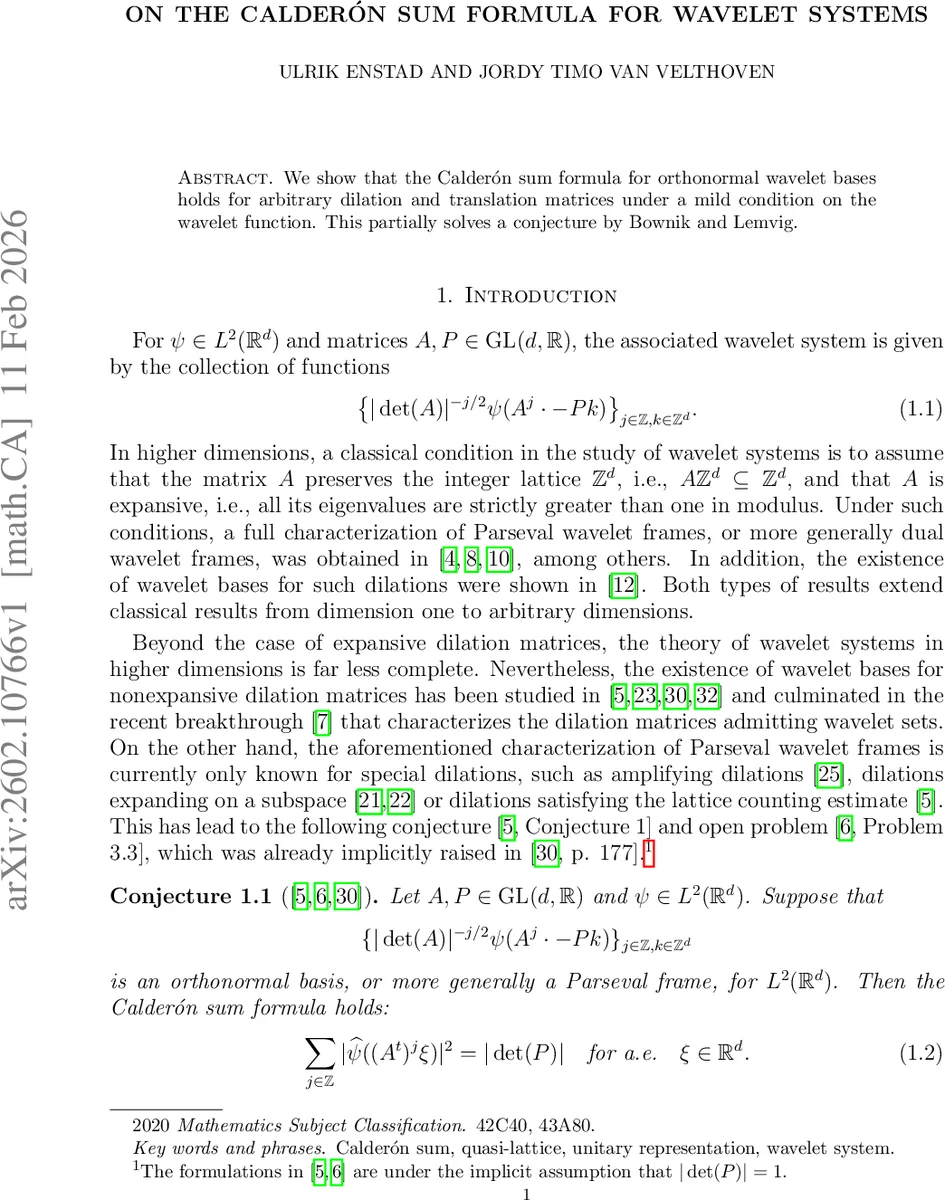
We show that the Calderón sum formula for orthonormal wavelet bases holds for arbitrary dilation and translation matrices under a mild condition on the wavelet function. This partially solves a conjecture by Bownik and Lemvig.
💡 Research Summary
The paper addresses a long‑standing conjecture concerning the Calderón sum formula for orthonormal wavelet bases in arbitrary dimensions. Classical wavelet theory assumes that the dilation matrix A preserves the integer lattice (i.e., Aℤᵈ⊂ℤᵈ) and is expansive (all eigenvalues have modulus > 1). Under these hypotheses, a full characterization of Parseval wavelet frames and the existence of orthonormal wavelet bases are known. Recent work has shown that wavelet bases can exist for non‑expansive dilations, but a general Calderón sum identity has only been proved for special classes of dilations (e.g., amplifying dilations, subspace‑expanding dilations, or matrices satisfying a lattice‑counting estimate).
The authors propose a new approach that works for any invertible dilation matrix A and any translation matrix P, provided the wavelet generator ψ satisfies a mild regularity condition. Specifically, they introduce the space Bπ, consisting of all ψ∈L²(ℝᵈ) such that the orbit π(Λ)ψ is a Bessel sequence for every relatively separated subset Λ of the semi‑direct product group
(G = \mathbb{R}^d \rtimes \langle A\rangle).
Here π is the unitary representation defined by
(\pi(x,A^j)\psi = |\det A|^{-j/2},\psi\bigl(A^{-j}(\cdot - x)\bigr)).
The condition ψ∈Bπ is standard in group‑frame theory; it holds, for example, for ψ with sufficient decay and smoothness.
Main Result (Theorem 1.2).
If ψ∈Bπ and the discrete wavelet system
({,\pi(A^j P^k, A^j)\psi : j\in\mathbb Z,;k\in\mathbb Z^d,})
forms a Parseval frame for L²(ℝᵈ), then the associated semi‑continuous system
({,\pi(x, A^j)\psi : x\in\mathbb R^d,;j\in\mathbb Z,})
is a tight frame, and the Calderón sum holds almost everywhere:
\
Comments & Academic Discussion
Loading comments...
Leave a Comment