Hidden Licensing Risks in the LLMware Ecosystem
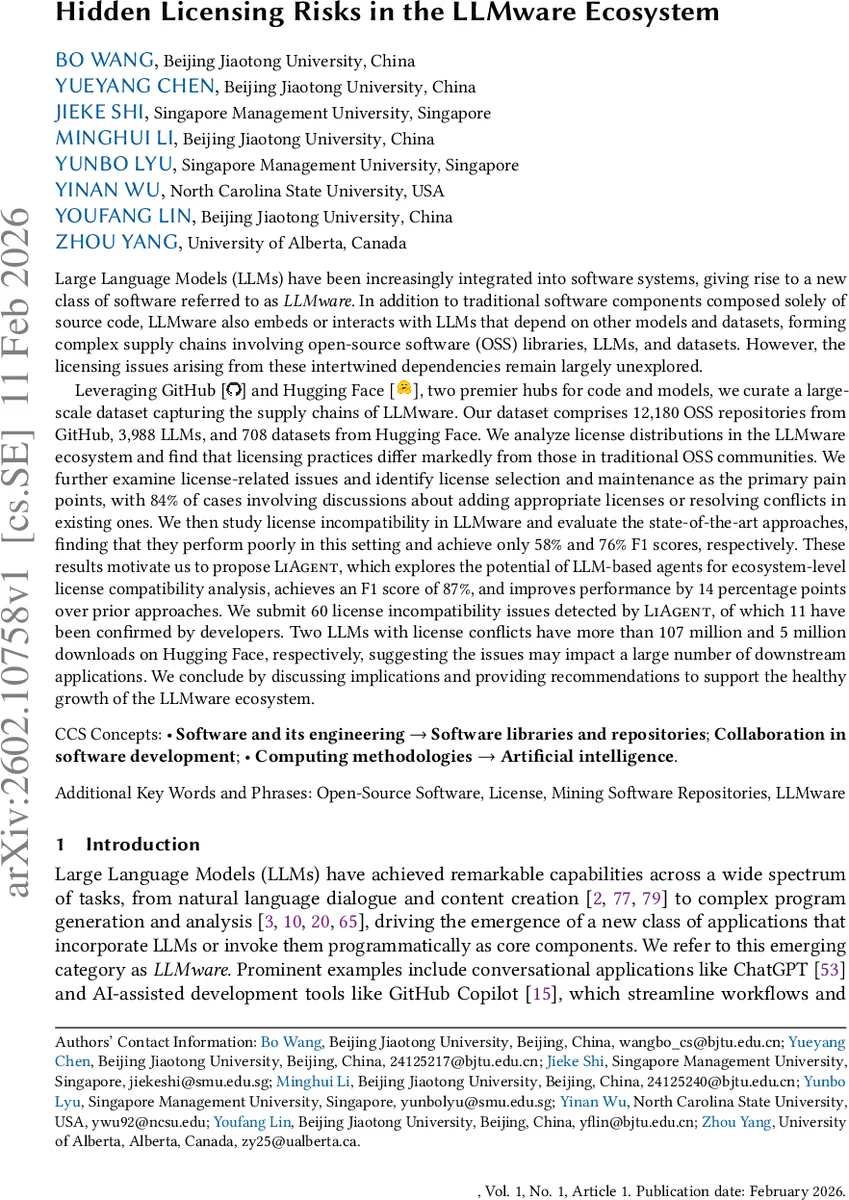
Large Language Models (LLMs) are increasingly integrated into software systems, giving rise to a new class of systems referred to as LLMware. Beyond traditional source-code components, LLMware embeds or interacts with LLMs that depend on other models and datasets, forming complex supply chains across open-source software (OSS), models, and datasets. However, licensing issues emerging from these intertwined dependencies remain largely unexplored. Leveraging GitHub and Hugging Face, we curate a large-scale dataset capturing LLMware supply chains, including 12,180 OSS repositories, 3,988 LLMs, and 708 datasets. Our analysis reveals that license distributions in LLMware differ substantially from traditional OSS ecosystems. We further examine license-related discussions and find that license selection and maintenance are the dominant concerns, accounting for 84% of cases. To understand incompatibility risks, we analyze license conflicts along supply chains and evaluate state-of-the-art detection approaches, which achieve only 58% and 76% F1 scores in this setting. Motivated by these limitations, we propose LiAgent, an LLM-based agent framework for ecosystem-level license compatibility analysis. LiAgent achieves an F1 score of 87%, improving performance by 14 percentage points over prior methods. We reported 60 incompatibility issues detected by LiAgent, 11 of which have been confirmed by developers. Notably, two conflicted LLMs have over 107 million and 5 million downloads on Hugging Face, respectively, indicating potentially widespread downstream impact. We conclude with implications and recommendations to support the sustainable growth of the LLMware ecosystem.
💡 Research Summary
The paper investigates licensing risks in the emerging “LLMware” ecosystem, where software applications embed or invoke large language models (LLMs) that themselves depend on other models and datasets. By mining GitHub and Hugging Face, the authors construct a comprehensive supply‑chain dataset comprising 12,180 OSS repositories, 3,988 LLMs, and 708 datasets. They first map dependencies using API signatures from 23 Hugging Face Python libraries and static code analysis, then trace each LLM to its base model and training data via Hugging Face metadata, resulting in a three‑tier directed graph (OSS → LLM → Dataset/Base Model).
License analysis reveals that traditional OSS licenses such as MIT (26.5 %) and Apache‑2.0 (22.2 %) dominate, yet 35 % of all artifacts lack any declared license. Hugging Face models show a broader spectrum, including AI‑specific licenses like OpenRAIL and LLaMA2, and corporate‑released models often adopt proprietary AI licenses, whereas individual contributors frequently omit licensing information. Statistical comparison shows significant divergence between GitHub and Hugging Face licensing practices.
To understand developer concerns, the authors manually examine 337 GitHub issues, 171 model discussions, and 84 dataset discussions. Through open card sorting they identify seven concern categories; license creation (54 %) and license update (30 %) together account for 84 % of all discussions, indicating that selecting and maintaining appropriate licenses is the primary pain point. LLM‑related license questions are disproportionately high (21 % of LLM discussions) compared with OSS (3.6 %) and datasets (9.6 %). Resolution speed differs markedly: 61 % of GitHub issues close within a day, while half of Hugging Face discussions remain unresolved after two years.
The core of the study examines license incompatibility across the supply chain. Licenses are modeled as sets of “can”, “cannot”, and “must” obligations; a conflict is flagged when a downstream license is more permissive than an upstream one (e.g., downstream “can” paired with upstream “cannot”). The analysis finds that 52 % of supply chains contain at least one conflict. The most frequent patterns involve missing licenses (No‑License → Apache‑2.0 and the reverse), incompatibilities between permissive OSS licenses due to differing patent grants or attribution requirements (MIT → Apache‑2.0), and mismatches between OSS licenses and AI‑specific licenses (Apache‑2.0 → CC‑BY‑4.0, Apache‑2.0 → LLaMA2).
Existing automated compatibility tools are evaluated on a benchmark of 124 OSS licenses, 16 AI‑specific licenses, and mutated variants that flip a single obligation. Semantic‑similarity approaches achieve 61 % F1 on OSS and 42 % on AI licenses; the state‑of‑the‑art LiDetector reaches 76 % and 81 % respectively, but performance drops sharply on mutated licenses. To address these shortcomings, the authors propose LiAgent, an LLM‑based multi‑agent framework. An extraction agent first identifies license terms and their obligations; a repair agent then iteratively resolves detected conflicts. LiAgent attains 88 % F1 on OSS and 89 % on AI licenses, and maintains 86‑88 % F1 on mutated sets, outperforming LiDetector by up to 14 percentage points.
The practical impact is demonstrated by reporting 60 incompatibility issues to real‑world projects; 11 have been confirmed by developers, with 8 already fixed. Notably, two conflicted LLMs have over 107 million and 5 million downloads on Hugging Face, suggesting a potentially large downstream effect. The paper concludes with actionable recommendations: standardize license declarations across code, models, and datasets; develop clear compatibility guidelines for OSS versus AI‑specific licenses; and integrate LLM‑driven compatibility analysis into CI pipelines to proactively detect risks.
Overall, the study provides the first large‑scale empirical view of licensing in LLMware, quantifies the prevalence and nature of incompatibilities, demonstrates the limitations of existing tools, and offers a novel, effective LLM‑based solution, thereby laying groundwork for more sustainable and legally sound AI‑augmented software development.
Comments & Academic Discussion
Loading comments...
Leave a Comment