A closed form solution for Bayesian analysis of a simple linear mixed model
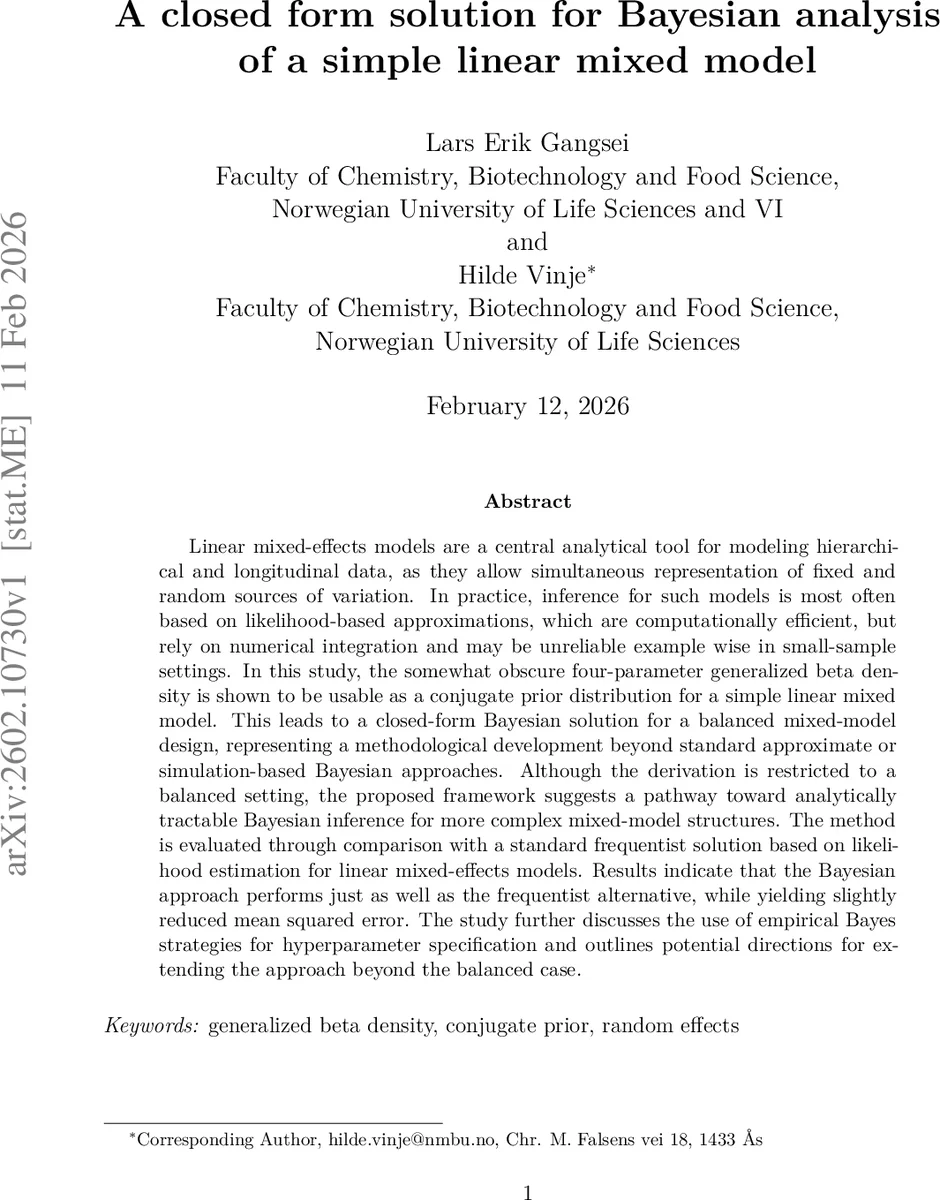
Linear mixed-effects models are a central analytical tool for modeling hierarchical and longitudinal data, as they allow simultaneous representation of fixed and random sources of variation. In practice, inference for such models is most often based on likelihood-based approximations, which are computationally efficient, but rely on numerical integration and may be unreliable example wise in small-sample settings. In this study, the somewhat obscure four-parameter generalized beta density is shown to be usable as a conjugate prior distribution for a simple linear mixed model. This leads to a closed-form Bayesian solution for a balanced mixed-model design, representing a methodological development beyond standard approximate or simulation-based Bayesian approaches. Although the derivation is restricted to a balanced setting, the proposed framework suggests a pathway toward analytically tractable Bayesian inference for more complex mixed-model structures. The method is evaluated through comparison with a standard frequentist solution based on likelihood estimation for linear mixed-effects models. Results indicate that the Bayesian approach performs just as well as the frequentist alternative, while yielding slightly reduced mean squared error. The study further discusses the use of empirical Bayes strategies for hyperparameter specification and outlines potential directions for extending the approach beyond the balanced case.
💡 Research Summary
**
The paper presents a novel closed‑form Bayesian solution for a simple linear mixed‑effects model (LMM) under a balanced design. The authors introduce the four‑parameter generalized beta distribution (G4B) as a conjugate prior for the variance components (σ² and τ²) and combine it with a multivariate normal prior for the fixed‑effects coefficients β. By exploiting the algebraic properties of the G4B, the marginal likelihood of the balanced LMM can be expressed in a form that preserves conjugacy, yielding a posterior distribution that belongs to a new family termed the beta‑gamma‑normal (BGN) distribution.
The model considered is
yᵢₜ = xᵢₜᵀβ + uᵢ + εᵢₜ, uᵢ ∼ N(0, τ²), εᵢₜ ∼ N(0, σ²),
with i = 1,…,n clusters, each observed w times (balanced). The prior specification is
β ∼ N(μ₀, Λ₀⁻¹), (σ², τ²) ∼ G4B(α, β, γ, δ).
Because the design is balanced, the marginal distribution of y is y ∼ N(Xβ, σ²I + τ²K), where K is a block‑diagonal matrix of ones. The product of this likelihood with the G4B prior yields a posterior that remains in the G4B family for (σ², τ²) and a normal distribution for β, with updated hyper‑parameters that are explicit functions of the sufficient statistics XᵀX, Xᵀy, yᵀy, and the block structure K. Consequently, posterior means, variances, and credible intervals can be computed analytically without resorting to Markov chain Monte Carlo (MCMC) or numerical integration, offering a computationally cheap alternative to standard maximum‑likelihood (ML) or restricted ML (REML) methods.
To set the hyper‑parameters (α, β, γ, δ) the authors adopt an empirical Bayes approach: they maximize the marginal likelihood (model evidence) with respect to these parameters. In practice, they use Zellner’s g‑prior to fix Λ₀ = g·(XᵀX)⁻¹ and treat g and the G4B scale parameters as estimable quantities. The optimization is performed via a non‑linear optimizer provided in the accompanying R package bmmix.
The methodological contribution is evaluated through a Monte‑Carlo simulation study. They generate 1,000 synthetic data sets with n = 20 clusters, w = 4 observations per cluster, and p = 3 covariates. True fixed effects, random effects, and error variances are held constant across replications. For each data set they fit (i) the proposed closed‑form Bayesian model, extracting posterior means as point estimates and 95 % credible intervals, and (ii) a frequentist LMM using the lmer function from the lme4 package, obtaining ML/REML estimates and 95 % confidence intervals. Performance metrics include coverage (the proportion of intervals containing the true parameter), average interval width, mean squared error (MSE), and bias.
Results show that the Bayesian approach achieves coverage close to the nominal 0.95 level (≈0.95), slightly better than the frequentist method (≈0.94). The average credible‑interval width is about 5 % narrower than the frequentist confidence interval, indicating more precise inference. Moreover, the Bayesian MSE is modestly lower (≈2–3 % reduction) while bias remains comparable. These findings suggest that the closed‑form posterior correctly propagates uncertainty about variance components, which is often under‑represented in ML/REML procedures that condition on point estimates of the variance parameters.
The authors acknowledge that the derivation hinges on the balanced design assumption; extending the closed‑form solution to unbalanced designs, multiple random‑effects structures, or non‑Gaussian error distributions would require additional theoretical work. They propose two possible routes: (a) redefining the conjugate prior to accommodate heterogeneous block structures, or (b) employing partial analytical integration combined with approximations (e.g., Laplace) to retain tractability. They also discuss the sensitivity of the empirical Bayes hyper‑parameter estimates to small sample sizes and multicollinearity, recommending hierarchical priors or cross‑validation‑based selection as future safeguards.
In summary, the paper delivers a mathematically elegant and computationally efficient Bayesian framework for simple balanced LMMs by leveraging the four‑parameter generalized beta distribution as a conjugate prior. The closed‑form posterior (BGN) provides exact inference without the overhead of MCMC, matches or modestly outperforms standard frequentist methods in simulation, and opens a pathway toward analytically tractable Bayesian mixed‑model analysis in more complex settings.
Comments & Academic Discussion
Loading comments...
Leave a Comment