Cross-Sectional Asset Retrieval via Future-Aligned Soft Contrastive Learning
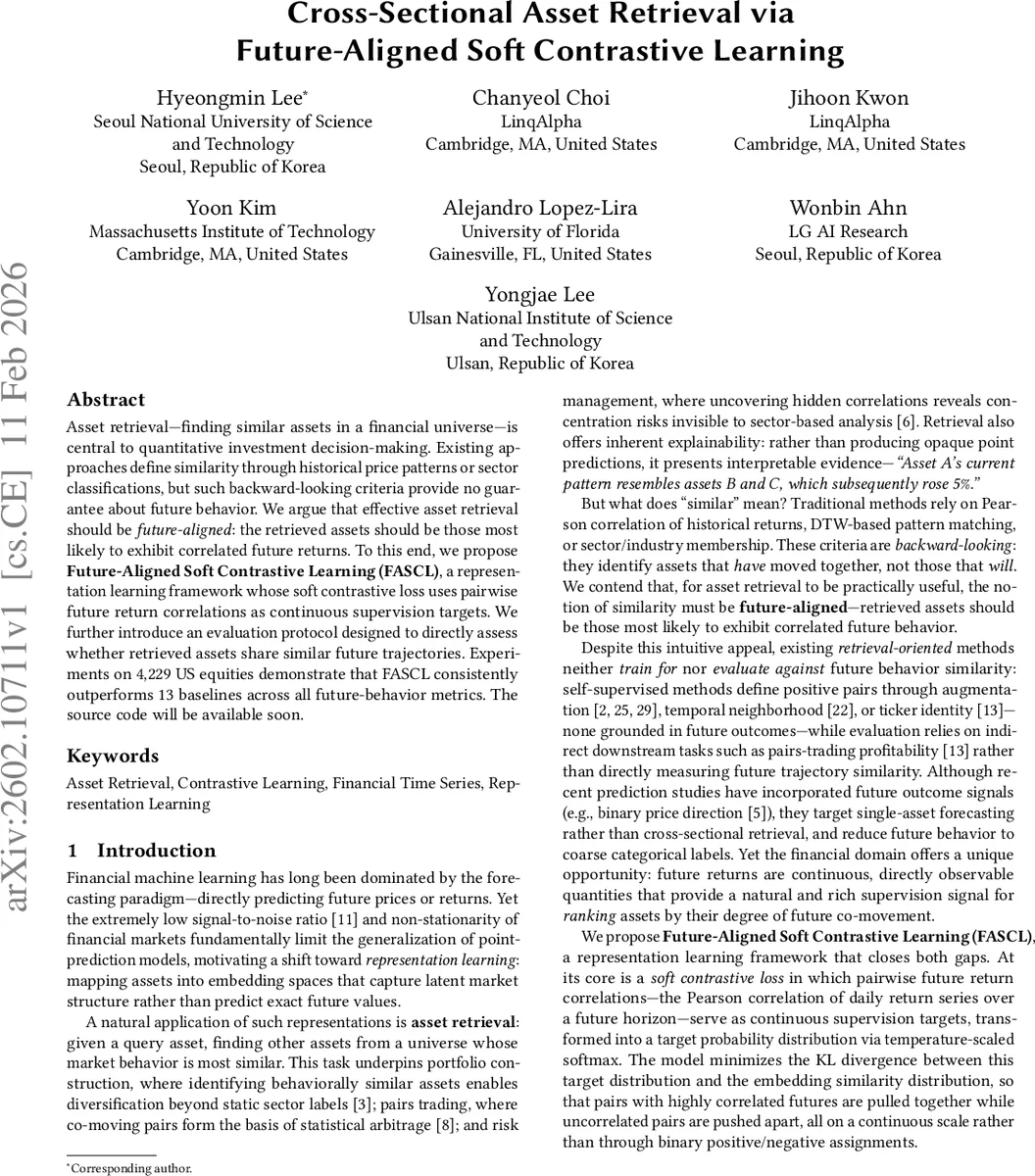
Asset retrieval–finding similar assets in a financial universe–is central to quantitative investment decision-making. Existing approaches define similarity through historical price patterns or sector classifications, but such backward-looking criteria provide no guarantee about future behavior. We argue that effective asset retrieval should be future-aligned: the retrieved assets should be those most likely to exhibit correlated future returns. To this end, we propose Future-Aligned Soft Contrastive Learning (FASCL), a representation learning framework whose soft contrastive loss uses pairwise future return correlations as continuous supervision targets. We further introduce an evaluation protocol designed to directly assess whether retrieved assets share similar future trajectories. Experiments on 4,229 US equities demonstrate that FASCL consistently outperforms 13 baselines across all future-behavior metrics. The source code will be available soon.
💡 Research Summary
The paper tackles the problem of asset retrieval—finding assets whose future market behavior is similar to that of a query asset—in a way that directly aligns the learned similarity with future outcomes. Traditional retrieval methods rely on backward‑looking signals such as historical price correlation, dynamic time warping, or sector classifications, which do not guarantee that retrieved assets will co‑move in the future. The authors argue that a practically useful retrieval system must be “future‑aligned”: the similarity metric should reflect the likelihood of correlated future returns.
To achieve this, they introduce Future‑Aligned Soft Contrastive Learning (FASCL). The framework consists of two main components: (1) a patch‑based Transformer encoder that converts multivariate financial time‑series windows into fixed‑dimensional embeddings, and (2) a soft contrastive loss that uses pairwise Pearson correlations of future return series as continuous supervision targets.
Encoder design – Each asset is represented by a 64‑day window of six market features (price, volume, etc.). The window is split into non‑overlapping 4‑day patches, each linearly projected to a 384‑dimensional token via a 1‑D convolution. A learnable
Comments & Academic Discussion
Loading comments...
Leave a Comment