Stabilization of nonautonomous Navier-Stokes flows under dynamic slip boundary conditions
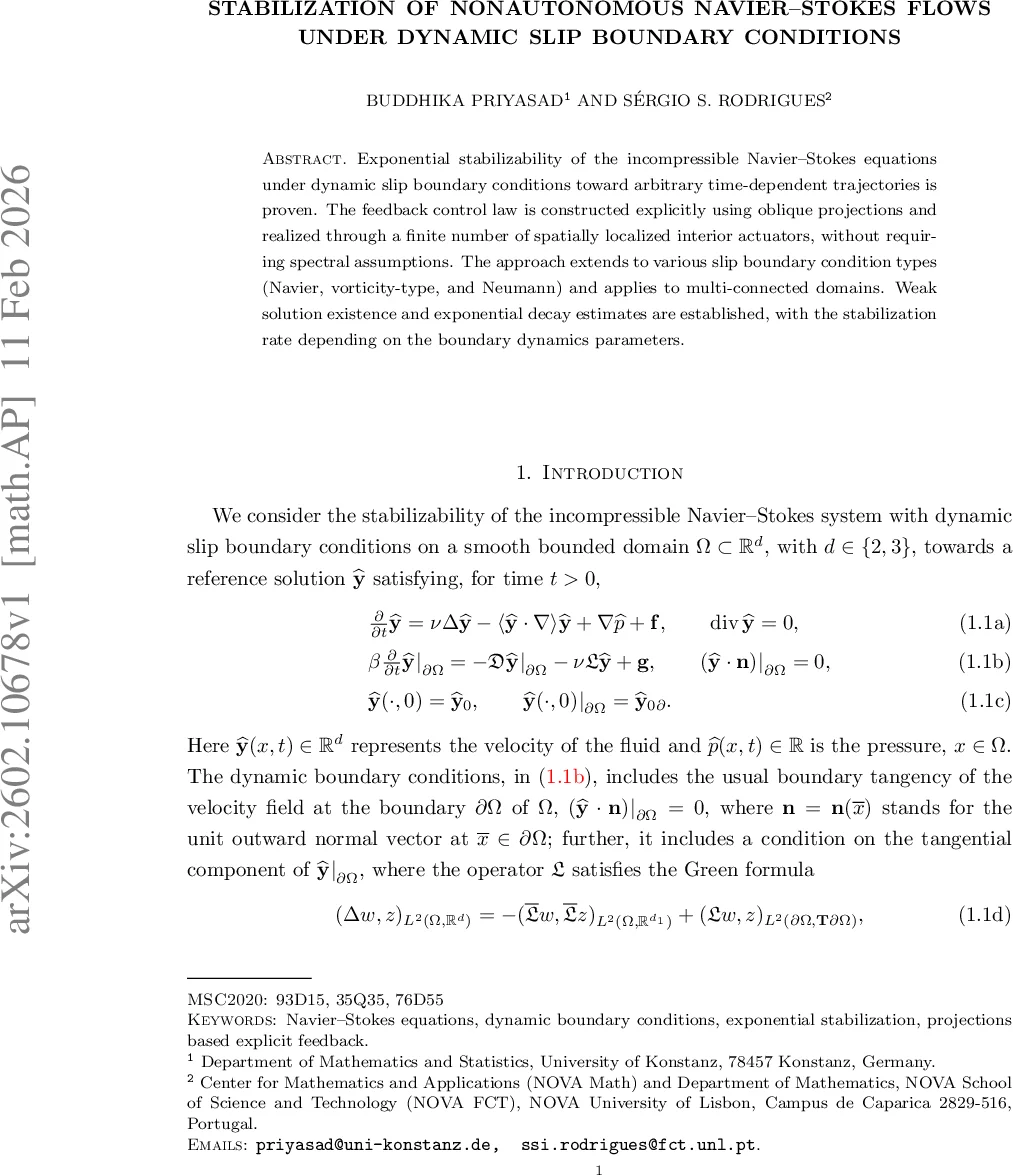
Exponential stabilizability of the incompressible Navier-Stokes equations under dynamic slip boundary conditions toward arbitrary time-dependent trajectories is proven. The feedback control law is constructed explicitly using oblique projections and realized through a finite number of spatially localized interior actuators, without requiring spectral assumptions. The approach extends to various slip boundary condition types (Navier, vorticity-type, and Neumann) and applies to multi-connected domains. Weak solution existence and exponential decay estimates are established, with the stabilization rate depending on the boundary dynamics parameters.
💡 Research Summary
The paper addresses the exponential stabilizability of the incompressible Navier‑Stokes equations posed on a smooth, possibly multi‑connected domain Ω⊂ℝ^d (d=2,3) when the fluid is subject to dynamic slip boundary conditions. The boundary dynamics are governed by β∂t y|{∂Ω}=−Dy−νLy+g together with the usual no‑penetration condition (y·n)=0, where D is a symmetric positive‑definite surface operator (e.g., a scaled identity or a shifted Laplace–Beltrami operator) and L encodes various slip types (Navier, vorticity‑type, Neumann). The authors consider a reference trajectory b_y(t) that solves the same system with given volume and boundary forces f and g, and they aim to drive the actual state y(t) toward b_y(t) using interior controls.
A finite set of spatially localized interior actuators {Φ_i}_{i=1}^m is introduced. The domain is partitioned into subdomains; each subdomain hosts one actuator whose shape is the indicator of a small region ω multiplied by a canonical unit vector. The total number of actuators is m = d·#P, where #P is the number of subdomains. The control input u(t)∈ℝ^m is taken in feedback form u = K_λ (y−b_y), where K_λ is built from the Helmholtz projection Π onto divergence‑free, boundary‑tangential fields and the orthogonal projection onto the span of the actuators. Explicitly, K_λ y = −λ V_m^{-1} ((ΠΦ_1,y)_H,…,(ΠΦ_m,y)_H)^T, with V_m the Gram matrix of the projected actuators. This construction yields an “oblique projection” feedback law that does not rely on any spectral information of the linearized operator.
The main analytical contributions are: (i) proof of existence of weak (Leray‑Hopf) solutions for both the uncontrolled and controlled systems under the dynamic slip conditions; (ii) a monotonicity estimate showing that, for sufficiently many actuators and a large enough gain λ, the sum of the Stokes operator and the feedback operator is strongly monotone; (iii) a rigorous exponential decay estimate for the error (y−b_y, (y−b_y)|_{∂Ω}) in the product space L^2(Ω)×L^2(∂Ω), namely
‖Y(t)−b_Y(t)‖ ≤ e^{−μ(t−s)}‖Y(s)−b_Y(s)‖,
with decay rate μ = β^{−1}α, where α is the smallest eigenvalue of D. Consequently, as β→0 (static slip) the rate μ→∞, reproducing the well‑known fact that arbitrarily fast stabilization is possible for static slip conditions.
The results hold without any spectral gap assumptions, apply to arbitrary smooth domains (including multi‑connected ones), and cover all three major slip boundary types. The paper also provides concrete geometric conditions (Assumption 5.1) on the actuator supports that guarantee the required Sobolev extension properties.
In summary, the authors develop a constructive, explicitly implementable feedback control strategy based on oblique projections and a finite number of localized interior actuators, and they prove that this strategy yields exponential stabilization of Navier‑Stokes flows under dynamic slip boundary conditions toward any prescribed time‑dependent trajectory. This work extends the theory of fluid flow control to a class of boundary conditions that model realistic fluid–structure interactions and had previously received little attention.
Comments & Academic Discussion
Loading comments...
Leave a Comment