An improved lower bound on the Banach--Mazur distance to the cross-polytope
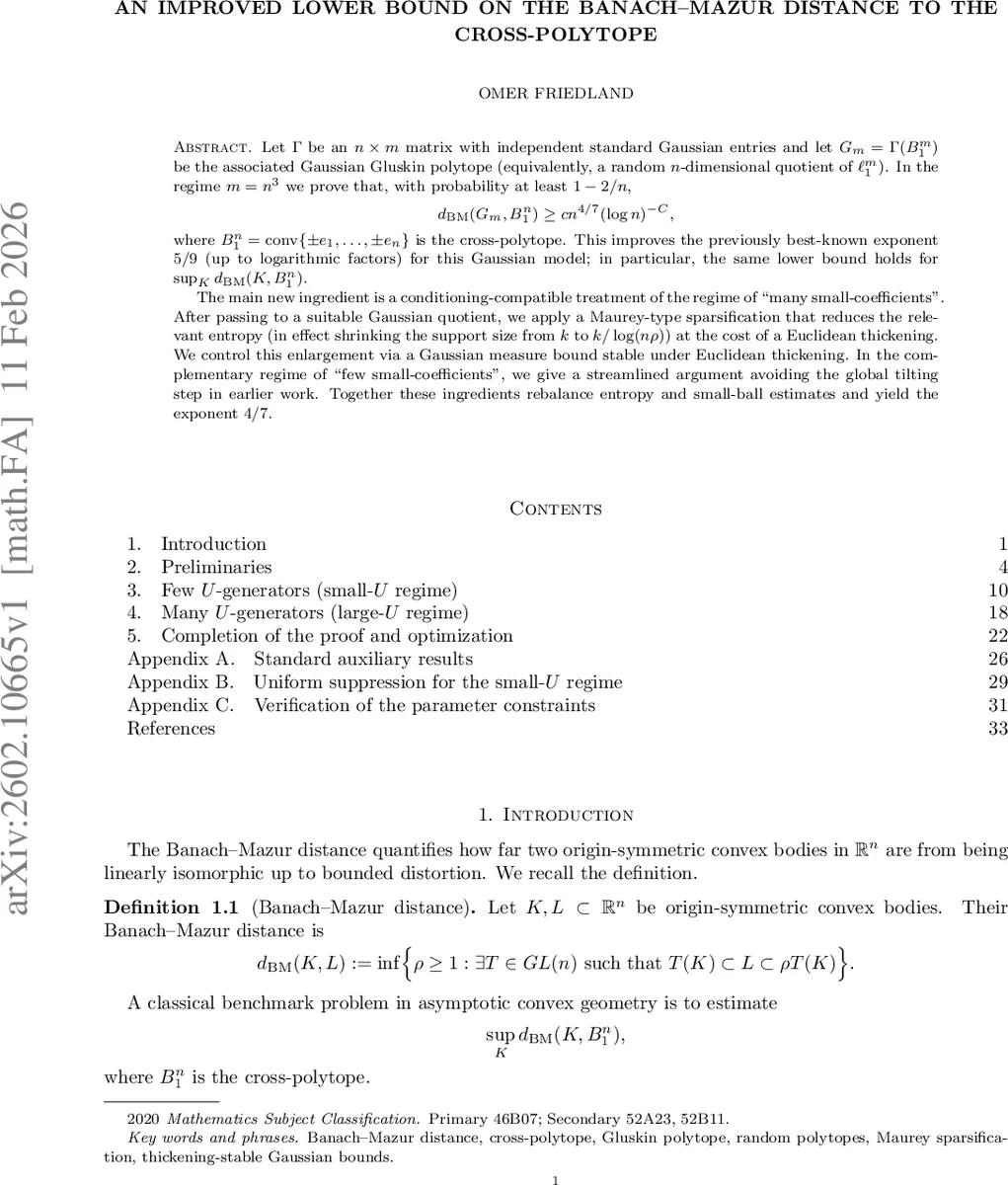
Let $Γ$ be an $n\times m$ matrix with independent standard Gaussian entries and let $G_m = Γ(B_1^m)$ be the associated Gaussian Gluskin polytope (equivalently, a random $n$-dimensional quotient of $\ell_1^m$). In the regime $m = n^3$ we prove that, with probability at least $1-2/n$, $$ d_{\mathrm{BM}}(G_m,B_1^n) \ge c n^{4/7}(\log n)^{-C}, $$ where $B_1^n = \conv{\pm e_1,\dots,\pm e_n}$ is the cross-polytope. This improves the previously best-known exponent $5/9$ (up to logarithmic factors) for this Gaussian model; in particular, the same lower bound holds for $\sup_{K} d_{\mathrm{BM}}(K,B_1^n)$. The main new ingredient is a conditioning-compatible treatment of the regime of many small-coefficients''. After passing to a suitable Gaussian quotient, we apply a Maurey-type sparsification that reduces the relevant entropy (in effect shrinking the support size from $k$ to $k/\log(nρ)$) at the cost of a Euclidean thickening. We control this enlargement via a Gaussian measure bound stable under Euclidean thickening. In the complementary regime of few small-coefficients’’, we give a streamlined argument avoiding the global tilting step in earlier work. Together these ingredients rebalance entropy and small-ball estimates and yield the exponent $4/7$.
💡 Research Summary
The paper investigates the Banach–Mazur distance between high‑dimensional symmetric convex bodies and the cross‑polytope (B_1^n=\operatorname{conv}{\pm e_i}_{i=1}^n). While the general upper bound is known to be of order (n^{5/6}), the best previously known lower bound for random Gaussian Gluskin polytopes (G_m=\Gamma(B_1^m)) with (m=n^3) was (c,n^{5/9}(\log n)^{-C}) (Tikhomirov, 2022). This work improves the exponent to (4/7) (up to logarithmic factors), establishing that with probability at least (1-2/n),
\
Comments & Academic Discussion
Loading comments...
Leave a Comment