Nonlinear dynamics in magnonic Fabry-Pérot resonators: Low-power neuron-like activation and transmission suppression
We report on nonlinear spin-wave dynamics in magnonic Fabry-Pérot resonators composed of yttrium iron garnet (YIG) films coupled to CoFeB nanostripes. Using super-Nyquist sampling magneto-optical Kerr effect microscopy and micromagnetic simulations, we observe a systematic downshift of the spin-wave transmission gaps as the excitation power increases. This nonlinear behavior occurs at low power levels, reduced by a strong spatial concentration of spin waves within the resonator. The resulting power-dependent transmission enables neuron-like activation behavior and frequency-selective nonlinear spin-wave absorption. Our results highlight magnonic Fabry-Pérot resonators as compact low-power nonlinear elements for neuromorphic magnonic computing architectures.
💡 Research Summary
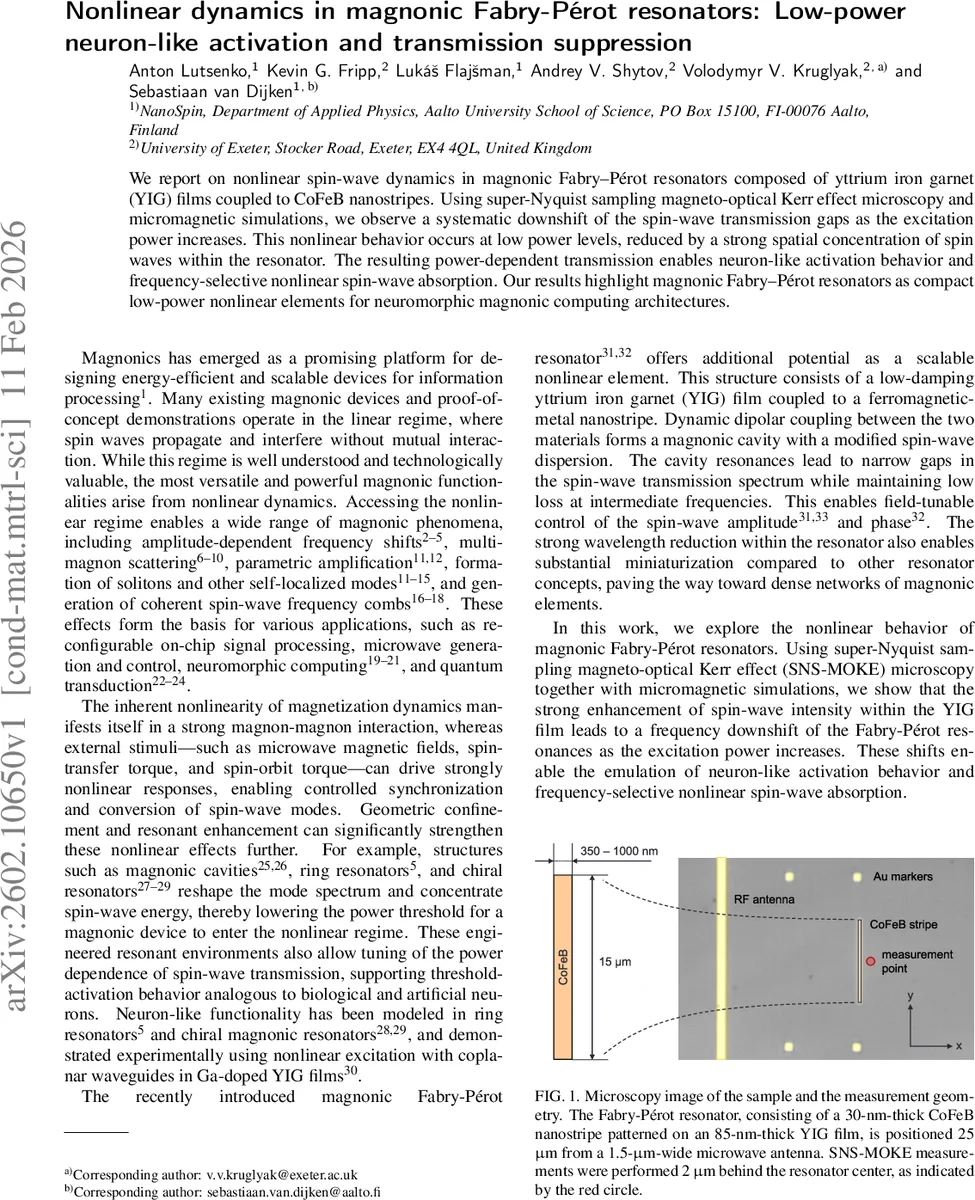
In this work the authors investigate nonlinear spin‑wave dynamics in magnonic Fabry‑Pérot resonators formed by a thin yttrium‑iron‑garnet (YIG) film coupled to cobalt‑iron‑boron (CoFeB) nanostripes. The resonators consist of an 85 nm YIG layer deposited on a (111) GGG substrate, over which 30 nm thick CoFeB nanostripes of varying width (350–1000 nm) are patterned. A 1 nm Ta/3 nm TaOₓ spacer prevents exchange coupling while allowing dynamic dipolar interaction, creating a magnonic cavity that concentrates spin‑wave energy inside the low‑damping YIG.
Spin waves are excited by a 1.5 µm wide Au micro‑strip antenna placed 25 µm from the nanostripe, with microwave powers ranging from –15 dBm to +5 dBm. The transmitted spin‑wave signal is probed 2 µm behind the resonator centre using super‑Nyquist sampling magneto‑optical Kerr effect (SNS‑MOKE) microscopy, which provides frequency‑resolved amplitude maps with high sensitivity.
Experimentally, the transmission spectra display clear gaps associated with the n = 2 and n = 3 Fabry‑Pérot resonances. As the excitation power increases, these gaps shift monotonically toward lower frequencies by up to ~50 MHz. This down‑shift is opposite to the intrinsic nonlinearity of bare YIG, where higher power leads to an upward shift of the dispersion curve (longer wavelength). Control measurements on YIG without a CoFeB stripe confirm that the observed behavior originates from the resonator, not from the film itself.
Micromagnetic simulations performed with MuMax3 reproduce the experimental trends. The YIG parameters (Ms = 1.2 × 10⁵ A m⁻¹, Aex = 3.5 × 10⁻¹² J m⁻¹, α = 5 × 10⁻⁴) and CoFeB parameters (Ms = 1.15 × 10⁶ A m⁻¹, Aex = 1.6 × 10⁻¹¹ J m⁻¹, α = 5 × 10⁻³) are used, together with a 5 nm air gap representing the spacer. By comparing simulations with and without the nanostripe, the authors isolate the resonator’s contribution. The simulations show that the resonator suppresses transmission by ~80 % at the n = 2 resonance while the resonance frequency moves downward as the incident amplitude A₀ increases.
Two distinct power‑dependent transmission regimes emerge. When the excitation frequency lies inside a linear‑regime gap, increasing power triggers a rapid rise in transmitted amplitude—an activation curve reminiscent of a neuronal threshold function. Conversely, for frequencies just below the gap, higher power further suppresses transmission, providing a nonlinear limiter that could protect downstream circuitry from excessive microwave power. The activation threshold corresponds to an incident spin‑wave amplitude of only ~4 % of the YIG saturation magnetization, indicating that the resonator’s field enhancement (≈5× for the in‑plane component, >10× for the out‑of‑plane component) dramatically lowers the nonlinear threshold compared with bare YIG.
The authors discuss the implications for magnonic neuromorphic computing. By placing such resonators at selected nodes in a spin‑wave network, one can introduce nonlinearity only where needed, while the rest of the network remains linear and exploits interference for information routing. This selective nonlinearity reduces overall energy consumption relative to fully nonlinear architectures. Moreover, the frequency‑selective suppression could be used for magnonic logic gates, amplitude‑encoded computation, or as a component in time‑delay reservoir computing schemes.
In summary, the study demonstrates that magnonic Fabry‑Pérot resonators provide a compact, low‑power platform for nonlinear spin‑wave functionality. The resonant concentration of spin‑wave energy yields a substantial reduction in the power required to reach nonlinear behavior, enabling neuron‑like activation and frequency‑specific attenuation. These results open a pathway toward energy‑efficient magnonic neural networks and nonlinear magnonic logic devices.
Comments & Academic Discussion
Loading comments...
Leave a Comment