Run-length certificates in quantum learning: sample complexity and noise thresholds
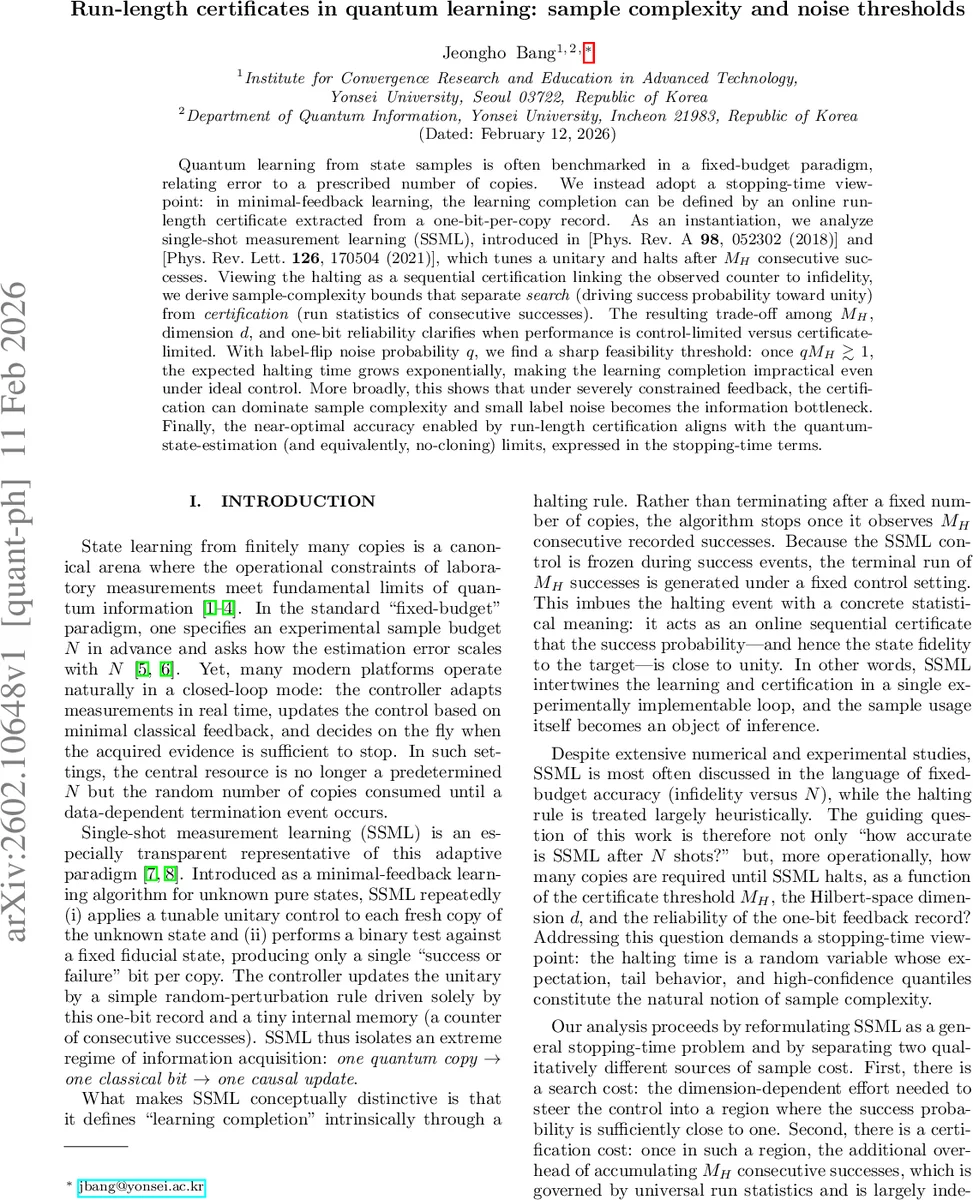
Quantum learning from state samples is often benchmarked in a fixed-budget paradigm, relating error to a prescribed number of copies. We instead adopt a stopping-time viewpoint: in minimal-feedback learning, the learning completion can be defined by an online run-length certificate extracted from a one-bit-per-copy record. As an instantiation, we analyze single-shot measurement learning (SSML), introduced in [Phys. Rev. A 98, 052302 (2018)] and [Phys. Rev. Lett. 126, 170504 (2021)], which tunes a unitary and halts after $M_H$ consecutive successes. Viewing the halting as a sequential certification linking the observed counter to infidelity, we derive sample-complexity bounds that separate search (driving success probability toward unity) from certification (run statistics of consecutive successes). The resulting trade-off among $M_H$, dimension $d$, and one-bit reliability clarifies when performance is control-limited versus certificate-limited. With label-flip noise probability $q$, we find a sharp feasibility threshold: once $qM_H \gtrsim 1$, the expected halting time grows exponentially, making the learning completion impractical even under ideal control. More broadly, this shows that under severely constrained feedback, the certification can dominate sample complexity and small label noise becomes the information bottleneck. Finally, the near-optimal accuracy enabled by run-length certification aligns with the quantum-state-estimation (and equivalently, no-cloning) limits, expressed in the stopping-time terms.
💡 Research Summary
This paper reexamines quantum state learning from a stopping‑time perspective, focusing on the single‑shot measurement learning (SSML) protocol introduced in earlier works. In SSML a learner repeatedly (i) applies a tunable unitary (U(p)) to a fresh copy of an unknown pure state (|\psi_\tau\rangle) and (ii) performs a binary projective measurement ({M_f,,\mathbb{I}-M_f}) that asks whether the processed state equals a fixed fiducial state (|f\rangle). The outcome is recorded as a single bit (success (s) or failure (u)). A counter (M_S(n)) tracks the number of consecutive successes; the algorithm halts as soon as this counter reaches a pre‑specified threshold (M_H). The final unitary parameter (p_{\text{est}}) is then used to reconstruct the unknown state.
The authors formalize SSML as an adapted stochastic process ({p(n),M_S(n)}) with respect to the natural filtration generated by all past measurement bits, random perturbation directions, and the initial parameter. The halting time
\
Comments & Academic Discussion
Loading comments...
Leave a Comment