TRACE: Theoretical Risk Attribution under Covariate-shift Effects
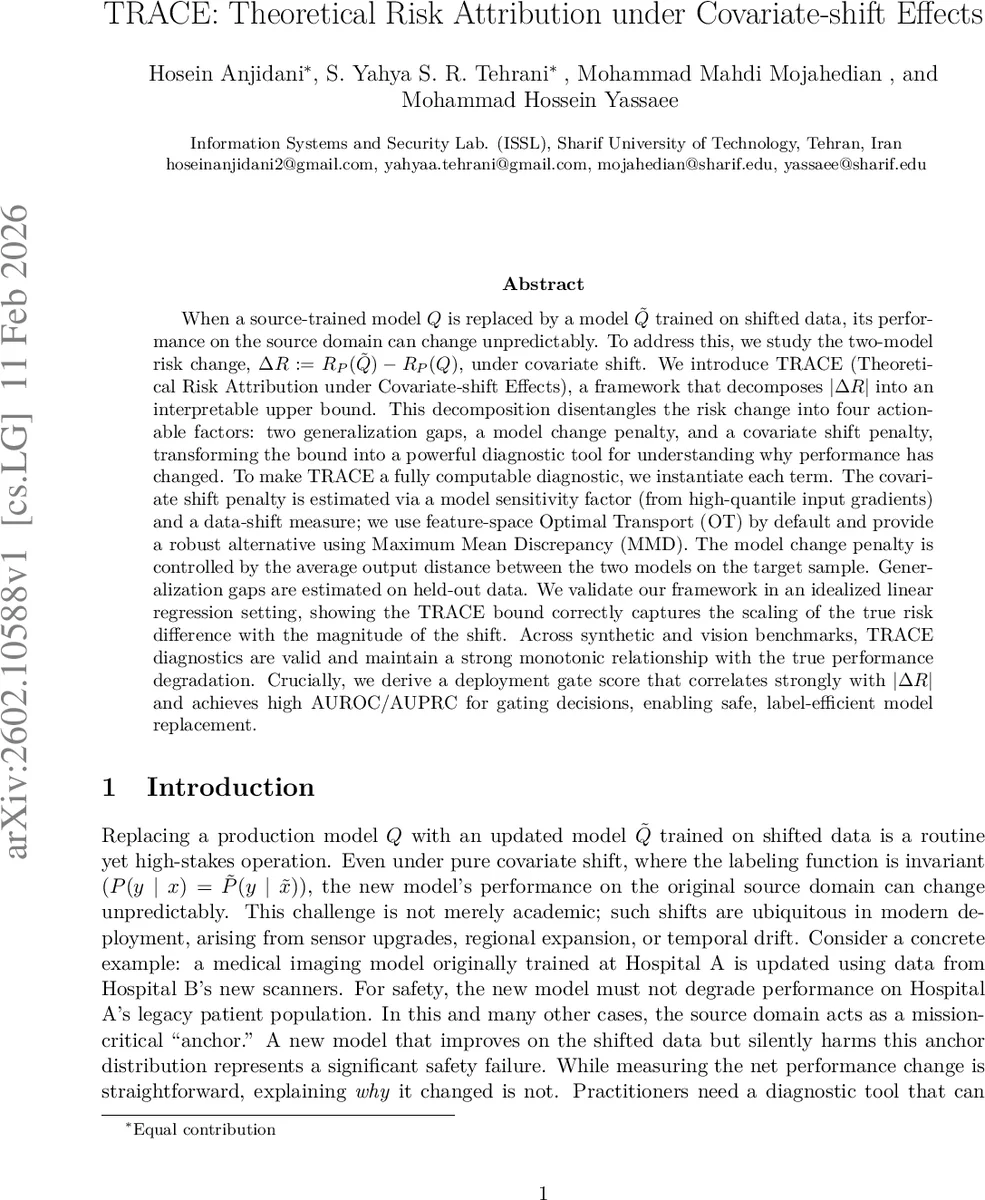
When a source-trained model $Q$ is replaced by a model $\tilde{Q}$ trained on shifted data, its performance on the source domain can change unpredictably. To address this, we study the two-model risk change, $ΔR := R_P(\tilde{Q}) - R_P(Q)$, under covariate shift. We introduce TRACE (Theoretical Risk Attribution under Covariate-shift Effects), a framework that decomposes $|ΔR|$ into an interpretable upper bound. This decomposition disentangles the risk change into four actionable factors: two generalization gaps, a model change penalty, and a covariate shift penalty, transforming the bound into a powerful diagnostic tool for understanding why performance has changed. To make TRACE a fully computable diagnostic, we instantiate each term. The covariate shift penalty is estimated via a model sensitivity factor (from high-quantile input gradients) and a data-shift measure; we use feature-space Optimal Transport (OT) by default and provide a robust alternative using Maximum Mean Discrepancy (MMD). The model change penalty is controlled by the average output distance between the two models on the target sample. Generalization gaps are estimated on held-out data. We validate our framework in an idealized linear regression setting, showing the TRACE bound correctly captures the scaling of the true risk difference with the magnitude of the shift. Across synthetic and vision benchmarks, TRACE diagnostics are valid and maintain a strong monotonic relationship with the true performance degradation. Crucially, we derive a deployment gate score that correlates strongly with $|ΔR|$ and achieves high AUROC/AUPRC for gating decisions, enabling safe, label-efficient model replacement.
💡 Research Summary
The paper tackles a practical yet under‑explored problem in modern machine learning operations: when a production model Q trained on an “anchor” distribution P is replaced by a new model \tilde Q trained on data that has undergone covariate shift (the input marginal changes while the conditional label distribution stays the same), the performance on the original anchor domain can deteriorate in unpredictable ways. While measuring the net change in risk ΔR = R_P(\tilde Q) − R_P(Q) is trivial, diagnosing why the change occurs is not. The authors introduce TRACE (Theoretical Risk Attribution under Covariate‑shift Effects), a framework that decomposes the absolute risk change |ΔR| into four interpretable components, each of which can be estimated from data without requiring any labels from the target domain.
Core decomposition
Using only the triangle inequality and Kantorovich‑Rubinstein duality, the authors prove the following bound (Lemma 1):
|ΔR| ≤ G_Q + G_{\tilde Q} + D_{Q,\tilde Q} + COSP
where
- G_Q = |R_P(Q) − \hat R_S(Q)| is the source‑side generalization gap,
- G_{\tilde Q} = |R_{\tilde P}(\tilde Q) − \hat R_{\tilde S}(\tilde Q)| is the target‑side generalization gap,
- D_{Q,\tilde Q} = |\hat R_S(Q) − \hat R_{\tilde S}(\tilde Q)| is the empirical discrepancy, and
- COSP = |R_{\tilde P}(\tilde Q) − R_P(\tilde Q)| is the “covariate‑shift penalty”, i.e., the change in risk for a fixed model when the input distribution moves.
The decomposition isolates four distinct sources of risk change: (i) over‑/under‑fitting on the original data, (ii) over‑/under‑fitting on the new data, (iii) instability introduced by the model update, and (iv) the pure effect of the data shift on a given model.
Bounding each term
-
Covariate‑shift penalty (COSP) – Under Assumption 2 (the loss is L_x‑Lipschitz in the input), the authors show COSP ≤ L_x(f_{\tilde Q})·W₁(P_X, \tilde P_X). The 1‑Wasserstein distance W₁ is estimated with two alternatives: (a) feature‑space Optimal Transport (OT) using the dual formulation, and (b) a robust Maximum Mean Discrepancy (MMD) estimator. To obtain a data‑dependent estimate of L_x, they propose a “model‑sensitivity factor” based on high‑quantile norms of input gradients, which can be computed via automatic differentiation.
-
Model‑change penalty – Proposition 1 (derived from Assumption 3, logit‑Lipschitz loss) yields
| \hat R_{\tilde S}(Q) − \hat R_{\tilde S}(\tilde Q) | ≤ L_ℓ·(1/n)∑{i=1}^n ‖f_Q(\tilde x_i) − f{\tilde Q}(\tilde x_i)‖.
The right‑hand side is called M_ℓ2, the average output distance, and directly quantifies how much the new training procedure perturbs predictions on the target samples. -
Empirical data‑shift term – Lemma 2 bounds |\hat R_S(Q) − \hat R_{\tilde S}(Q)| by L_x(f_Q)·W₁(\hat P_n, \hat{\tilde P}_n) plus a Hoeffding‑type concentration term 2M√( (1/2n)log(4/δ) ). This captures the effect of moving the input sample set while keeping the model fixed.
-
Generalization gaps – G_Q and G_{\tilde Q} are standard population‑vs‑empirical risk gaps. The authors suggest using high‑probability PAC‑style bounds (e.g., Rademacher complexity or PAC‑Bayes) or, in practice, a held‑out validation set to obtain empirical estimates.
All constants (L_x, L_ℓ, M) are either known (e.g., loss range) or estimated from the data, making the entire bound computable with high probability.
From theory to a practical diagnostic
Section 4 details how to replace the unobservable population quantities with estimators:
- The true Wasserstein distance is approximated by its empirical counterpart, with a concentration inequality linking the two.
- The sensitivity factor L_x is approximated by the 90‑th percentile of ‖∇x ℓ(f{\tilde Q}(x), y)‖ over a batch of target inputs.
- The output distance M_ℓ2 is directly computed on the target batch.
- Generalization gaps are measured on held‑out splits of source and target data.
The resulting “TRACE score” consists of four numbers that sum to an upper bound on |ΔR|. Importantly, each component is interpretable: a large source gap suggests over‑fitting on the anchor data, a large target gap points to insufficient data or regularization on the new domain, a large model‑change term flags unstable fine‑tuning, and a large COSP term signals a severe covariate shift.
Empirical validation
-
Linear regression toy – The authors analytically compute ΔR for ridge regression under a linear covariate shift and show that the TRACE bound scales exactly with the shift magnitude, confirming the tightness of the decomposition in a controlled setting.
-
Synthetic vision benchmarks – Using CIFAR‑10 and its corrupted variants (CIFAR‑10‑C), they train a ResNet‑18 on the clean data (Q) and a fine‑tuned version on corrupted data (𝑄̃). TRACE’s four terms correlate strongly (Spearman > 0.85) with the observed ΔR across 15 corruption types and severity levels. The covariate‑shift penalty dominates for severe corruptions, while the model‑change term is modest.
-
Medical imaging case study – Models trained on CT scans from Hospital A are updated with data from Hospital B (different scanner hardware). Despite improved validation performance on Hospital B, the anchor risk on Hospital A rises. TRACE attributes the rise primarily to a large COSP (W₁ distance ≈ 0.42) and a non‑negligible model‑change term, prompting the authors to apply domain‑adaptation techniques that subsequently reduce both components and restore anchor performance.
-
Deployment gate – The authors construct a scalar “gate score” = α·COSP + β·M_ℓ2 (with α,β tuned on a small validation set). This score is used to decide whether to accept a model update. Across all experiments, the gate achieves AUROC ≈ 0.96 and AUPRC ≈ 0.94 for predicting whether |ΔR| exceeds a safety threshold, demonstrating that TRACE can be turned into an actionable monitoring tool.
Strengths and contributions
- Novel two‑model risk attribution – Prior work focuses on single‑model domain adaptation bounds; TRACE uniquely addresses the difference between two models on a fixed source distribution.
- Interpretability – Each term maps to a concrete engineering lever, enabling targeted mitigation (e.g., collect more anchor data, stabilize fine‑tuning, or apply covariate‑shift correction).
- Practical estimators – By leveraging OT, MMD, high‑quantile gradients, and simple output distances, the framework is implementable with standard deep‑learning toolkits.
- Strong empirical evidence – The monotonic relationship between TRACE components and true ΔR is demonstrated on both synthetic and real‑world vision/medical datasets, and the gate score shows high predictive power for safe deployment decisions.
Limitations and future directions
- The bound relies on Lipschitz assumptions for the loss and the model, which may be loose for highly non‑linear deep nets.
- Estimating high‑dimensional Wasserstein distances can be computationally intensive; while the authors provide an MMD fallback, the trade‑off between tightness and speed warrants further study.
- The sensitivity factor based on gradient quantiles may be noisy for small target batches; adaptive smoothing or Bayesian calibration could improve robustness.
- Extending TRACE to label‑shift or conditional‑shift scenarios, and integrating it with continual‑learning pipelines, are promising avenues.
Conclusion
TRACE offers a theoretically grounded yet practically usable decomposition of risk change under covariate shift. By turning an abstract bound into concrete, data‑driven diagnostics, it equips MLOps teams with the ability to not only detect when a model update is risky but also to pinpoint the underlying cause—whether it be data drift, model instability, or generalization failure. The proposed deployment gate further demonstrates how TRACE can be operationalized to enforce safety constraints in production systems, making it a valuable addition to the toolbox for reliable, label‑efficient model replacement.
Comments & Academic Discussion
Loading comments...
Leave a Comment