Eisenstein-prime Obstruction Sieve for Monogenicity
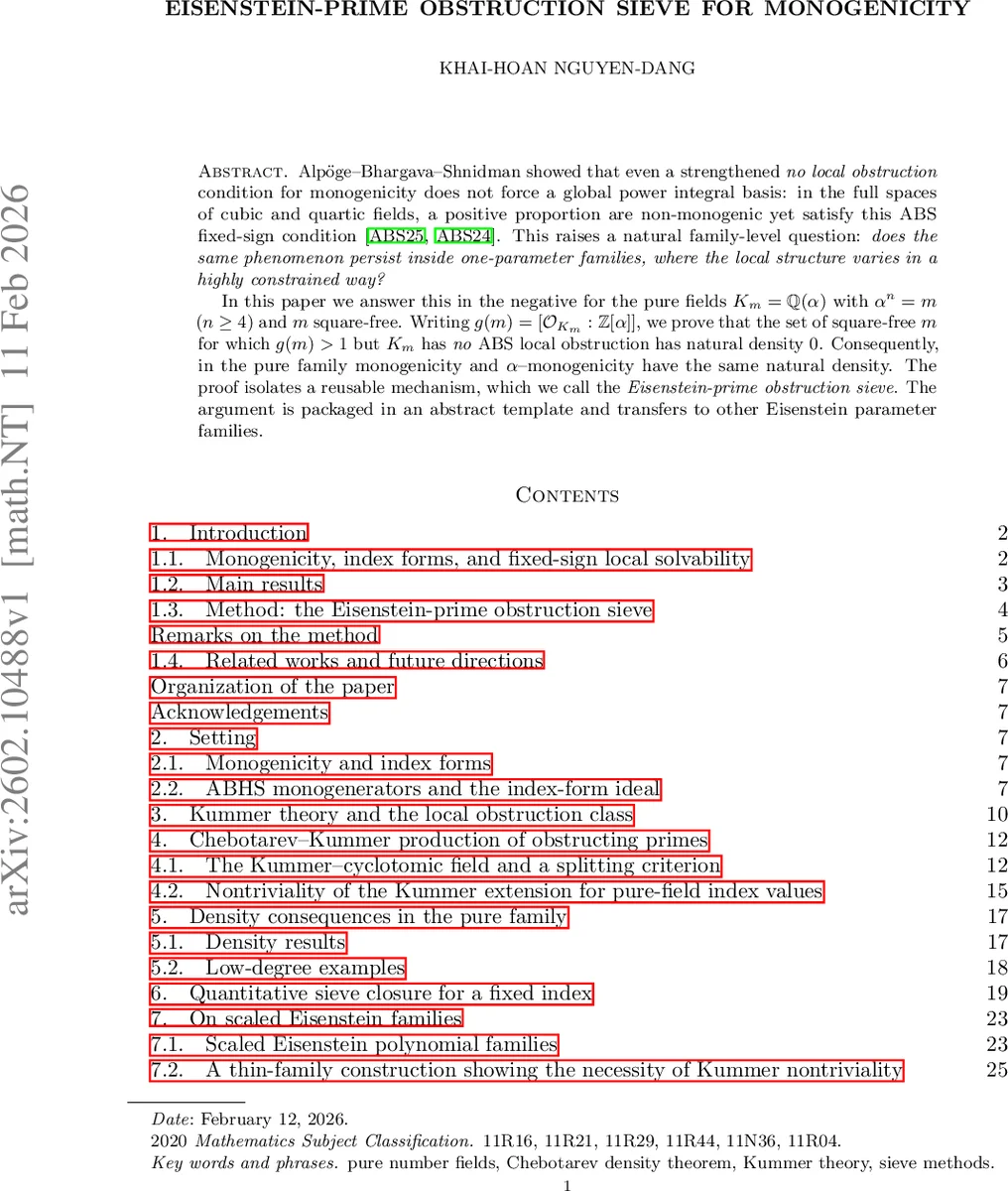
Alpöge–Bhargava–Shnidman showed that even a strengthened \emph{no local obstruction} condition for monogenicity does not force a global power integral basis: in the full spaces of cubic and quartic fields, a positive proportion are non-monogenic yet satisfy this ABS fixed-sign condition. This raises a natural family-level question: does the same phenomenon persist inside one-parameter families, where the local structure varies in a highly constrained way? In this paper we answer this in the negative for the pure fields $K_m=\mathbb Q(α)$ with $α^n=m$ ($n\ge 4$) and $m$ square-free. Writing $g(m)=[\mathcal O_{K_m}:\mathbb Z[α]]$, we prove that the set of square-free $m$ for which $g(m)>1$ but $K_m$ has no ABS local obstruction has natural density $0$. Consequently, in the pure family monogenicity and $α$–monogenicity have the same natural density. The proof isolates a reusable mechanism, which we call the Eisenstein-prime obstruction sieve. The argument is packaged in an abstract template and transfers to other Eisenstein parameter families.
💡 Research Summary
The paper investigates whether the “fixed‑sign local obstruction” condition introduced by Alpöge–Bhargava–Shnidman (ABS) can force a global power integral basis in one‑parameter families where the local structure is highly constrained. The authors focus on pure number fields Kₘ = ℚ(α) with αⁿ = m, n ≥ 4, and m a square‑free integer (so Xⁿ − m is irreducible). Writing g(m) =
Comments & Academic Discussion
Loading comments...
Leave a Comment