Efficient Computation of Maximum Flexi-Clique in Networks
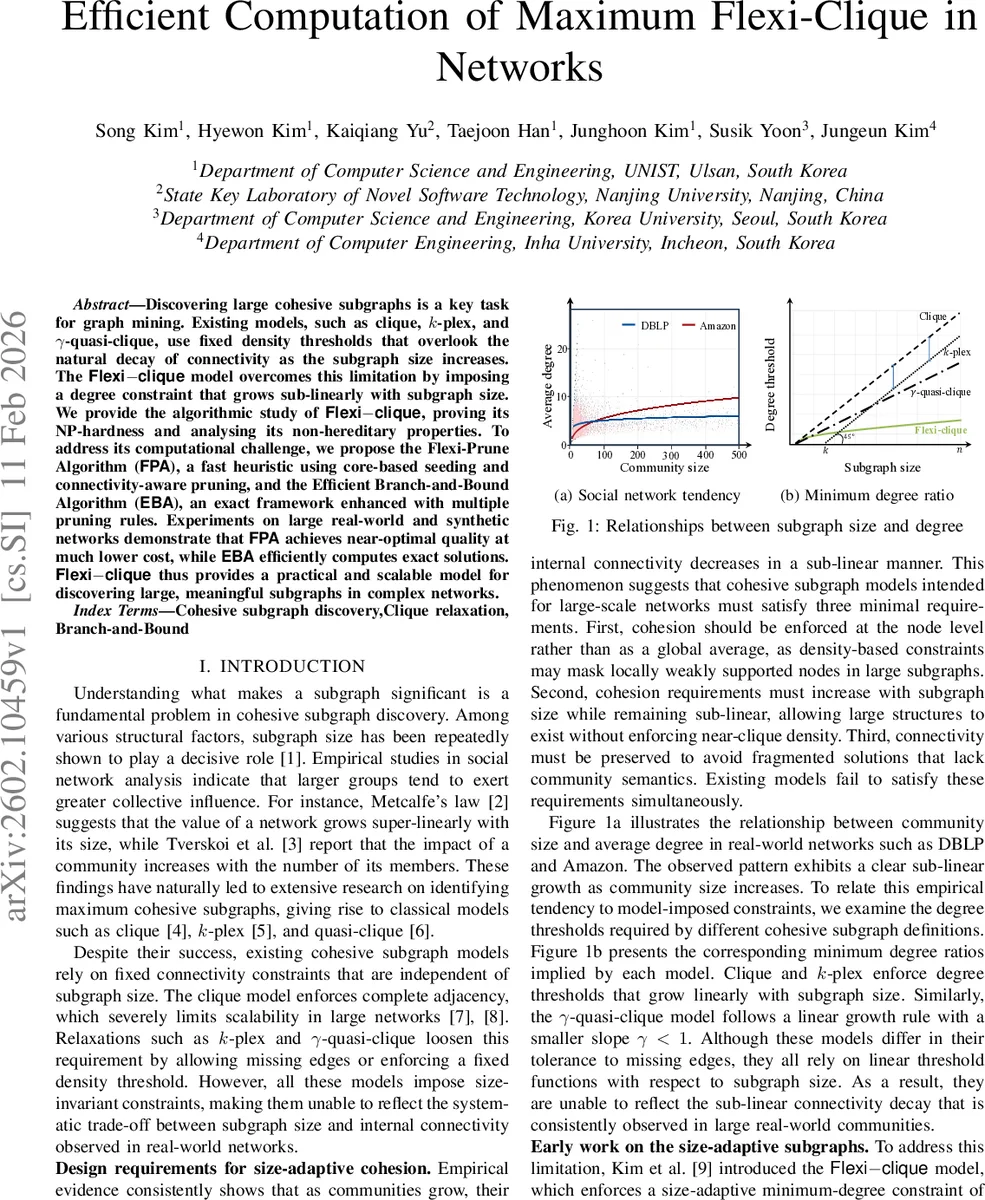
Discovering large cohesive subgraphs is a key task for graph mining. Existing models, such as clique, k-plex, and γ-quasi-clique, use fixed density thresholds that overlook the natural decay of connectivity as the subgraph size increases. The Flexi-clique model overcomes this limitation by imposing a degree constraint that grows sub-linearly with subgraph size. We provide the algorithmic study of Flexi-clique, proving its NP-hardness and analysing its non-hereditary properties. To address its computational challenge, we propose the Flexi-Prune Algorithm FPA, a fast heuristic using core-based seeding and connectivity-aware pruning, and the Efficient Branch-and-Bound Algorithm EBA, an exact framework enhanced with multiple pruning rules. Experiments on large real-world and synthetic networks demonstrate that FPA achieves near-optimal quality at much lower cost, while EBA efficiently computes exact solutions. Flexi-clique thus provides a practical and scalable model for discovering large, meaningful subgraphs in complex networks.
💡 Research Summary
The paper introduces Flexi‑clique, a novel cohesive‑subgraph model that adapts its minimum‑degree requirement to the size of the subgraph. For a given τ∈
Comments & Academic Discussion
Loading comments...
Leave a Comment