Tuning Terahertz Optomechanics of MoS2 Bilayers with Homogeneous In-plane Strain
Homogeneous in-plane biaxial tensile strain strengthens the out-of-plane van der Waals interaction in \MoS\ bilayers (BLs) and can be used to fine-tune their terahertz (THz) oscillations. Using ultralow-frequency Raman spectroscopy on hexagonal (2H) and rhombohedral (2R) stacked BLs, we observe a hardening of the interlayer breathing modes originating from a strain-induced Poisson contraction of the vdW separation between the layers, and characterized by an effective out-of-plane Poisson’s ratio of $ν_\mathrm{eff} \approx 0.19\text{–}0.24$. Strikingly, this geometric contraction drives the system into a highly repulsive regime of the intermolecular potential, corresponding to a Grüneisen parameter of $γ\approx 10\text{–}14$. This value surpasses even the `giant’ one reported for phosphorene, establishing these van der Waals BLs as highly tunable nonlinear mechanical platforms that can be addressed at the THz regime, couple strongly with light, and do not need external pressure knobs.
💡 Research Summary
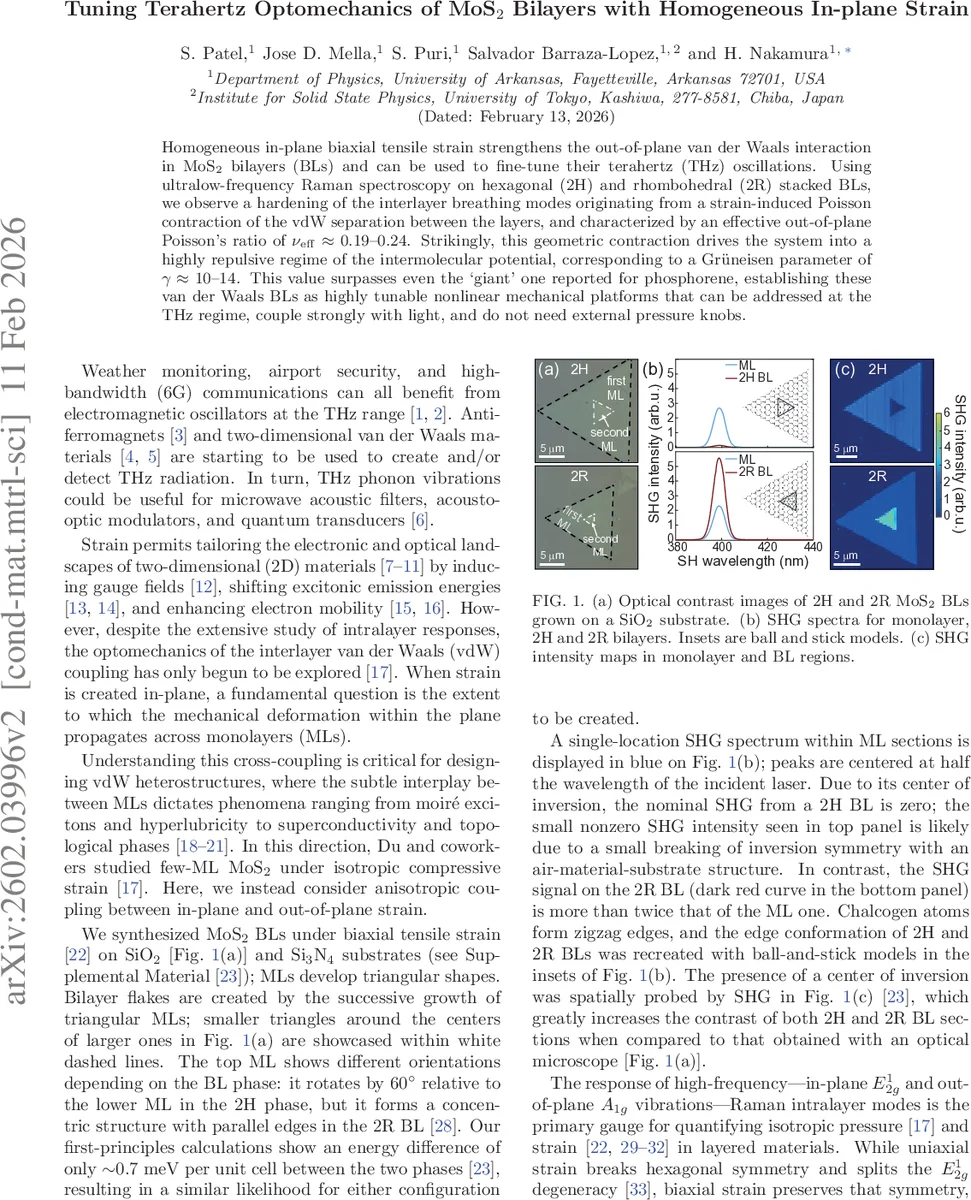
In this work the authors demonstrate that homogeneous in‑plane biaxial tensile strain can be used as a precise, built‑in knob to tune the terahertz (THz) optomechanical response of molybdenum disulfide (MoS₂) bilayers (BLs). By growing triangular monolayers on SiO₂ and Si₃N₄ substrates via chemical vapor deposition, they generate intrinsic tensile strains of +0.36 % (Si₃N₄) and +0.72 % (SiO₂) through thermal‑expansion mismatch. Two stacking orders are investigated: the conventional 2H (60° rotated) and the rhombohedral 2R (parallel edges). Second‑harmonic generation and high‑frequency Raman (E₁₂g, A₁g) confirm the presence and magnitude of the strain, with the in‑plane E₁₂g mode red‑shifting at ≈‑0.10 THz %⁻¹, consistent with previous reports.
The core of the study is ultralow‑frequency Raman spectroscopy that resolves the interlayer shear (E₂₂g ≈ 0.67 THz) and breathing (B₂g ≈ 1.13 THz) modes. While the shear mode shows only a slight blueshift under tension, the breathing mode hardens dramatically: its frequency rises from 1.13 THz (unstrained, transferred sample) to 1.19 THz at +0.72 % strain, corresponding to a tuning rate of +0.07 THz %⁻¹. This counter‑intuitive stiffening under in‑plane tension is attributed to a Poisson‑driven contraction of the interlayer spacing, which steepens the van‑der‑Waals (vdW) confinement potential.
First‑principles density‑functional theory (DFT) calculations, performed with several vdW‑corrected exchange‑correlation functionals, reproduce the monotonic increase of the B₂g frequency and the simultaneous reduction of the interlayer distance d from 6.40 Å to 6.28 Å as strain grows. The effective out‑of‑plane Poisson’s ratio extracted from the geometry, ν_eff = –ε⊥/ε∥, lies between 0.19 and 0.24, markedly lower than typical three‑dimensional semiconductors (ν≈0.27–0.31) and even bulk MoS₂ (ν≈0.30). Using the experimental strain‑tuning rate and the theoretical Poisson contraction ratio (ε⊥/ε∥≈‑0.47 to ‑0.65), the out‑of‑plane Grüneisen parameter is estimated as γ_out ≈ 10–14. This value exceeds the previously reported “giant” γ≈8.6 for phosphorene, highlighting the extreme sensitivity of the vdW potential to vertical compression.
The authors also note a striking reversal of Raman intensities between the two stackings: in 2H the shear mode dominates, whereas in 2R the breathing mode is stronger. This reflects the different symmetry constraints and suggests that stacking order can be used to select which interlayer phonon couples most efficiently to external fields.
Beyond the phononic picture, the work discusses the electronic implications of the strain‑induced stiffening. The breathing‑mode frequency is directly linked to the interlayer hopping parameter t⊥; increasing t⊥ modifies the bandwidth of moiré flat bands, exciton lifetimes, and potentially the emergence of correlated phases in twisted heterostructures. Consequently, the demonstrated strain‑tuning provides a deterministic, pressure‑free method to engineer electronic band structures, optomechanical coupling, and THz phonon–photon interactions.
Potential applications span high‑bandwidth (6G) communications, atmospheric sensing, and quantum transduction, where a mechanically tunable THz oscillator that couples strongly to light is highly desirable. The study establishes MoS₂ bilayers as a versatile, nonlinear mechanical platform whose interlayer spacing can be dynamically controlled via in‑plane strain, opening new avenues for strain‑engineered vdW devices without the need for external pressure apparatus.
Comments & Academic Discussion
Loading comments...
Leave a Comment