Stellar masses of optically dark galaxies: uncertainty introduced by the attenuation law and star-formation histories
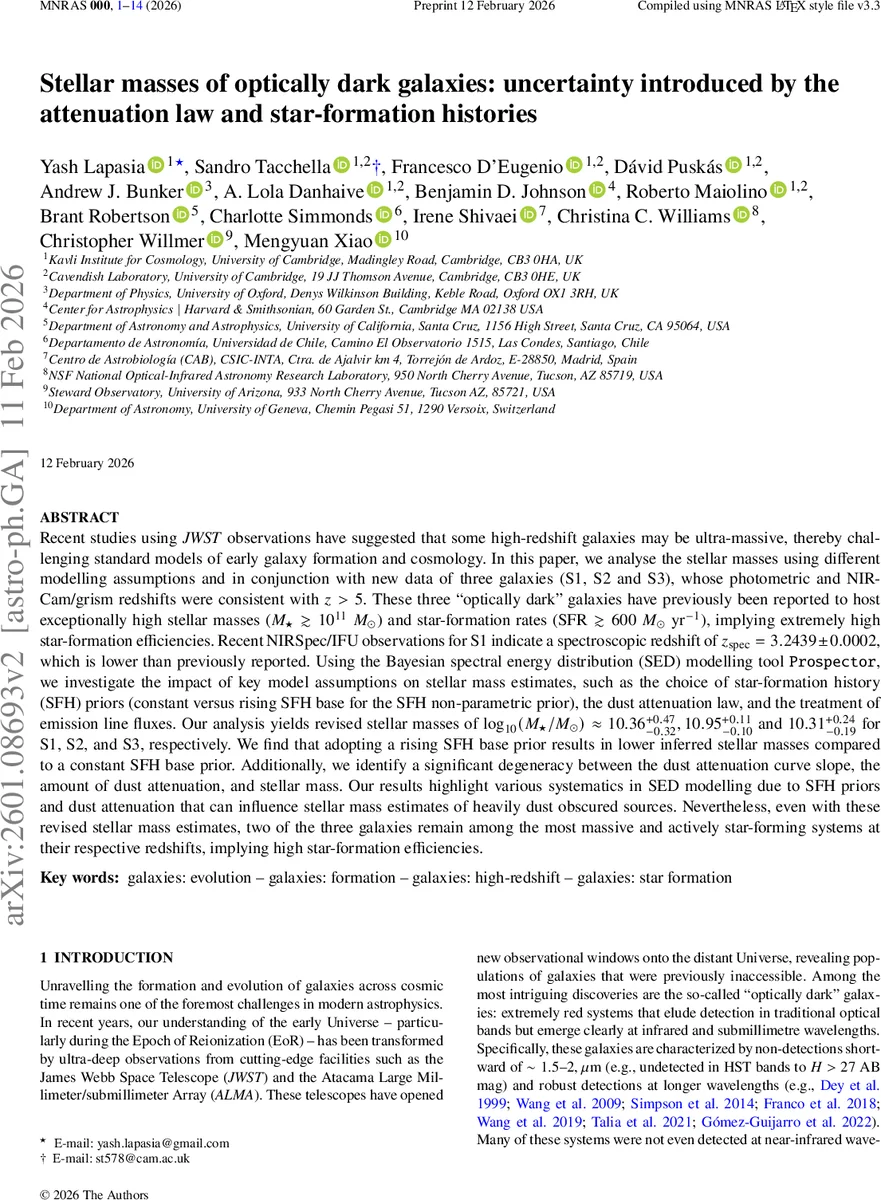
JWST observations have suggested that some high-redshift galaxies may be ultra-massive, thereby challenging standard models of early galaxy formation and cosmology. We analyse the stellar masses using different modelling assumptions and with new data of three galaxies (S1, S2 and S3), whose NIRCam/grism redshifts were consistent with $z>5$. These three optically dark galaxies have previously been reported to host exceptionally high stellar masses and star-formation rates, implying extremely high star-formation efficiencies. Recent NIRSpec/IFU observations for S1 indicate a spectroscopic redshift of $z_{\rm spec}=3.2439\pm0.0002$, which is lower than previously reported. Using the Bayesian spectral energy distribution (SED) modelling tool \texttt{Prospector}, we investigate the impact of key model assumptions on stellar mass estimates, such as the choice of star-formation history (SFH) priors (constant versus rising SFH base for the non-parametric prior), the dust attenuation law, and the treatment of emission line fluxes. Our analysis yields revised stellar masses of $\log(M_{\star}/M_{\odot}) \approx 10.36^{+0.47}{-0.32}, 10.95^{+0.11}{-0.10}$ and $10.31^{+0.24}_{-0.19}$ for S1, S2, and S3, respectively. We find that adopting a rising SFH base prior results in lower inferred stellar masses compared to a constant SFH base prior. We identify a significant degeneracy between the dust attenuation curve slope, the amount of dust attenuation, and stellar mass. Our results highlight various systematics in SED modelling due to SFH priors and dust attenuation that can influence stellar mass estimates of heavily dust obscured sources. Nevertheless, even with these revised stellar mass estimates, two of the three galaxies remain among the most massive and actively star-forming systems at their respective redshifts, implying high star-formation efficiencies.
💡 Research Summary
This paper revisits the stellar‑mass estimates of three “optically dark” galaxies (S1, S2, and S3) originally identified in the JWST/FRESCO survey and reported by Xiao et al. (2024) as ultra‑massive systems at redshifts z≈5–6 with log M★/M⊙ ≳ 11. New spectroscopic data from JWST/NIRSpec IFU reveal that S1 actually lies at a much lower redshift, z = 3.2439 ± 0.0002, prompting a comprehensive re‑analysis of all available photometry and spectroscopy.
The authors employ the Bayesian SED‑fitting framework Prospector, which allows flexible treatment of star‑formation histories (SFHs), dust attenuation laws, and nebular emission. They explore two non‑parametric SFH priors: a constant‑SFR base and a rising‑SFR base. For dust attenuation they test the classic Calzetti law, an SMC‑like curve, and a flexible parameterisation that lets the slope and total V‑band attenuation (A_V) vary freely. Nebular emission is modeled explicitly, and measured Hα line fluxes from the NIRSpec/FRESCO grism (for S2 and S3) and from the IFU (for S1) are incorporated directly, eliminating the need for ad‑hoc line‑subtraction from broadband fluxes.
Key findings:
-
SFH Prior Impact – A rising‑SFR base systematically yields lower stellar masses than a constant‑SFR base because recent star formation boosts the luminosity, reducing the mass‑to‑light ratio. For S1 the difference reaches ~0.3 dex, while for S2 and S3 the effect is ~0.1–0.2 dex.
-
Dust‑Attenuation Degeneracy – The slope of the attenuation curve (δ) and the overall attenuation (A_V) are strongly degenerate. A flatter curve (SMC‑like) requires higher A_V to reproduce the observed red colours, which in turn inflates the inferred dust‑reprocessed infrared luminosity and pushes stellar masses upward. Conversely, a steeper Calzetti‑type curve can fit the same colours with lower A_V, leading to smaller masses. The authors find that allowing δ to vary freely produces posterior distributions where the most probable solutions have moderate A_V (~2–3 mag) and a slightly greyer curve (δ≈‑0.3).
-
Emission‑Line Treatment – Including nebular lines directly in the model prevents artificial boosting of the Balmer/4000 Å break by strong Hα+
Comments & Academic Discussion
Loading comments...
Leave a Comment