Figuring Out Gas & Galaxies In Enzo (FOGGIE) XI: Circumgalactic O VI Emission Traces Clumpy Inflowing Recycled Gas
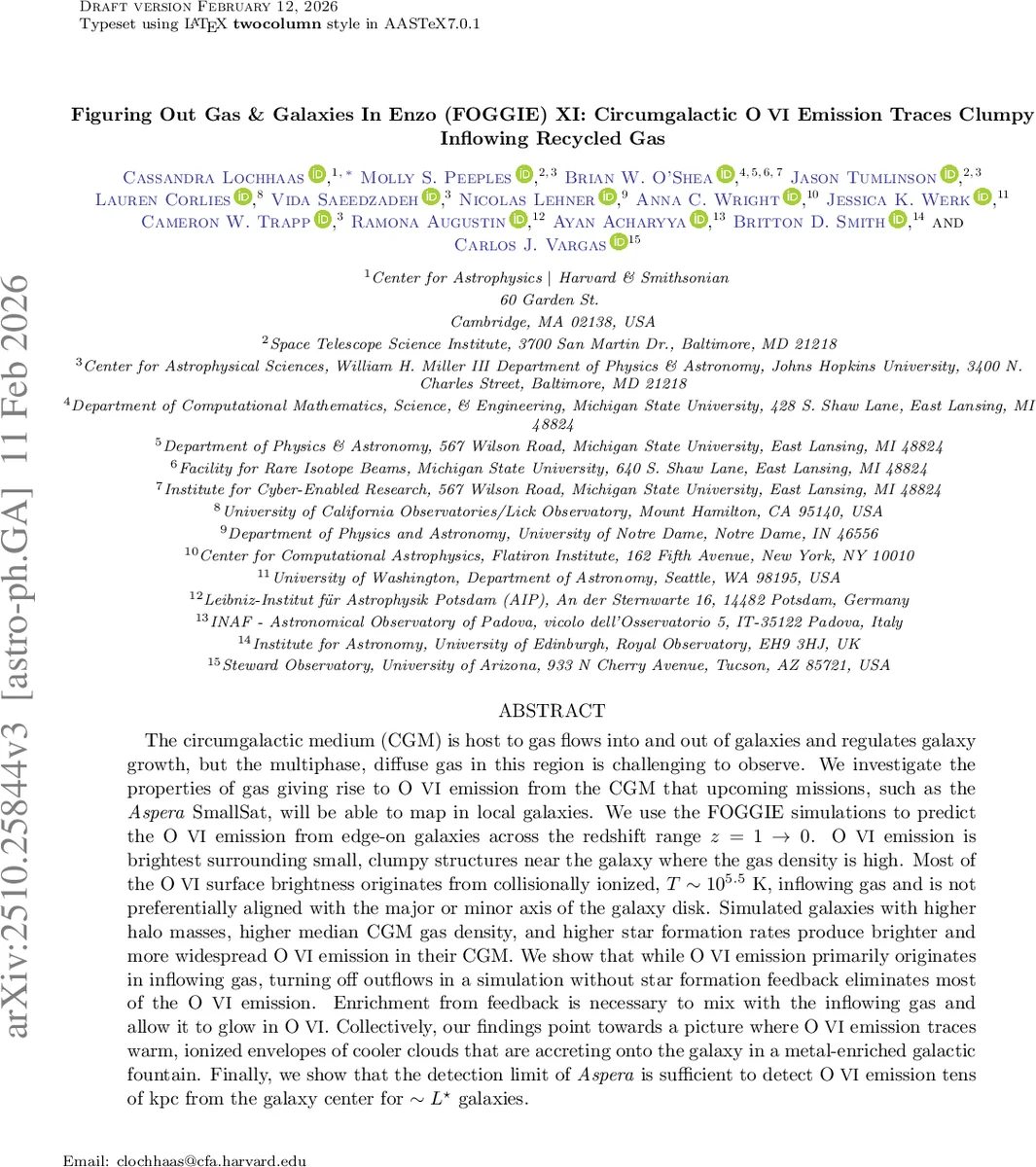
The circumgalactic medium (CGM) is host to gas flows into and out of galaxies and regulates galaxy growth, but the multiphase, diffuse gas in this region is challenging to observe. We investigate the properties of gas giving rise to O VI emission from the CGM that upcoming missions, such as the Aspera SmallSat, will be able to map in local galaxies. We use the FOGGIE simulations to predict the O VI emission from edge-on galaxies across the redshift range $z=1\rightarrow0$. O VI emission is brightest surrounding small, clumpy structures near the galaxy where the gas density is high. Most of the O VI surface brightness originates from collisionally ionized, $T\sim10^{5.5}$ K, inflowing gas and is not preferentially aligned with the major or minor axis of the galaxy disk. Simulated galaxies with higher halo masses, higher median CGM gas density, and higher star formation rates produce brighter and more widespread O VI emission in their CGM. We show that while O VI emission primarily originates in inflowing gas, turning off outflows in a simulation without star formation feedback eliminates most of the O VI emission. Enrichment from feedback is necessary to mix with the inflowing gas and allow it to glow in O VI. Collectively, our findings point towards a picture where O VI emission traces warm, ionized envelopes of cooler clouds that are accreting onto the galaxy in a metal-enriched galactic fountain. Finally, we show that the detection limit of Aspera is sufficient to detect O VI emission tens of kpc from the galaxy center for $\sim L^\star$ galaxies.
💡 Research Summary
This paper uses the high‑resolution “Figuring Out Gas & Galaxies In Enzo” (FOGGIE) cosmological zoom‑in simulations to predict and interpret O VI λλ1031,1037 Å emission from the circumgalactic medium (CGM) of nearby, roughly L* galaxies over the redshift range z = 1→0. The authors first describe the simulation setup: Enzo is run with a forced‑refinement cube (288 ckpc on a side) that limits cell sizes to 1.1 ckpc, while an additional cooling‑refinement criterion refines cells down to 274 pc where the cooling length is short. Six halos with masses ∼10¹¹–10¹² M⊙ are examined; star formation follows the Cen & Ostriker (1992) prescription, and thermal feedback injects 10⁵¹ erg per 100 M⊙ of stars plus 2.5 % of the stellar mass as metals. No active‑galactic‑nucleus (AGN) feedback is included, which may affect the baryon budget in the most massive halos.
To compute O VI emissivity, the authors generate CLOUDY tables that give the line emissivity as a function of temperature and density for solar metallicity, assuming ionization equilibrium that includes both collisional and photo‑ionization processes. Each simulation cell is assigned an O VI emissivity from these tables, and surface‑brightness (SB) maps are produced by projecting along the line of sight for edge‑on orientations.
The main physical findings are: (1) O VI SB is strongly peaked around small, dense clumps (∼1–5 kpc in size) located within ∼10–30 kpc of the galactic disk. (2) The bulk of the emission originates from gas at T ≈ 10⁵·⁵ K and n_H ≈ 10⁻³–10⁻² cm⁻³, i.e., collisionally ionized O VI. (3) Kinematic analysis shows that >80 % of the O VI‑bright gas has negative radial velocity, indicating inflow rather than outflow. This inflowing gas is metal‑enriched by prior stellar feedback, forming warm ionized envelopes around cooler clouds—a classic “galactic fountain” or recycled‑gas scenario. (4) Purely hot outflows (T ≈ 10⁷ K) contribute negligibly to O VI emission because they are too tenuous and metal‑poor in the simulation.
The authors also explore how galaxy properties affect O VI emission. Higher halo mass, higher median CGM density, and higher star‑formation rate (SFR) all correlate with brighter, more extended O VI SB. For typical L* galaxies with SFR ≈ 2–5 M⊙ yr⁻¹, the predicted SB exceeds the detection threshold of the upcoming Aspera SmallSat (≈10⁻¹⁸ erg s⁻¹ cm⁻² arcsec⁻²) out to tens of kiloparsecs, implying that Aspera should be able to map O VI emission well beyond the optical disk. The authors note that this threshold is a lower limit; unresolved sub‑clumps below the simulation’s resolution or below the instrument’s sensitivity would remain undetected.
The paper discusses several caveats. The thermal‑only feedback model produces very fast, hot, and diffuse outflows that do not generate O VI, potentially under‑estimating the outflow contribution seen in reality. The lack of AGN feedback may lead to higher CGM baryon fractions and different temperature distributions compared with simulations that include AGN. Finally, the CLOUDY emissivity tables assume ionization equilibrium, which may not capture non‑equilibrium cooling flows or shock‑heated gas that could also emit O VI.
In summary, the study demonstrates that O VI emission is a powerful tracer of warm, metal‑enriched inflowing gas in the CGM, highlighting the clumpy, recycled nature of the baryon cycle. The predictions suggest that forthcoming UV emission missions like Aspera will be able to produce spatially resolved O VI maps, providing direct constraints on the physical state, kinematics, and metal content of the gas that fuels galaxy growth. This work thus bridges the gap between absorption‑line studies and emission‑line imaging, offering a new avenue to test galaxy formation models.
Comments & Academic Discussion
Loading comments...
Leave a Comment