A Rigorous Quantum Framework for Inequality-Constrained and Multi-Objective Binary Optimization
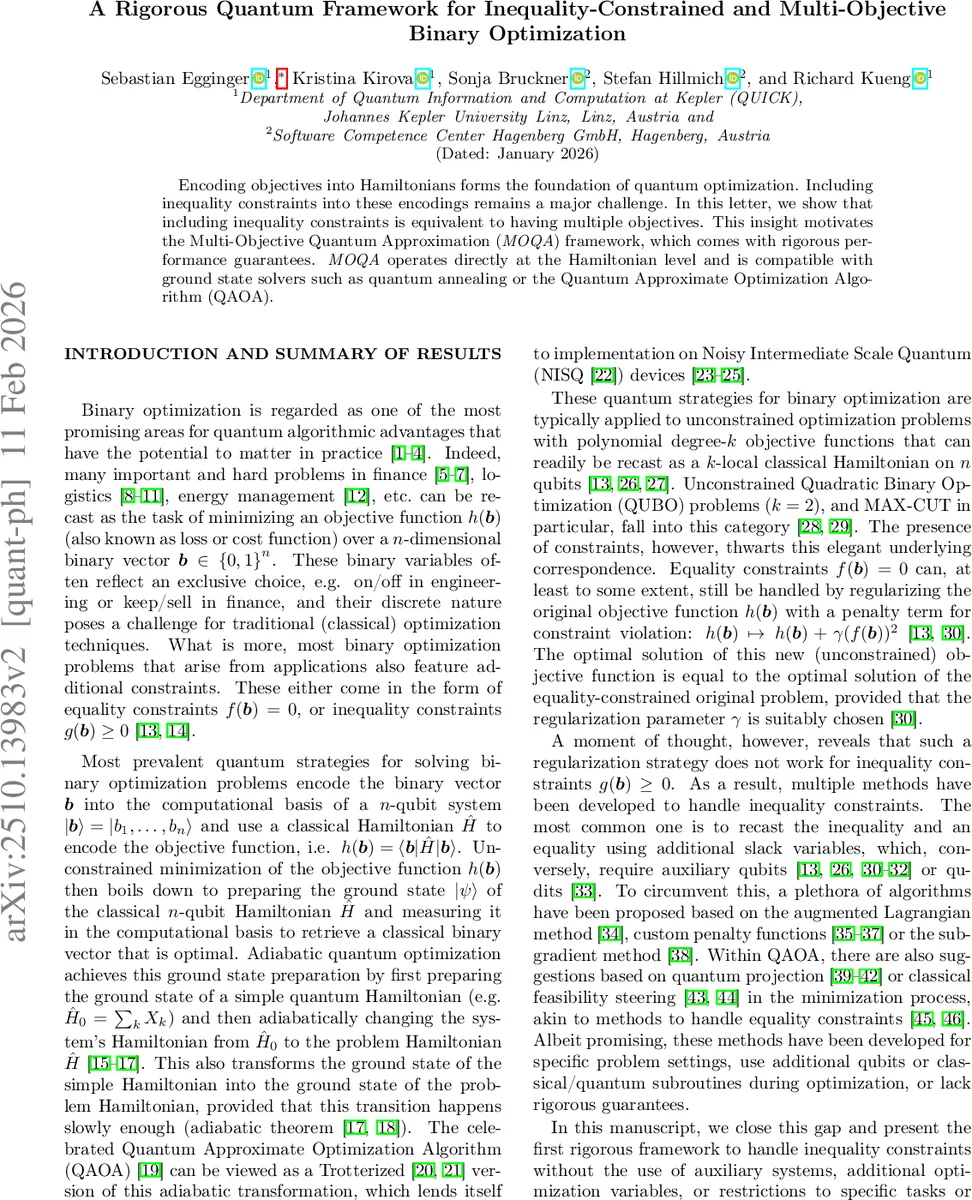
Encoding combinatorial optimization problems into physically meaningful Hamiltonians with tractable energy landscapes forms the foundation of quantum optimization. Numerous works have studied such efficient encodings for the class of Quadratic Unconstrained Binary Optimization (QUBO) problems. However, many real-world tasks are constrained, and handling equality and, in particular, inequality constraints on quantum computers remains a major challenge. In this letter, we show that including inequality constraints is equivalent to solving a multi-objective optimization. This insight motivates the Multi-Objective Quantum Approximation (MOQA) framework, which approximates the maximum via smaller $p$-norms and comes with rigorous performance guarantees. MOQA operates directly at the Hamiltonian level and is compatible with, but not restricted to, ground-state solvers such as quantum adiabatic annealing, the Quantum Approximate Optimization Algorithm (QAOA), or imaginary-time evolution. Moreover, it is not limited to quadratic functions.
💡 Research Summary
The paper addresses a fundamental obstacle in quantum optimization: handling inequality constraints without auxiliary qubits or problem‑specific tricks. The authors first observe that an inequality constraint g(b) ≥ 0 can be incorporated into the objective via a ReLU penalty γ max{0, −g(b)}. This transforms the constrained problem into the maximization of two functions, h₁(b)=h(b) and h₂(b)=h(b)−γg(b), i.e., a multi‑objective optimization of the form max{h₁(b),h₂(b)}. By generalising to M objectives, the problem becomes minimize over binary strings the quantity h_max(b)=maxₘ hₘ(b).
Each objective hₘ(b) is assumed to be representable as a k‑local Ising‑type Hamiltonian Ĥₘ acting on n qubits. The central technical contribution is the Multi‑Objective Quantum Approximation (MOQA) framework, which approximates the “max” operator using ℓₚ‑norms. Specifically, the authors define an approximating Hamiltonian Ĥ(p)=∑ₘ Ĥₘ^p and recover an estimate of the original max via the p‑th root: Ĥ(p)^{1/p}. Proposition 1 proves that for any binary vector b, the inequality
M^{−1/p} Ĥ(p)^{1/p} ≤ Ĥ_max ≤ Ĥ(p)^{1/p}
holds, where Ĥ_max is the exact diagonal Hamiltonian satisfying ⟨b|Ĥ_max|b⟩=maxₘ⟨b|Ĥₘ|b⟩. This bound is independent of the problem size n and becomes tight when p≈log M.
Theorem 1 connects the approximation quality to the spectral gap ratio r(Ĥ_max) = (λ₂−λ₁)/λ₁, where λ₁ and λ₂ are the smallest and second‑smallest eigenvalues of Ĥ_max. The theorem states that if p > log M / log(r(Ĥ_max)+1), then the ground‑state subspace of Ĥ(p) coincides exactly with that of Ĥ_max. Consequently, provided the original multi‑objective problem has a non‑vanishing gap ratio (a standard assumption for efficient adiabatic evolution), a low‑degree polynomial approximation (p=polylog n) suffices to preserve the optimal solution while keeping the Hamiltonian’s locality at kp and the number of terms at most T·p (T≤n^k). For QUBO (k=2) this yields a 2p‑local Hamiltonian with at most n^{2p} terms, a manageable overhead for modest p.
The authors discuss implementation aspects, noting that the increase in locality may be advantageous on platforms that naturally support multi‑qubit interactions, such as neutral‑atom arrays or trapped‑ion chains. They also emphasize that MOQA operates at the Hamiltonian level and is compatible with any ground‑state preparation method, including quantum annealing, QAOA (viewed as a Trotterized adiabatic path), and imaginary‑time evolution.
Empirical validation is performed on randomly generated QUBO instances with a single linear inequality constraint. For n=6 variables the full cost landscape (64 configurations) is plotted alongside MOQA approximations for p = 5, 10, 20, illustrating progressively tighter fits. A larger benchmark with n=16 and 10 000 random instances examines the absolute error ε as a function of the spectral gap ratio. The results confirm that once p exceeds the theoretical threshold derived from Theorem 1, the error collapses to zero, corroborating the analytical guarantees.
In summary, the paper delivers a rigorous, general‑purpose framework for embedding inequality‑constrained binary optimization into quantum Hamiltonians without extra qubits. By recasting constraints as a multi‑objective max and approximating this max via ℓₚ‑norm sums, MOQA provides provable guarantees on ground‑state preservation, controllable locality growth, and polynomial scaling of Hamiltonian terms. This advances the state of the art in quantum combinatorial optimization and opens a clear pathway for implementing constrained problems on near‑term and future quantum hardware.
Comments & Academic Discussion
Loading comments...
Leave a Comment