Clifford quantum cellular automata from topological quantum field theories and invertible subalgebras
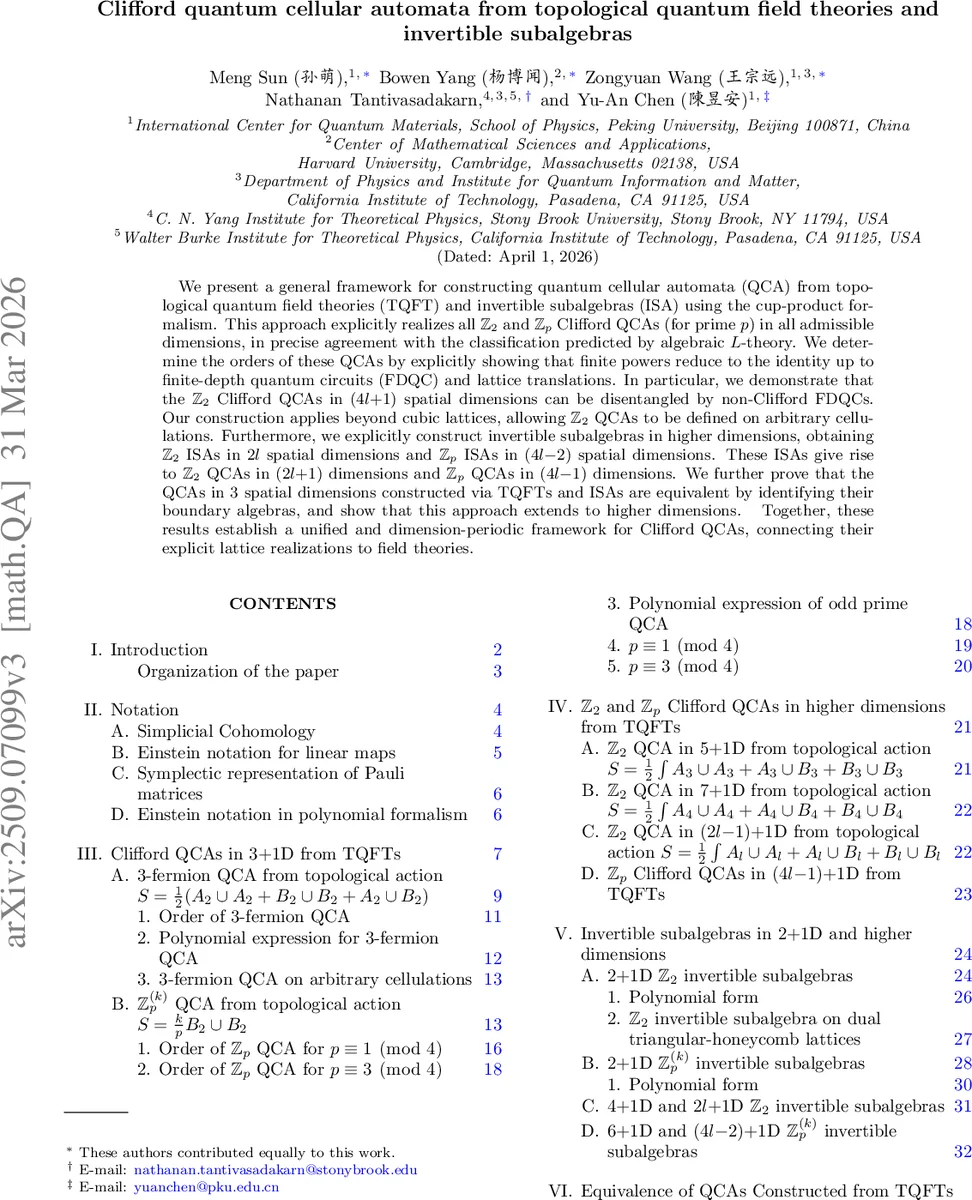
We present a general framework for constructing quantum cellular automata (QCA) from topological quantum field theories (TQFT) and invertible subalgebras (ISA) using the cup-product formalism. This approach explicitly realizes all $\mathbb{Z}_2$ and $\mathbb{Z}_p$ Clifford QCAs (for prime $p$) in all admissible dimensions, in precise agreement with the classification predicted by algebraic $L$-theory. We determine the orders of these QCAs by explicitly showing that finite powers reduce to the identity up to finite-depth quantum circuits (FDQC) and lattice translations. In particular, we demonstrate that the $\mathbb{Z}_2$ Clifford QCAs in $(4l{+}1)$ spatial dimensions can be disentangled by non-Clifford FDQCs. Our construction applies beyond cubic lattices, allowing $\mathbb{Z}_2$ QCAs to be defined on arbitrary cellulations. Furthermore, we explicitly construct invertible subalgebras in higher dimensions, obtaining $\mathbb{Z}_2$ ISAs in $2l$ spatial dimensions and $\mathbb{Z}_p$ ISAs in $(4l{-}2)$ spatial dimensions. These ISAs give rise to $\mathbb{Z}_2$ QCAs in $(2l{+}1)$ dimensions and $\mathbb{Z}_p$ QCAs in $(4l{-}1)$ dimensions. We further prove that the QCAs in $3$ spatial dimensions constructed via TQFTs and ISAs are equivalent by identifying their boundary algebras, and show that this approach extends to higher dimensions. Together, these results establish a unified and dimension-periodic framework for Clifford QCAs, connecting their explicit lattice realizations to field theories.
💡 Research Summary
This paper develops a unified, dimension‑periodic construction of Clifford quantum cellular automata (QCAs) by exploiting two complementary frameworks: topological quantum field theory (TQFT) discretized via higher cup‑product formalism, and invertible subalgebras (ISAs) generalized to arbitrary cellulations. Starting from the cup‑product representation of cohomology, the authors translate TQFT actions such as (S=\frac12(A\cup A+A\cup B+B\cup B)) in even spacetime dimensions into Pauli stabilizer Hamiltonians. By expressing these actions in Laurent‑polynomial (Laurent) language, they obtain explicit unitary maps that send Pauli operators to Pauli operators, thereby realizing all (\mathbb Z_2) and (\mathbb Z_p) (prime (p)) Clifford QCAs in every admissible dimension. The classification matches the predictions of algebraic (L)-theory: (\mathbb Z_2) QCAs appear in dimensions (D=4\ell) (non‑trivial) and (D=4\ell+2) (trivializable by non‑Clifford finite‑depth quantum circuits, FDQCs), while (\mathbb Z_p) QCAs exist only for (D=4\ell) with order 2 when (p\equiv1\pmod4) and order 4 when (p\equiv3\pmod4). The authors prove that finite powers of each QCA reduce to the identity up to FDQC and lattice translations, thereby determining the exact order in the quotient group of QCAs modulo circuits and shifts.
In parallel, the ISA construction starts from known 2+1‑dimensional invertible subalgebras and lifts them to higher dimensions using the same cup‑product machinery. This yields (\mathbb Z_2) ISAs in (2\ell) spatial dimensions and (\mathbb Z_p) ISAs in ((4\ell-2)) dimensions, which in turn generate (\mathbb Z_2) QCAs in ((2\ell+1)) and (\mathbb Z_p) QCAs in ((4\ell-1)) dimensions. By comparing the boundary algebras, the paper demonstrates the equivalence of the TQFT‑derived and ISA‑derived QCAs in three spatial dimensions and outlines the generalization to higher dimensions.
The work also addresses practical concerns: the constructions are independent of the underlying lattice geometry, applying equally to arbitrary triangulations or cellulations, and they provide explicit polynomial and matrix representations for low‑dimensional examples (e.g., the 3‑fermion QCA in 3+1 D and its 5+1 D analogue). The authors connect these explicit models to symplectic matrices, bounded algebraic K‑theory, and the Gross‑Nesme‑Vogts‑Werner index, establishing rigorous criteria for when two Clifford QCAs are considered equivalent. Overall, the paper offers a comprehensive toolkit for generating, classifying, and analyzing Clifford QCAs across dimensions, with implications for Floquet engineering, fault‑tolerant logical gates, and the broader mathematical understanding of locality‑preserving unitaries.
Comments & Academic Discussion
Loading comments...
Leave a Comment