Energy Injection Identification enabled Disaggregation with Deep Multi-Task Learning
Non-Intrusive Load Monitoring (NILM) offers a cost-effective method to obtain fine-grained appliance-level energy consumption in smart homes and building applications. However, the increasing adoption of behind-the-meter (BTM) energy sources such as solar panels and battery storage poses new challenges for conventional NILM methods that rely solely on at-the-meter data. The energy injected from the BTM sources can obscure the power signatures of individual appliances, leading to a significant decrease in NILM performance. To address this challenge, we present DualNILM, a deep multi-task learning framework designed for the dual tasks of appliance state recognition and injected energy identification. Using a Transformer-based architecture that integrates sequence-to-point and sequence-to-sequence strategies, DualNILM effectively captures multiscale temporal dependencies in the aggregate power consumption patterns, allowing for accurate appliance state recognition and energy injection identification. Extensive evaluation on self-collected and synthesized datasets demonstrates that DualNILM maintains an excellent performance for dual tasks in NILM, much outperforming conventional methods. Our work underscores the framework’s potential for robust energy disaggregation in modern energy systems with renewable penetration. Synthetic photovoltaic augmented datasets with realistic injection simulation methodology are open-sourced at https://github.com/MathAdventurer/PV-Augmented-NILM-Datasets.
💡 Research Summary
The paper addresses a critical gap in Non‑Intrusive Load Monitoring (NILM) that emerges as behind‑the‑meter (BTM) renewable generation—primarily solar photovoltaics (PV) and battery storage—becomes commonplace in residential and commercial buildings. Traditional NILM assumes that the aggregate power measured at the utility meter is a non‑negative sum of consumptive loads, an assumption that breaks down when BTM sources inject power back into the grid. This injection creates “signal eclipse” (appliance signatures are masked by generation fluctuations), “temporal aliasing” (generation variability mimics appliance switching), and fundamentally transforms the inverse problem from a constrained non‑negative optimization to an under‑determined real‑valued problem.
To tackle these challenges, the authors propose DualNILM, a deep multi‑task learning framework that simultaneously performs (1) appliance state recognition (ON/OFF detection) and (2) energy injection identification (continuous estimation of injected power). The architecture is built on a Transformer encoder‑decoder backbone. Input features are multi‑channel time‑series comprising active power, reactive power, current harmonics, voltage magnitude, and optionally weather‑derived proxies. Multi‑head self‑attention dynamically weights these channels, allowing the model to emphasize short‑term, high‑frequency appliance events while capturing long‑term, smoother PV generation trends.
DualNILM splits the decoder into two heads: a sequence‑to‑point (Seq2Point) head that outputs binary probabilities for each target appliance, trained with binary cross‑entropy loss; and a sequence‑to‑sequence (Seq2Seq) head that regresses the injected power waveform, trained with mean‑squared error. The total loss is a weighted sum L = α·L_state + β·L_injection, where α and β are tuned to balance the typically sparse injection intervals against the more frequent appliance events.
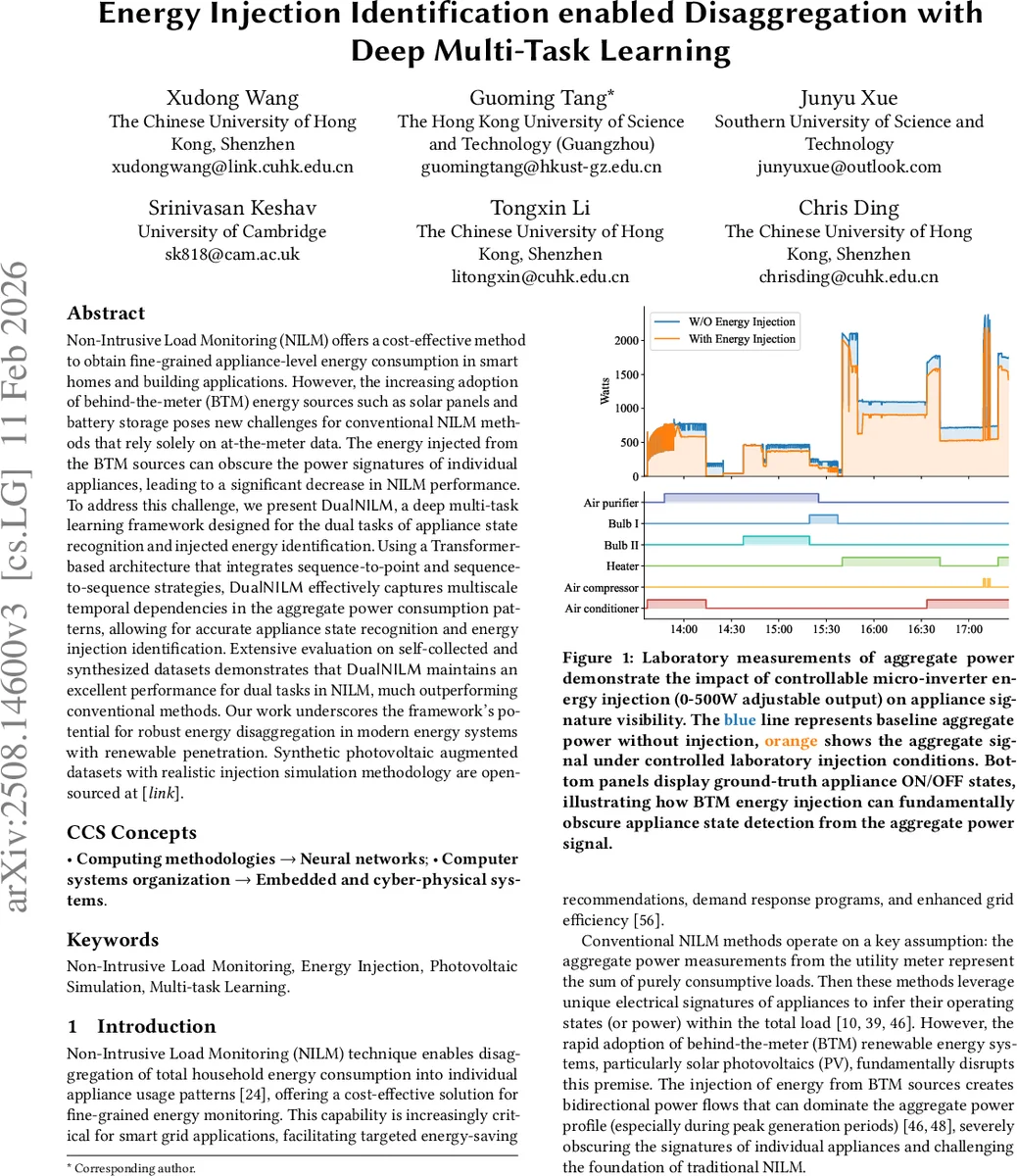
A major contribution is the creation of synthetic PV‑augmented NILM datasets. The authors take established public datasets (REDD, UK‑DALE) and overlay realistic PV generation profiles derived from actual meteorological data (irradiance, temperature, cloud cover). The simulation respects inverter characteristics (near‑unity power factor, active‑power‑dominant injection) and produces net‑metered signals that include both consumption and generation, even allowing net negative power flow. Laboratory measurements with a controllable micro‑inverter (0‑500 W) are also collected to validate the synthetic approach. All data and code are released publicly.
Experimental results demonstrate that DualNILM outperforms state‑of‑the‑art NILM models (CNN‑RNN, Seq2Point, BERT‑based) across multiple metrics. For appliance state detection, DualNILM achieves an average F1‑score improvement of roughly 12 percentage points, maintaining robustness during peak PV generation when traditional models suffer severe degradation. For injection estimation, the model attains a mean absolute error (MAE) of 0.12 kW on the 500 W micro‑inverter test, compared to >0.35 kW for baseline methods. Importantly, the model does not enforce a non‑negative constraint, enabling accurate disaggregation even when net power becomes negative.
Attention visualizations reveal that during high‑generation periods the model places greater weight on active‑power channels, whereas during rapid appliance switching it leverages current‑harmonic and voltage features. This adaptive feature selection illustrates the benefit of multi‑task learning: the injection head provides a long‑term context that stabilizes the appliance head, and vice‑versa.
The authors acknowledge limitations: (i) the current feature set omits high‑frequency (>10 kHz) harmonics that could aid detection of ultra‑low‑power devices; (ii) reliance on synthetic PV data may introduce domain shift when deploying in real‑world settings; (iii) the model is evaluated primarily on 1‑10 Hz sampling rates, leaving high‑resolution data unexplored. Future work is suggested in three directions: (a) collecting real‑world BTM‑PV measurements at higher sampling rates; (b) integrating graph neural networks to capture inter‑appliance dependencies; and (c) exploring privacy‑preserving federated learning to train across multiple households without sharing raw data.
In summary, DualNILM provides a principled, transformer‑based multi‑task solution that restores NILM viability in modern energy systems with significant behind‑the‑meter renewable penetration. By openly releasing the PV‑augmented datasets and code, the paper establishes a new benchmark for BTM‑aware NILM research and paves the way for more resilient, privacy‑respecting load monitoring in the era of distributed generation.
Comments & Academic Discussion
Loading comments...
Leave a Comment