When Domains Collide: An Activity Theory Exploration of Cross-Disciplinary Collaboration
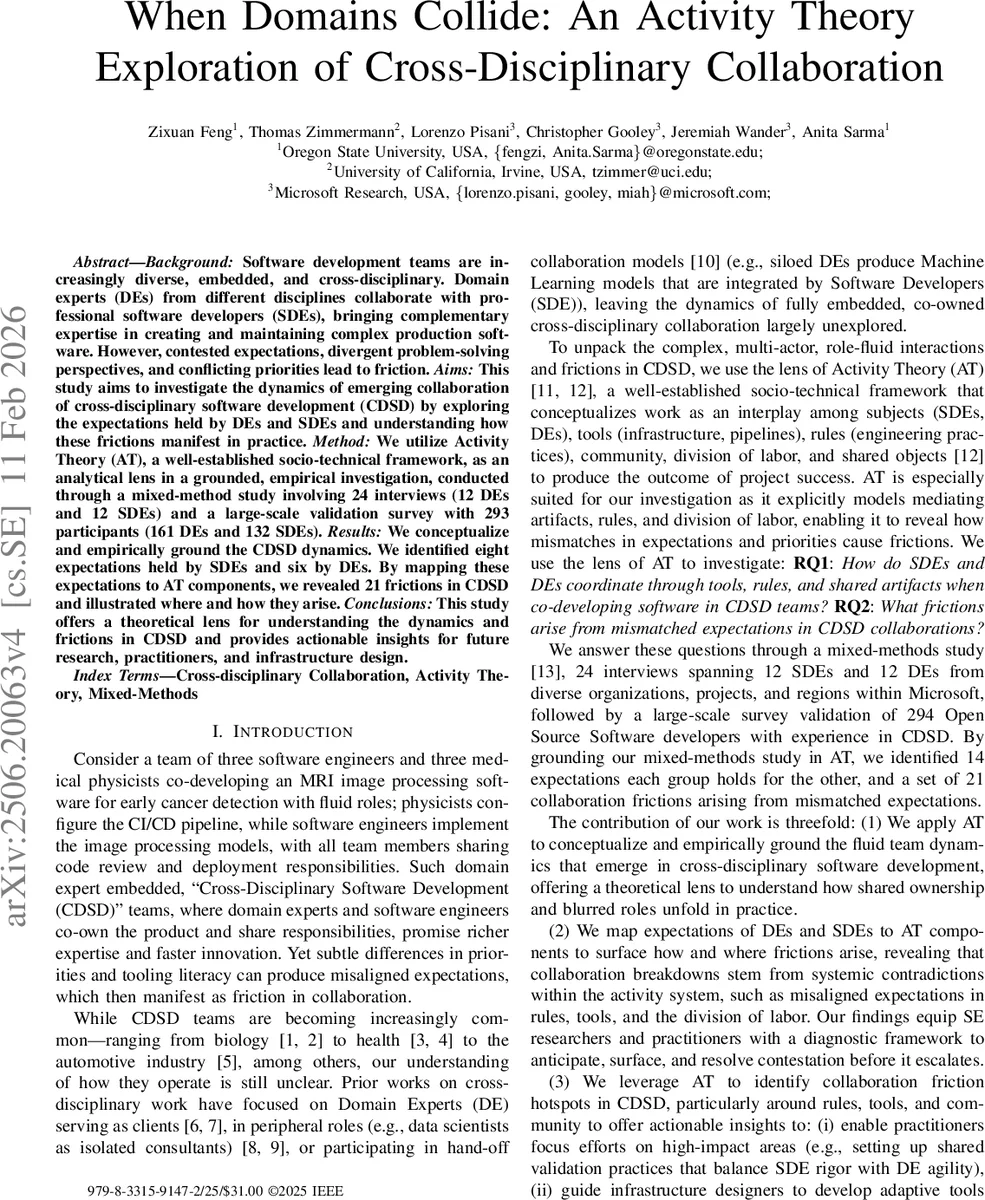
Background: Software development teams are increasingly diverse, embedded, and cross-disciplinary. Domain experts (DEs) from different disciplines collaborate with professional software developers (SDEs), bringing complementary expertise in creating and maintaining complex production software. However, contested expectations, divergent problem-solving perspectives, and conflicting priorities lead to friction. Aims: This study aims to investigate the dynamics of emerging collaboration of cross-disciplinary software development (CDSD) by exploring the expectations held by DEs and SDEs and understanding how these frictions manifest in practice. Method: We utilize Activity Theory (AT), a well-established socio-technical framework, as an analytical lens in a grounded, empirical investigation, conducted through a mixed-method study involving 24 interviews (12 DEs and 12 SDEs) and a large-scale validation survey with 293 participants (161 DEs and 132 SDEs). Results: We conceptualize and empirically ground the CDSD dynamics. We identified eight expectations held by SDEs and six by DEs. By mapping these expectations to AT components, we revealed 21 frictions in CDSD and illustrated where and how they arise. Conclusions: This study offers a theoretical lens for understanding the dynamics and frictions in CDSD and provides actionable insights for future research, practitioners, and infrastructure design.
💡 Research Summary
This paper investigates the dynamics of Cross‑Disciplinary Software Development (CDSD), where professional software developers (SDEs) and domain experts (DEs) work together as co‑owners of a product throughout the entire development lifecycle. While prior work has treated DEs as clients, peripheral consultants, or hand‑off contributors, the authors focus on the emerging “Embedded Collaboration” model in which DEs and SDEs share responsibilities, tools, and goals. To understand how expectations differ and how friction emerges, the study adopts Activity Theory (AT) as an analytical lens. AT’s six components—Subject, Tools, Rules, Community, Division of Labor, and Object—provide a structured way to map expectations and identify contradictions within the activity system.
The research follows a mixed‑methods design. First, 24 semi‑structured interviews (12 SDEs, 12 DEs) were conducted at Microsoft, with interview guides derived from AT components. The interviews revealed eight expectations held by SDEs (e.g., code quality, automated testing, documentation standards, CI/CD rigor) and six expectations held by DEs (e.g., rapid prototyping, low tool entry barriers, freedom to apply domain knowledge). The authors coded mismatches as “contradictions” and identified 21 concrete friction points, most of which cluster around AT’s Rules, Tools, and Division of Labor (e.g., divergent code‑review criteria, differing test depth, complex CI pipelines, ambiguous role boundaries, communication‑channel norms).
A follow‑up survey of 293 participants (161 DEs, 132 SDEs) validated the interview findings. Quantitative analysis confirmed that the identified expectations are widely held and that the 21 friction types are prevalent across diverse projects, including open‑source initiatives.
Key contributions are threefold. First, the paper demonstrates how AT can be applied to model fluid, cross‑disciplinary team dynamics, offering a theoretical lens that captures both socio‑technical artifacts and shared objectives. Second, by mapping expectations to AT components, the authors surface “hot‑spot” areas where contradictions are most likely to arise, providing a diagnostic framework that teams can use to anticipate and surface friction early. Third, the study offers actionable recommendations: co‑creation workshops to align rules, lightweight DE‑friendly tooling and automation scripts, explicit role‑responsibility matrices, continuous feedback loops, and community‑wide knowledge‑sharing sessions. These suggestions aim to reduce the cost of misaligned expectations and improve overall project success.
The authors acknowledge limitations: the primary data source is Microsoft and a set of open‑source projects, which may limit generalizability to other industries such as automotive or aerospace. Self‑reported survey data may also be subject to social desirability bias. Future work is proposed to combine longitudinal ethnographic observation with automated log analysis to quantify when and how frictions occur, and to test the AT‑based framework in a broader set of organizational and cultural contexts.
In sum, the paper provides a rigorous, theory‑driven examination of cross‑disciplinary software development, identifies concrete expectation gaps and their systemic origins, and delivers a practical roadmap for researchers, practitioners, and tool designers seeking to foster smoother collaboration between software engineers and domain experts.
Comments & Academic Discussion
Loading comments...
Leave a Comment