AI labeling reduces the perceived accuracy of online content but has limited broader effects
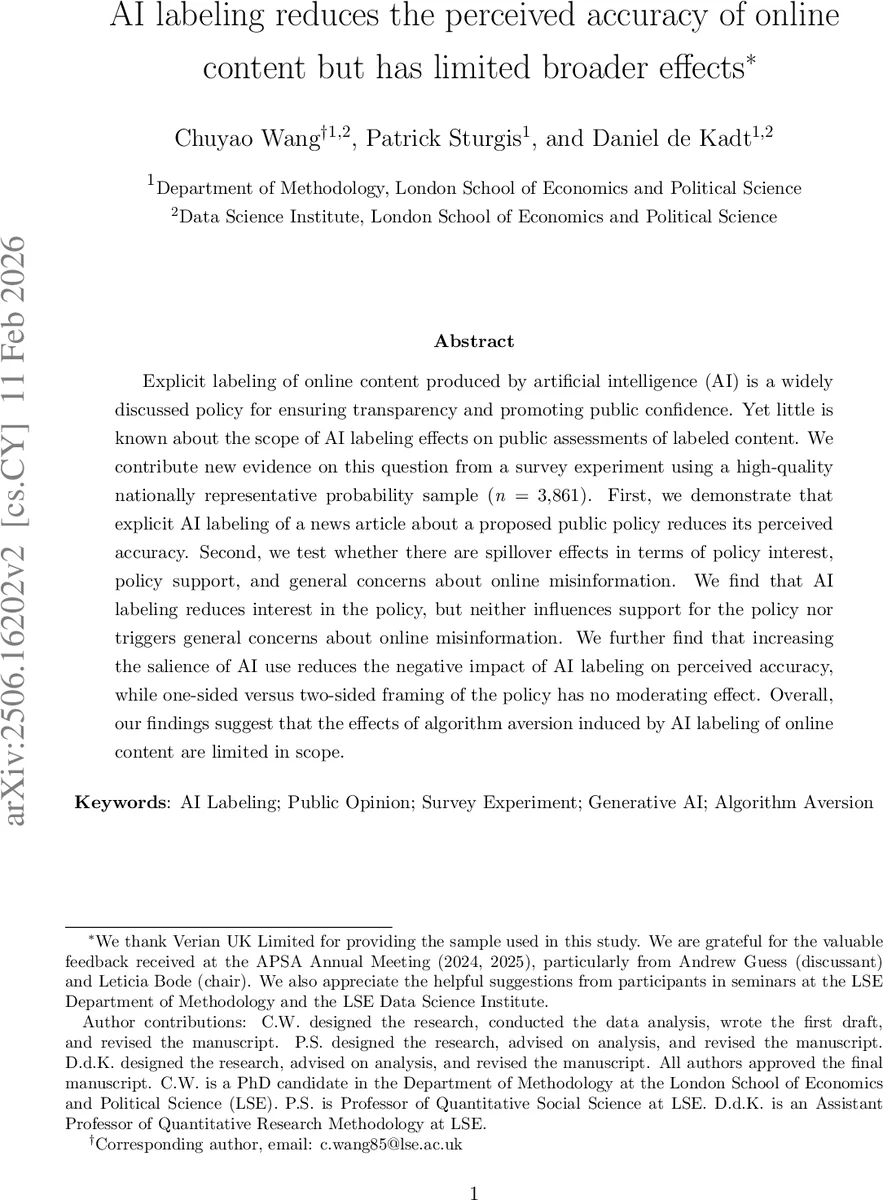
Explicit labeling of online content produced by artificial intelligence (AI) is a widely discussed policy for ensuring transparency and promoting public confidence. Yet little is known about the scope of AI labeling effects on public assessments of labeled content. We contribute new evidence on this question from a survey experiment using a high-quality nationally representative probability sample (\emph{n} = 3,861). First, we demonstrate that explicit AI labeling of a news article about a proposed public policy reduces its perceived accuracy. Second, we test whether there are spillover effects in terms of policy interest, policy support, and general concerns about online misinformation. We find that AI labeling reduces interest in the policy, but neither influences support for the policy nor triggers general concerns about online misinformation. We further find that increasing the salience of AI use reduces the negative impact of AI labeling on perceived accuracy, while one-sided versus two-sided framing of the policy has no moderating effect. Overall, our findings suggest that the effects of algorithm aversion induced by AI labeling of online content are limited in scope and that transparency policies may benefit from contextualizing AI use to mitigate unintended public skepticism.
💡 Research Summary
This paper investigates the public effects of labeling online content as generated by artificial intelligence (AI). Using a nationally representative probability sample of 3,861 UK adults, the authors conduct a 2 × 2 × 2 factorial survey experiment. The three binary factors are (1) a salience manipulation that briefly educates participants about generative AI, (2) the presence versus absence of an explicit AI label (“This report was generated by ChatGPT, an artificial intelligence”) attached to a news article, and (3) the framing of the article about a proposed Universal Basic Income (UBI) policy—either one‑sided (positive advocacy) or two‑sided (balanced pros and cons). Participants are randomly assigned to one of eight conditions, and after reading the article they rate four outcomes on 7‑point Likert scales: perceived accuracy of the information, interest in learning more about UBI, likelihood of supporting UBI, and general concern about online misinformation.
The main findings are as follows. First, AI labeling significantly lowers perceived accuracy (supporting H1). This replicates earlier work with non‑probability samples but extends it to a high‑quality, general‑population sample, enhancing external validity. Second, labeling reduces respondents’ interest in the policy (partial support for H2), yet it does not affect policy support or overall concern about misinformation (no support for H2‑support or H3). Thus, the aversion triggered by the label appears confined to credibility judgments rather than broader attitudinal or behavioral outcomes. Third, the salience manipulation attenuates the negative labeling effect on perceived accuracy (support for H5). Providing a brief explanation of AI use appears to mitigate algorithm aversion, suggesting that contextual information can soften the label’s impact. Fourth, the framing manipulation (one‑sided vs. two‑sided) does not interact with labeling (no support for H6), indicating that the label’s effect is driven more by the disclosure itself than by the persuasive tone of the message. Finally, the three‑way interaction (label + salience + one‑sided framing) does not produce multiplicative effects (no support for H7); the combined treatments yield at most additive influences.
The authors acknowledge several limitations. The experiment uses a single policy article (UBI), which may limit generalizability across issue domains. The AI label is specific (“generated by ChatGPT”), so results may differ with alternative wording or generic “AI‑generated” labels. Behavioral outcomes such as sharing or voting were not measured, and the study captures only immediate reactions rather than long‑term attitude change. Moreover, the salience treatment is a brief informational cue rather than an experiential intervention, so its durability is uncertain.
Policy implications are clear. While AI labeling can reduce perceived accuracy, it does not automatically erode broader public trust or increase concern about misinformation. Therefore, labeling alone may be insufficient to restore confidence in AI‑generated content. Complementary strategies—public education about AI capabilities, transparent explanations of how AI is used, and possibly nuanced labeling formats—are recommended to mitigate algorithm aversion. Policymakers should also temper expectations about the spillover effects of labeling on civic engagement or policy support, as the evidence suggests these effects are limited. Overall, the study provides robust, population‑level evidence that AI labeling influences credibility judgments but has modest broader impacts, highlighting the need for a multifaceted approach to AI transparency policies.
Comments & Academic Discussion
Loading comments...
Leave a Comment