Accurate, provable and fast polychromatic tomographic reconstruction: A variational inequality approach
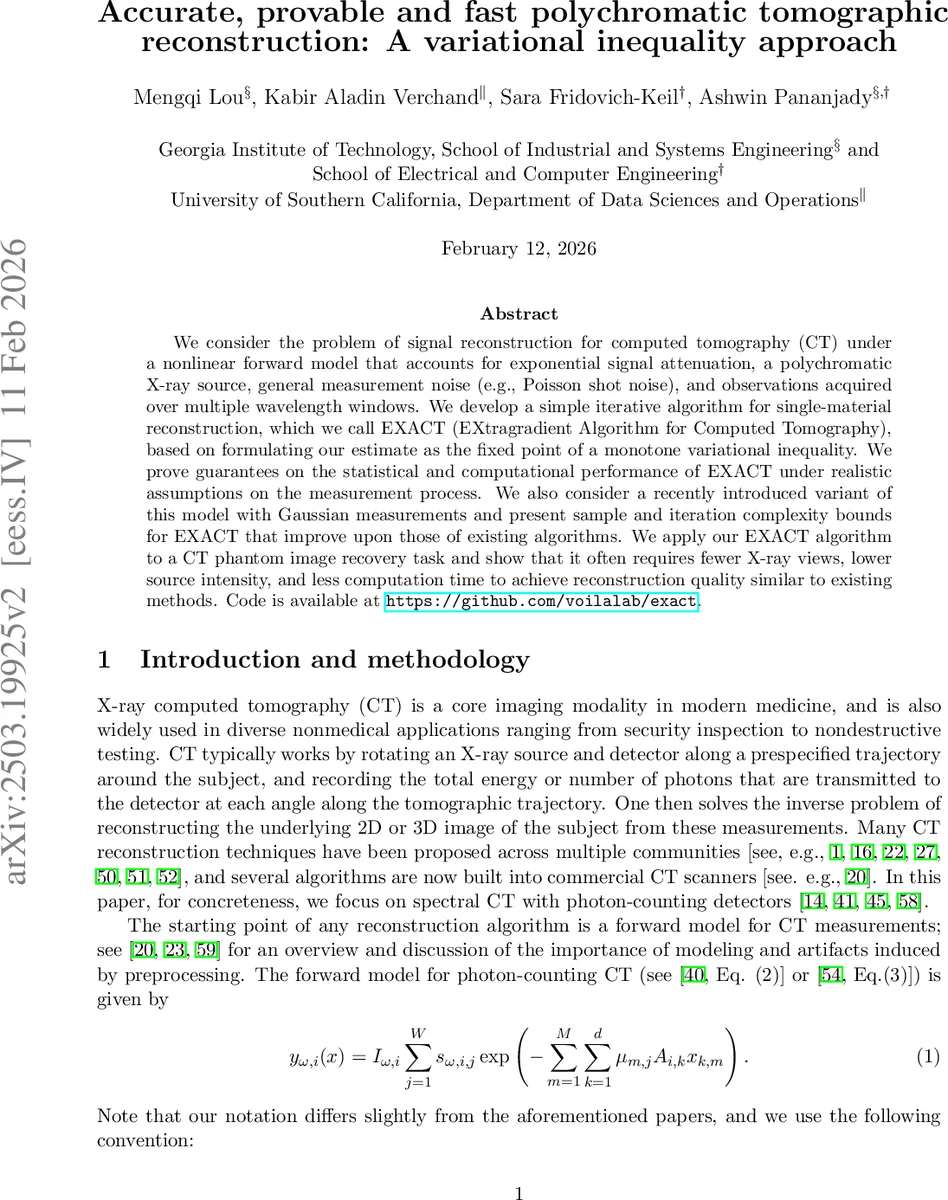
We consider the problem of signal reconstruction for computed tomography (CT) under a nonlinear forward model that accounts for exponential signal attenuation, a polychromatic X-ray source, general measurement noise (e.g., Poisson shot noise), and observations acquired over multiple wavelength windows. We develop a simple iterative algorithm for single-material reconstruction, which we call EXACT (EXtragradient Algorithm for Computed Tomography), based on formulating our estimate as the fixed point of a monotone variational inequality. We prove guarantees on the statistical and computational performance of EXACT under realistic assumptions on the measurement process. We also consider a recently introduced variant of this model with Gaussian measurements and present sample and iteration complexity bounds for EXACT that improve upon those of existing algorithms. We apply our EXACT algorithm to a CT phantom image recovery task and show that it often requires fewer X-ray views, lower source intensity, and less computation time to achieve reconstruction quality similar to existing methods. Code is available at https://github.com/voilalab/exact.
💡 Research Summary
The paper addresses the challenging problem of reconstructing computed tomography (CT) images when the forward model is nonlinear due to polychromatic X‑ray spectra, exponential attenuation, and realistic noise. Traditional CT reconstruction pipelines linearize the model by assuming a monochromatic source and applying a logarithmic transform; this approach becomes unstable when measured photon counts are low or when rays pass through high‑density materials, leading to streak artifacts and loss of quantitative accuracy.
To overcome these limitations, the authors formulate the reconstruction task as a variational inequality (VI) problem. They first simplify the full polychromatic model to a single‑material case (M = 1), which is common in applications such as perfusion imaging where the background is known and only a contrast agent needs to be recovered. The expected measurement for a projection vector a_i is expressed as
E
Comments & Academic Discussion
Loading comments...
Leave a Comment