Quantitative low-temperature spectral asymptotics for reversible diffusions in temperature-dependent domains
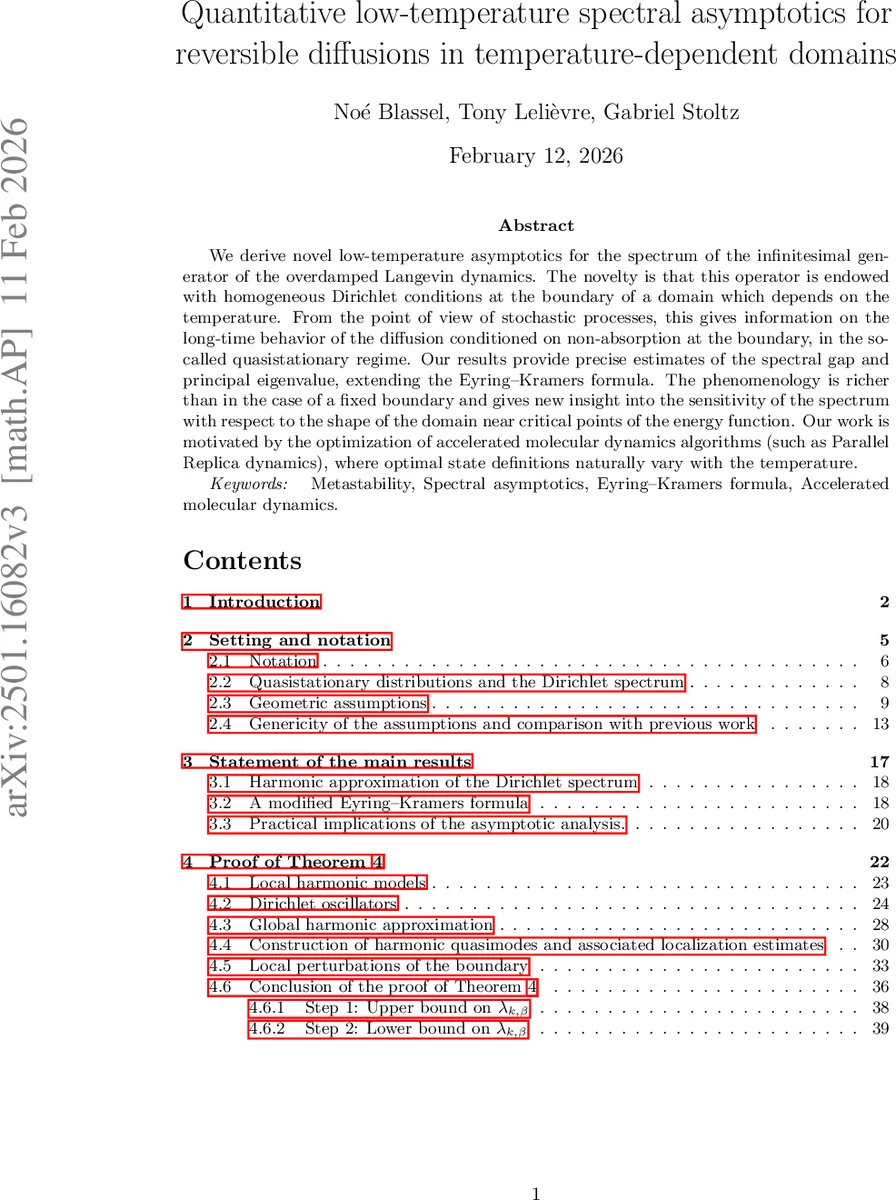
We derive novel low-temperature asymptotics for the spectrum of the infinitesimal generator of the overdamped Langevin dynamics. The novelty is that this operator is endowed with homogeneous Dirichlet conditions at the boundary of a domain which depends on the temperature. From the point of view of stochastic processes, this gives information on the long-time behavior of the diffusion conditioned on non-absorption at the boundary, in the so-called quasistationary regime. Our results provide precise estimates of the spectral gap and principal eigenvalue, extending the Eyring-Kramers formula. The phenomenology is richer than in the case of a fixed boundary and gives new insight into the sensitivity of the spectrum with respect to the shape of the domain near critical points of the energy function. Our work is motivated by–and is relevant to–the problem of finding optimal hyperparameters for accelerated molecular dynamics algorithms.
💡 Research Summary
The paper investigates the low‑temperature (β → ∞) spectral properties of the infinitesimal generator of the overdamped Langevin dynamics when homogeneous Dirichlet boundary conditions are imposed on a domain Ωβ that depends on the temperature parameter β. This setting is motivated by accelerated molecular dynamics algorithms (Parallel Replica, Hyperdynamics, Temperature‑Accelerated Dynamics) where the definition of metastable states must adapt to temperature in order to maximise efficiency.
The authors first recall that for a bounded domain Ω the Dirichlet eigenvalues λk,β(Ω) of the generator are directly linked to the quasi‑stationary distribution (QSD) of the diffusion conditioned on staying inside Ω. In particular, λ1,β gives the metastable exit rate, while the spectral gap λ2,β − λ1,β controls the exponential convergence to the QSD. The ratio J(Ω) = (λ2,β − λ1,β)/λ1,β quantifies the separation of timescales; a large J indicates a good metastable region.
The novelty lies in allowing Ω to vary with β. The authors introduce geometric assumptions: the potential V is smooth with a non‑degenerate minimum x0 and a finite set of saddle points; Ωβ shrinks towards x0 as β grows, with its boundary staying at a distance of order β⁻¹ᐟ² from critical points. The boundary is assumed C², with well‑defined outward normal nβ and a restricted Hessian H∂β.
Two main results are proved. Theorem 4 establishes a “harmonic limit”: as β→∞ the low‑lying eigenvalues satisfy λk,β(Ωβ) ≈ β εk + o(β), where εk are the eigenvalues of a harmonic oscillator obtained by a second‑order Taylor expansion of V around x0 together with the local geometry of ∂Ωβ. This extends the classical semi‑classical harmonic approximation to temperature‑dependent boundaries.
Theorem 5 provides a modified Eyring–Kramers formula for the principal eigenvalue in a single‑well domain:
λ1,β(Ωβ) ≈ |∇V·nβ| · β¹ᐟ² · (det Hmin / det H∂β)¹ᐟ² · exp(−β ΔV),
where ΔV is the energy difference between the boundary and the minimum, Hmin is the Hessian of V at x0, and H∂β is the Hessian restricted to the tangent space of the boundary. The prefactor explicitly captures the influence of the boundary curvature and its distance to the minimum.
Corollary 6 translates these asymptotics into concrete estimates for the metastable exit time (1/λ1,β) and the convergence rate to the QSD (λ2,β − λ1,β).
The proofs combine several techniques. Locally, V is approximated by a quadratic form, and the Dirichlet problem reduces to a harmonic oscillator with a moving boundary. Explicit eigenfunctions and eigenvalues are obtained for this “Dirichlet oscillator”. Globally, a partition‑of‑unity argument and energy estimates glue the local models together. Laplace’s method is adapted to the moving domain to extract the dominant exponential term and the β‑dependent prefactor. Upper and lower bounds are constructed separately, yielding matching leading orders.
From a practical standpoint, the authors discuss how to optimise the shape of Ωβ to maximise J(Ωβ). The analysis shows that moving the boundary closer to the minimum (while keeping it away from saddles) reduces λ1,β and simultaneously enlarges the spectral gap, thus increasing J. This provides a quantitative guideline for designing temperature‑dependent state definitions in Parallel Replica and related algorithms. The paper also outlines extensions to under‑damped Langevin dynamics, non‑reversible diffusions, and situations where entropic barriers dominate (e.g., narrow‑escape problems).
In summary, the work delivers a rigorous low‑temperature spectral asymptotic theory for reversible diffusions with temperature‑dependent Dirichlet boundaries, extends the Eyring–Kramers formula to this setting, and connects the results to the optimisation of metastable state definitions in accelerated molecular dynamics.
Comments & Academic Discussion
Loading comments...
Leave a Comment