Detecting high-dimensional entanglement by randomized product projections
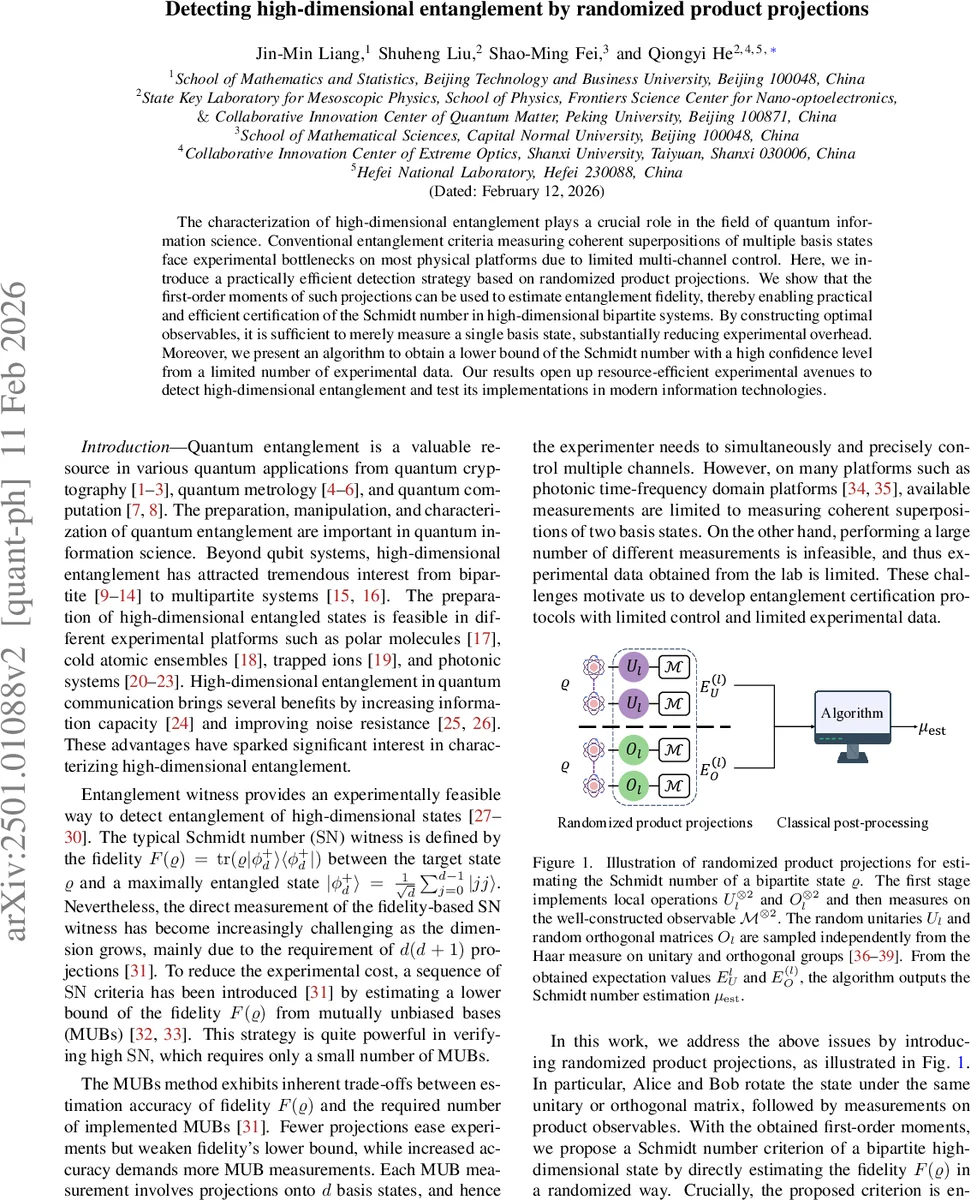
The characterization of high-dimensional entanglement plays a crucial role in the field of quantum information science. Conventional entanglement criteria measuring coherent superpositions of multiple basis states face experimental bottlenecks on most physical platforms due to limited multi-channel control. Here, we introduce a practically efficient detection strategy based on randomized product projections. We show that the first-order moments of such projections can be used to estimate entanglement fidelity, thereby enabling practical and efficient certification of the Schmidt number in high-dimensional bipartite systems. By constructing optimal observables, it is sufficient to merely measure a single basis state, substantially reducing experimental overhead. Moreover, we present an algorithm to obtain a lower bound of the Schmidt number with a high confidence level from a limited number of experimental data. Our results open up resource-efficient experimental avenues to detect high-dimensional entanglement and test its implementations in modern information technologies.
💡 Research Summary
The paper addresses a central challenge in quantum information science: the efficient certification of high‑dimensional entanglement. Traditional methods for estimating the Schmidt number (SN) of bipartite states—such as direct fidelity measurement or witnesses based on mutually unbiased bases (MUBs)—require a number of local projections that grows rapidly with the local dimension d, making them impractical on many platforms where multi‑channel control is limited.
To overcome this bottleneck, the authors propose a protocol based on “randomized product projections.” In each experimental run Alice and Bob apply the same random unitary U (or random orthogonal matrix O) to their shared state ρ, and then measure a product observable M⊗2. Crucially, they choose M to be a rank‑one projector onto a single computational basis state, |j⟩⟨j|. This choice reduces the experimental overhead to a single channel, independent of d.
For a fixed U (or O) the expectation value is
E_U(ρ)=Tr
Comments & Academic Discussion
Loading comments...
Leave a Comment