New Algorithms and Hardness Results for Robust Satisfiability of (Promise) CSPs
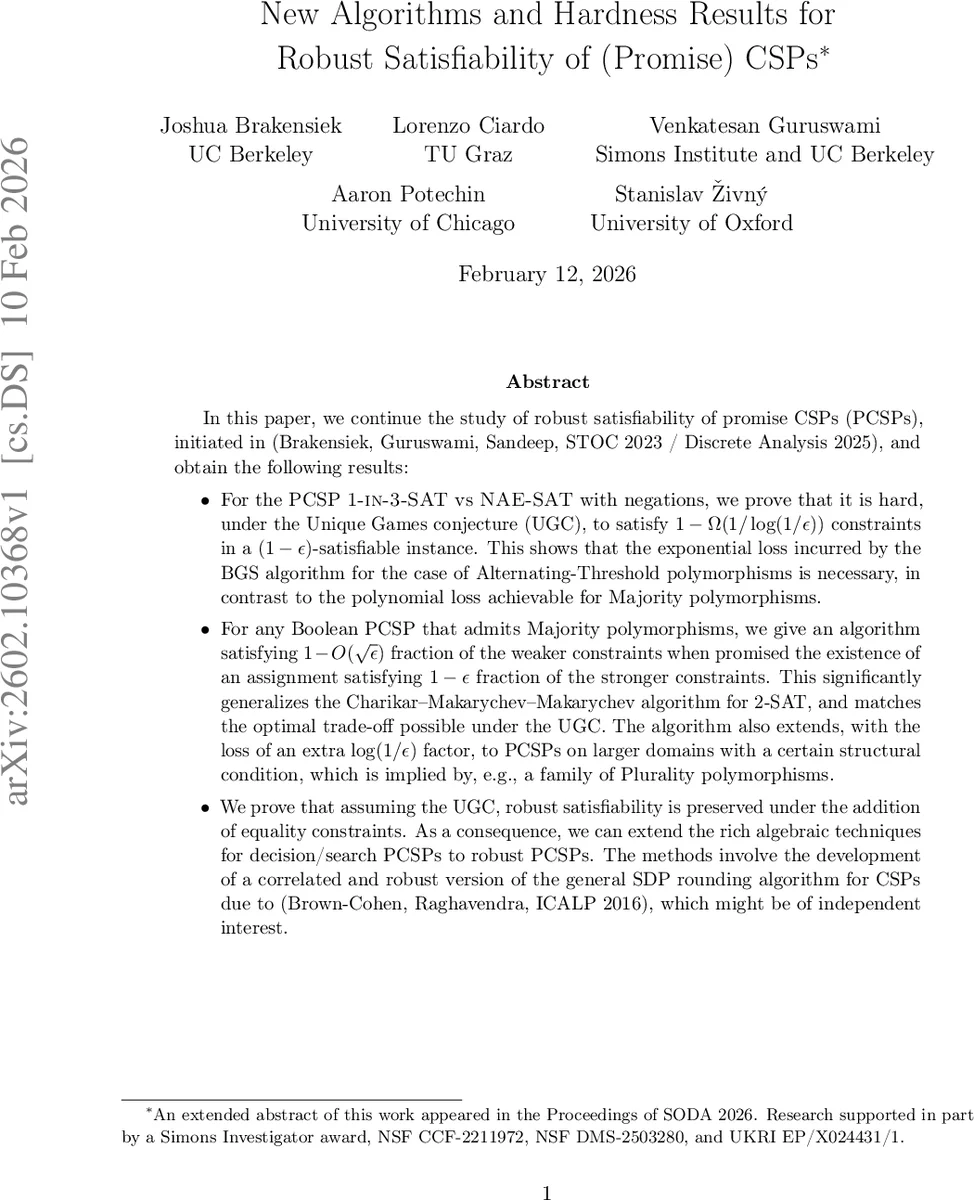
In this paper, we continue the study of robust satisfiability of promise CSPs (PCSPs), initiated in (Brakensiek, Guruswami, Sandeep, STOC 2023 / Discrete Analysis 2025), and obtain the following results: For the PCSP 1-in-3-SAT vs NAE-SAT with negations, we prove that it is hard, under the Unique Games conjecture (UGC), to satisfy $1-Ω(1/\log (1/ε))$ constraints in a $(1-ε)$-satisfiable instance. This shows that the exponential loss incurred by the BGS algorithm for the case of Alternating-Threshold polymorphisms is necessary, in contrast to the polynomial loss achievable for Majority polymorphisms. For any Boolean PCSP that admits Majority polymorphisms, we give an algorithm satisfying $1-O(\sqrtε)$ fraction of the weaker constraints when promised the existence of an assignment satisfying $1-ε$ fraction of the stronger constraints. This significantly generalizes the Charikar–Makarychev–Makarychev algorithm for 2-SAT, and matches the optimal trade-off possible under the UGC. The algorithm also extends, with the loss of an extra $\log (1/ε)$ factor, to PCSPs on larger domains with a certain structural condition, which is implied by, e.g., a family of Plurality polymorphisms. We prove that assuming the UGC, robust satisfiability is preserved under the addition of equality constraints. As a consequence, we can extend the rich algebraic techniques for decision/search PCSPs to robust PCSPs. The methods involve the development of a correlated and robust version of the general SDP rounding algorithm for CSPs due to (Brown-Cohen, Raghavendra, ICALP 2016), which might be of independent interest.
💡 Research Summary
This paper advances the study of robust satisfiability for promise constraint satisfaction problems (PCSPs), building on the framework introduced by Brakensiek, Guruswami, and Sandeep (BGS). The authors present three major contributions. First, they prove a near‑matching hardness result for the PCSP “1‑in‑3‑SAT versus NAE‑SAT with negations” under the Unique Games Conjecture (UGC). By constructing a continuous integrality gap and discretizing it, they show that any algorithm that, on a $(1-\varepsilon)$‑satisfiable instance, satisfies more than $1-\Omega(1/\log(1/\varepsilon))$ of the weaker constraints would violate the UGC. This establishes that the exponential loss $1-O(\log\log(1/\varepsilon)/\log(1/\varepsilon))$ exhibited by the BGS algorithm for Alternating‑Threshold (AT) polymorphisms is unavoidable, contrasting with the polynomial loss achievable for Majority (MAJ) polymorphisms.
Second, the paper revisits Boolean PCSPs that admit MAJ polymorphisms. While BGS achieved a loss of $O(\varepsilon^{1/3})$, the authors refine the analysis of the Charikar‑Makarychev‑Makarychev (CMM) SDP‑based algorithm. By a more careful treatment of multivariate Gaussian marginals and exploiting the mean‑centering property guaranteed by MAJ polymorphisms, they improve the loss to $O(\sqrt{\varepsilon})$. This matches the optimal trade‑off known for 2‑SAT under the UGC and shows that the BGS bound was not tight.
Third, the authors extend the robustness results to larger domains. They define a class of “separable” PCSPs that includes any template whose polymorphisms contain the Plurality family (PLUR). For such templates they design an SDP rounding scheme that incurs an additional $\log(1/\varepsilon)$ factor, yielding a robustness guarantee of $O(\sqrt{\varepsilon},\log(1/\varepsilon))$. This covers natural non‑Boolean problems such as Unique Games and the Set‑SAT generalization of $(2+\varepsilon)$‑SAT.
A further conceptual contribution is the proof that adding equality constraints to a robust PCSP preserves its robustness (up to the same loss factors) under the UGC. To achieve this, the authors develop a correlated and robust version of the general SDP rounding algorithm of Brown‑Cohen and Raghavendra (ICALP 2016). Their construction maintains the necessary correlation structure among variables while ensuring that the rounding step respects the promised robustness guarantees. This result enables the transfer of many algebraic gadget reductions—central to CSP complexity classifications—to the robust setting.
The paper is organized as follows. Section 2 establishes notation, basic SDP relaxations, and polymorphism concepts. Section 3 presents the AT integrality‑gap construction and the associated UGC hardness proof. Section 4 contains the refined analysis for MAJ polymorphisms, leading to the $O(\sqrt{\varepsilon})$ loss bound. Section 5 introduces separable PCSPs, defines the PLUR condition, and proves the $O(\sqrt{\varepsilon}\log(1/\varepsilon))$ robustness result. Section 6 details the equality‑preserving reduction, including measure‑theoretic foundations and the correlated rounding scheme. Section 7 concludes with open problems and potential extensions.
In summary, the work (1) shows that exponential loss for AT polymorphisms is inherent, (2) provides an optimal $O(\sqrt{\varepsilon})$ robust algorithm for all Boolean PCSPs with MAJ polymorphisms, (3) extends robust algorithms to a broad class of non‑Boolean templates with a modest logarithmic overhead, and (4) establishes a general framework for preserving robustness under equality‑type gadget reductions. These contributions significantly deepen our understanding of the algorithmic and hardness landscape of robust PCSPs and lay groundwork for future dichotomy theorems in this richer setting.
Comments & Academic Discussion
Loading comments...
Leave a Comment