Searching for radio emission from stellar wind-magnetosphere interaction or co-rotation breakdown in brown dwarfs
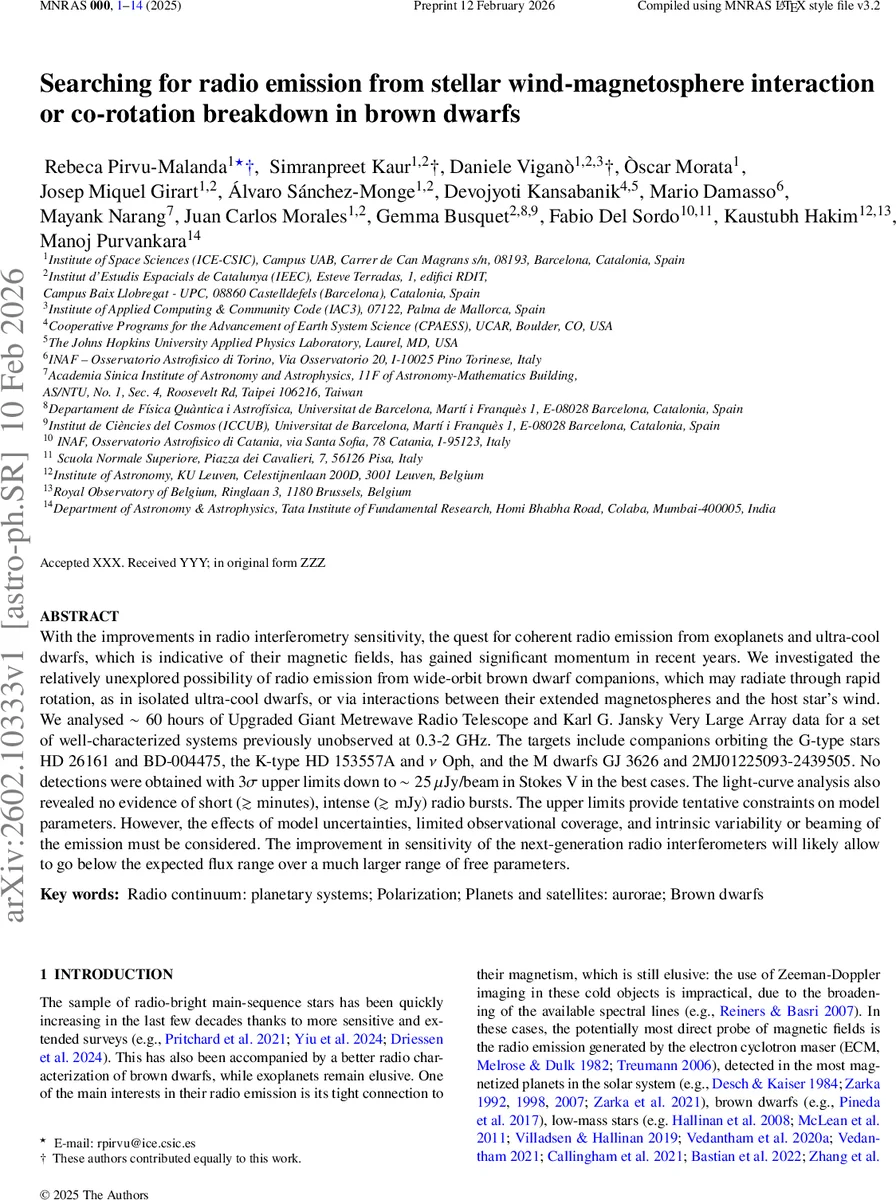
With the improvements in radio interferometry sensitivity, the quest for coherent radio emission from exoplanets and ultra-cool dwarfs, which is indicative of their magnetic fields, has gained significant momentum in recent years. We investigated the relatively unexplored possibility of radio emission from wide-orbit brown dwarf companions, which may radiate through rapid rotation, as in isolated ultra-cool dwarfs, or via interactions between their extended magnetospheres and the host star’s wind. We analysed $\sim 60$ hours of Upgraded Giant Metrewave Radio Telescope and Karl G. Jansky Very Large Array data for a set of well-characterized systems previously unobserved at 0.3-2 GHz. The targets include companions orbiting the G-type stars HD 26161 and BD-004475, the K-type HD 153557A and $ν$ Oph, and the M dwarfs GJ 3626 and 2MJ01225093-2439505. No detections were obtained with 3$σ$ upper limits down to $\sim 25,μ$Jy/beam in Stokes V in the best cases. The light-curve analysis also revealed no evidence of short ($\gtrsim$ minutes), intense ($\gtrsim$ mJy) radio bursts. The upper limits provide tentative constraints on model parameters. However, the effects of model uncertainties, limited observational coverage, and intrinsic variability or beaming of the emission must be considered. The improvement in sensitivity of the next-generation radio interferometers will likely allow to go below the expected flux range over a much larger range of free parameters.
💡 Research Summary
This paper presents a dedicated radio search for coherent electron‑cyclotron‑maser (ECM) emission from brown‑dwarf companions on wide orbits around main‑sequence stars. The authors motivate the study by noting that, while radio detections of isolated ultra‑cool dwarfs (UCDs) and a handful of exoplanets have been achieved, wide‑separation brown dwarfs remain largely unexplored. They argue that such objects could generate ECM emission via three channels: rapid rotation leading to co‑rotation breakdown, interaction between the brown dwarf’s magnetosphere and the stellar wind, and possible satellite‑induced currents.
Six well‑characterized systems were selected – two G‑type hosts (HD 26161, BD‑004475), two K‑type hosts (HD 153557A, ν Oph), and two M‑type hosts (GJ 3626, 2MJ01225093‑2439505) – each harbouring a brown‑dwarf companion with estimated masses of 10–70 M_Jup and orbital separations of tens to hundreds of AU. The targets had not previously been observed in the 0.3–2 GHz band.
Observations were carried out with the upgraded Giant Metrewave Radio Telescope (uGMRT) and the Karl G. Jansky Very Large Array (JVLA), totaling roughly 60 hours of on‑source time. The data were processed with standard flagging, calibration, and imaging pipelines, including careful RFI excision and self‑calibration to achieve thermal‑noise limited images. Stokes V images (circular polarization) reached 3σ sensitivities of 25–45 µJy beam⁻¹, and high‑time‑resolution light curves (down to 30 s) were extracted to search for short, intense bursts.
No statistically significant ECM signatures were found in any of the six systems. The non‑detections translate into upper limits that are 1–2 orders of magnitude below the flux densities predicted by simple scaling laws (e.g., the radiometric Bode’s law, radio‑magnetic law) for both rotation‑driven and wind‑magnetosphere‑driven emission. Consequently, the authors can rule out certain combinations of rotation period (< 5 h), magnetic field strength (~kG), stellar wind speed (~400 km s⁻¹), and mass‑loss rate (~10⁻¹⁴ M_⊙ yr⁻¹) that would have produced detectable signals.
The paper discusses the major caveats: ECM emission is highly beamed (beam opening angles of a few degrees) and often intermittent, so limited phase coverage can miss bursts; uncertainties in the brown dwarf magnetic field strength, plasma density, and wind properties are large; and satellite‑induced emission remains unconstrained without knowledge of any moons. The authors therefore treat the upper limits as tentative constraints rather than definitive falsifications of the models.
In the concluding section, the authors argue that next‑generation facilities such as SKA‑Low and the ngVLA, with sub‑10 µJy sensitivities and the ability to conduct long, continuous monitoring, will be essential to probe the expected flux regime. They also suggest that multi‑frequency, full‑polarization campaigns and very‑long‑baseline interferometry could disentangle auroral (ECM) from gyrosynchrotron components, and that coordinated optical/IR activity monitoring would help identify rotation periods and magnetic field strengths needed for more accurate model predictions. Overall, the study provides the first systematic upper limits on radio emission from wide‑orbit brown‑dwarf companions and outlines a roadmap for future detections.
Comments & Academic Discussion
Loading comments...
Leave a Comment