Tomography of 1-forms on a gas giant
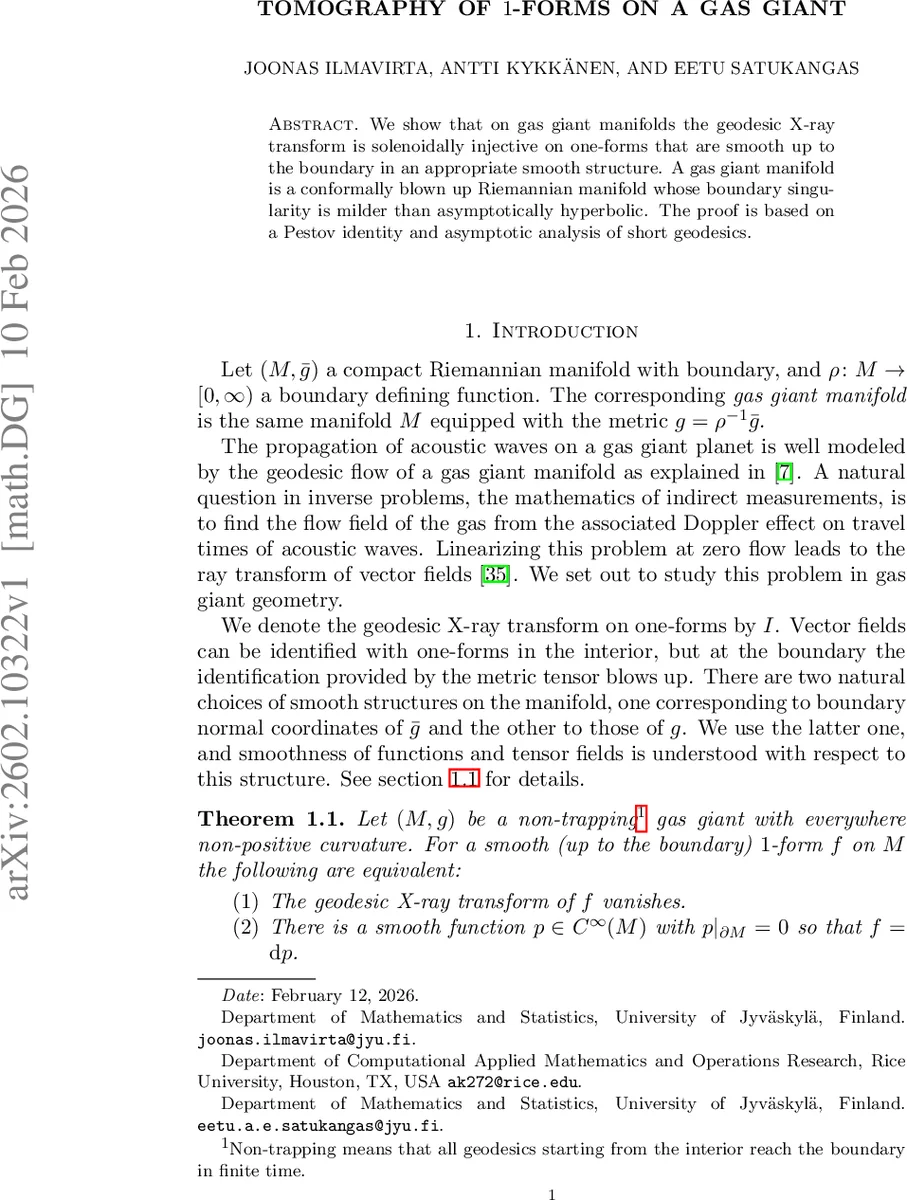
We show that on gas giant manifolds the geodesic X-ray transform is solenoidally injective on one-forms that are smooth up to the boundary in an appropriate smooth structure. A gas giant manifold is a conformally blown up Riemannian manifold whose boundary singularity is milder than asymptotically hyperbolic. The proof is based on a Pestov identity and asymptotic analysis of short geodesics.
💡 Research Summary
The paper studies the geodesic X‑ray transform of one‑forms on a class of manifolds that the authors call “gas giant manifolds.” A gas giant manifold is obtained from a compact Riemannian manifold ((M,\bar g)) with boundary by conformally blowing up the metric with a factor (\rho^{-1}), where (\rho) is a boundary defining function. This creates a singularity at the boundary that is milder than the one found in asymptotically hyperbolic spaces (which use (\rho^{-2})). The authors focus on the case (\alpha=1) in the more general family (g=\rho^{-\alpha}\bar g) because only then the analysis of geodesics and the required regularity estimates work cleanly.
The main result (Theorem 1.1) states that if the manifold ((M,g)) is non‑trapping (every interior geodesic reaches the boundary in finite time) and has everywhere non‑positive curvature, then the geodesic X‑ray transform (I) is solenoidally injective on one‑forms that are smooth up to the boundary in the appropriate smooth structure. In concrete terms, for a smooth one‑form (f) the condition (If=0) implies the existence of a smooth scalar function (p) vanishing on (\partial M) such that (f=dp). The converse direction is trivial because the X‑ray transform of an exact form always vanishes.
A central technical issue is the choice of smooth structure near the boundary. Two natural structures exist: one based on the original metric (\bar g) (coordinates ((s,y)) where (s) measures (\bar g)‑distance to the boundary) and another based on the blown‑up metric (g) (coordinates ((x,y)) where (x) measures (g)‑distance). The authors argue that the latter, though less obvious, yields a non‑singular Hamiltonian flow on the cotangent bundle and therefore is the appropriate framework for their analysis.
The proof proceeds through three lemmas:
-
Lemma 2.2 (Boundary Determination) – By analyzing short geodesics that stay close to the boundary, the authors show that any one‑form with vanishing X‑ray transform can be modified by an exact form (dq) (with (q|_{\partial M}=0)) so that the remainder (f-dq) decays like (x^\infty) near the boundary. This uses the strict convexity of the boundary in the blown‑up metric.
-
Lemma 2.3 (Regularity of the Integral Function) – For the modified one‑form (\tilde f = f-dq), the transport equation (X u_{\tilde f} = -\lambda \tilde f) admits a unique solution (u_{\tilde f}) on the unit cosphere bundle (S^*M). The authors define a function space (\Omega) that encodes weighted smoothness ((x^\infty C^\infty)), (L^2) control of normal derivatives, and vanishing boundary traces. They prove that (u_{\tilde f}\in\Omega) by a series of regularity estimates, relying on the non‑trapping assumption to guarantee that the integral defining (u_{\tilde f}) is well‑posed.
-
Lemma 2.4 (Pestov Identity and Potential Recovery) – Assuming the manifold has non‑positive curvature, a Pestov identity applied to any (u\in\Omega) whose derivative along the geodesic vector field (X) is a first‑order polynomial in the cotangent variable (\zeta) forces (u) to be the pull‑back of a scalar function: (u=\pi^*p). The curvature sign ensures that the bulk term in the Pestov identity is non‑negative, allowing the authors to conclude that the “solenoidal” part of (u) vanishes.
Combining the lemmas, the authors obtain (u_{\tilde f}=\pi^*p) for some smooth (p) with (p|_{\partial M}=0). Substituting back into the transport equation yields (\tilde f = -dp), and thus (f = d(q-p)), establishing the solenoidal injectivity.
The paper also discusses the relationship with Grushin‑type metrics, noting that while the gas giant metric shares some features (degeneracy of the metric in the normal direction), the proofs do not follow directly from existing Grushin literature. Moreover, the authors remark that the restriction to (\alpha=1) is technical: for other (\alpha) the geodesic flow acquires fractional powers of the boundary defining function, leading to non‑smooth behavior that breaks the Pestov‑based argument. They conjecture that the curvature assumption could be replaced by a “no conjugate points” condition, which would make the result applicable to a broader class of simple gas giant manifolds, but leave this for future work.
In summary, the article provides the first rigorous solenoidal injectivity result for the geodesic X‑ray transform of one‑forms on gas giant manifolds, introduces a careful choice of smooth structure to handle boundary singularities, and adapts the Pestov identity technique to a setting that interpolates between standard Riemannian and asymptotically hyperbolic geometries. This advances the mathematical foundation for inverse problems related to acoustic wave propagation in planetary atmospheres, where the Doppler shift of travel times encodes information about underlying flow fields.
Comments & Academic Discussion
Loading comments...
Leave a Comment