The delocalization of eigenvectors of real elliptic matrices
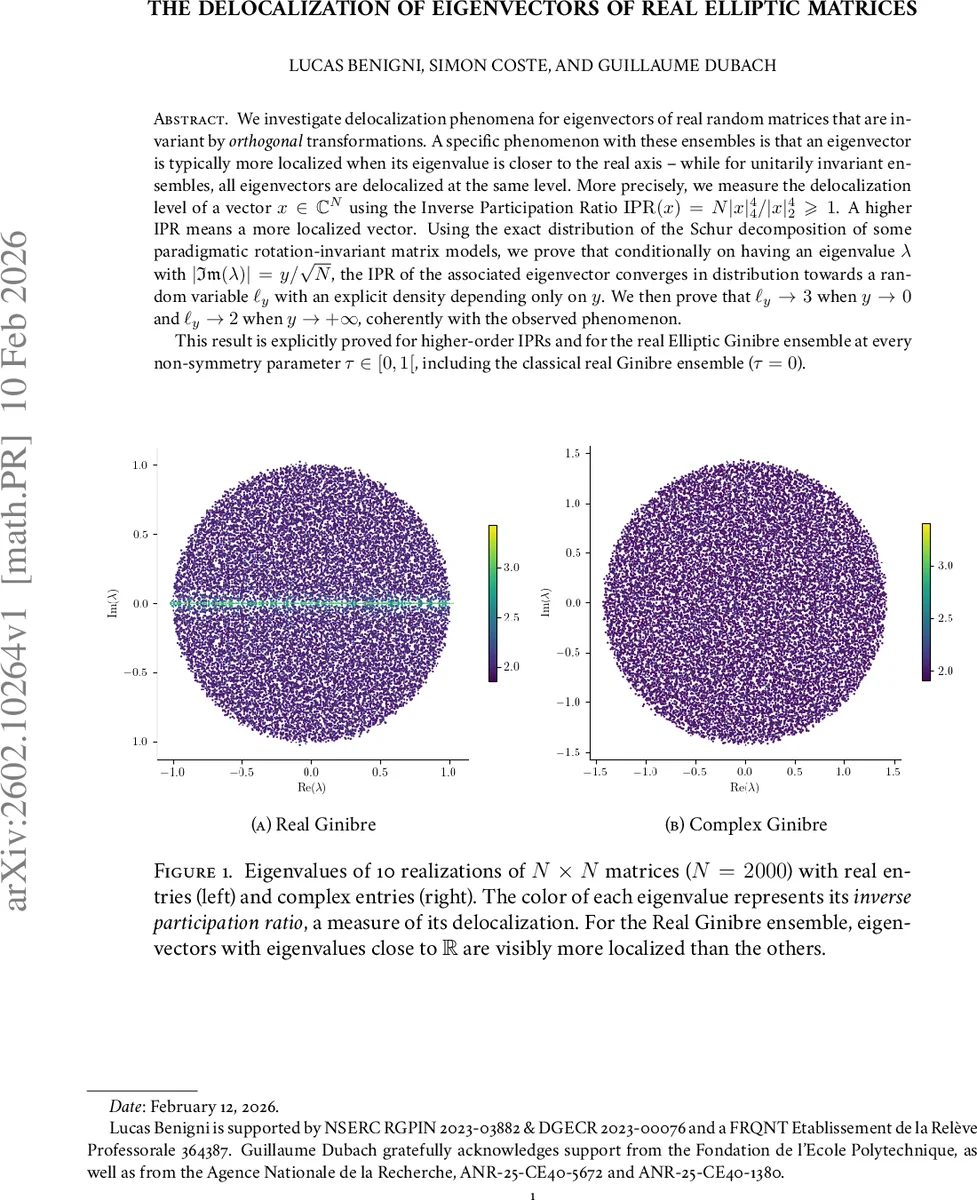
We investigate delocalization phenomena for eigenvectors of real random matrices that are invariant by orthogonal transformations. A specific phenomenon with these ensembles is that an eigenvector is typically more localized when its eigenvalue is closer to the real axis while for unitarily invariant ensembles, all eigenvectors are delocalized at the same level. More precisely, we measure the delocalization level of a vector $x\in \mathbb{C}^N$ using the Inverse Participation Ratio $\mathrm{IPR}(x) = N|x|_4^4 / |x|_2^4 \geqslant 1$. A higher IPR means a more localized vector. Using the exact distribution of the Schur decomposition of some paradigmatic rotation-invariant matrix models, we prove that conditionally on having an eigenvalue $λ$ with $|\mathfrak{Im}(λ)| = y / \sqrt{N}$, the IPR of the associated eigenvector converges in distribution towards a random variable $\ell_y$ with an explicit density depending only on $y$. We then prove that $\ell_y \to 3$ when $y \to 0$ and $\ell_y \to 2$ when $y\to +\infty$, coherently with the observed phenomenon. This result is explicitly proved for higher-order IPRs and for the real Elliptic Ginibre ensemble at every non-symmetry parameter $τ\in [0,1[$, including the classical real Ginibre ensemble ($τ=0$).
💡 Research Summary
The paper investigates a striking localization phenomenon for eigenvectors of real random matrices that are invariant under orthogonal transformations, focusing on the real Elliptic Ginibre (REG) ensemble. While eigenvectors of unitarily invariant (complex) ensembles are uniformly distributed on the complex unit sphere, the authors show that for orthogonally invariant real ensembles the degree of delocalization depends on the distance of the associated eigenvalue from the real axis. To quantify delocalization they use the Inverse Participation Ratio (IPR), defined for a vector (x\in\mathbb{C}^N) as (\mathrm{IPR}q(x)=N^{,q-1}|x|{2q}^{2q}/|x|_2^{2q}). An IPR of 1 corresponds to a perfectly delocalized vector, while IPR = N indicates complete localization on a single coordinate.
The authors exploit the exact Schur decomposition of REG matrices. A REG matrix can be written as a linear combination of a GOE matrix (H) and an antisymmetric Gaussian matrix (A): \
Comments & Academic Discussion
Loading comments...
Leave a Comment