Gravitational scalar production with a generic reheating scenario
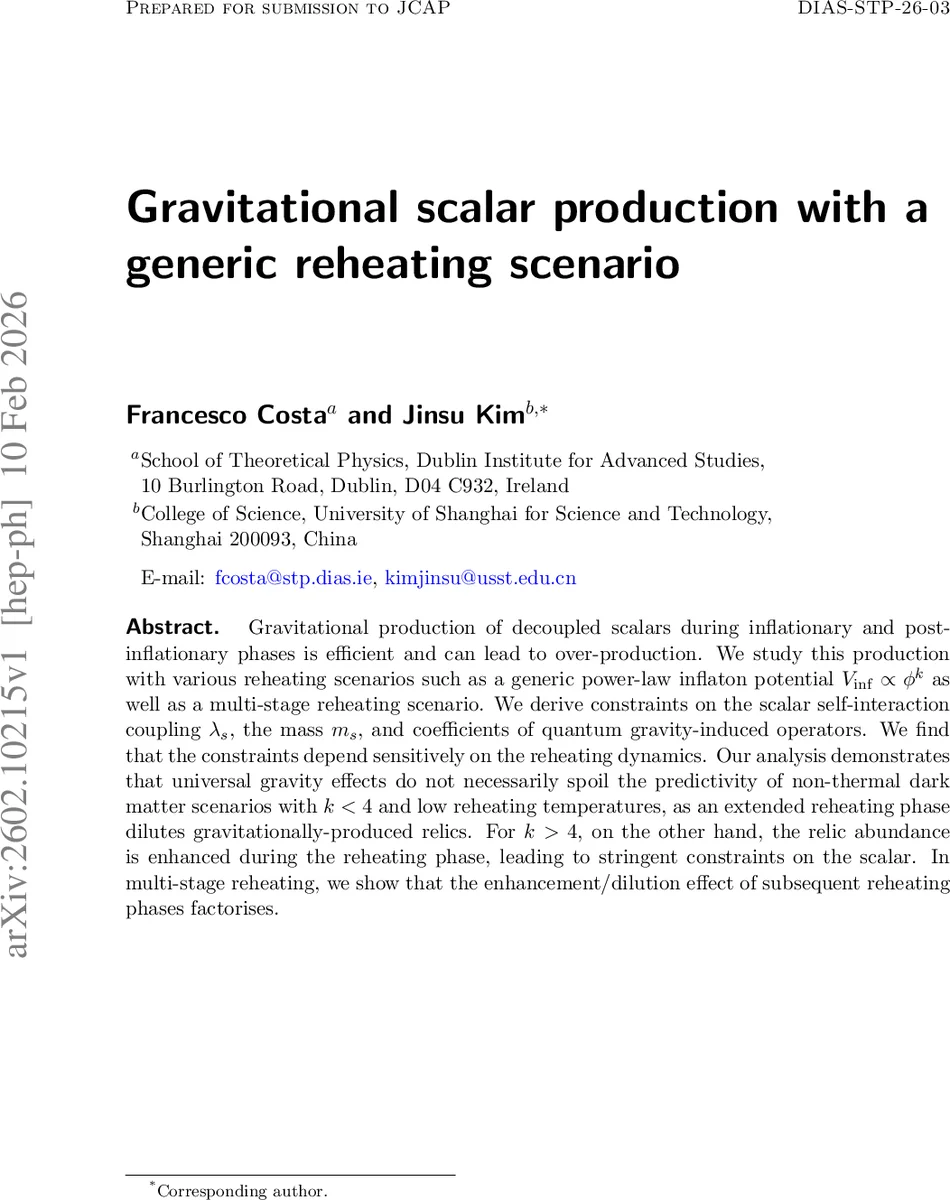
Gravitational production of decoupled scalars during inflationary and post-inflationary phases is efficient and can lead to over-production. We study this production with various reheating scenarios such as a generic power-law inflaton potential $V_{\rm inf}\propto ϕ^k$ as well as a multi-stage reheating scenario. We derive constraints on the scalar self-interaction coupling $λ_s$, the mass $m_s$, and coefficients of quantum gravity-induced operators. We find that the constraints depend sensitively on the reheating dynamics. Our analysis demonstrates that universal gravity effects do not necessarily spoil the predictivity of non-thermal dark matter scenarios with $k < 4$ and low reheating temperatures, as an extended reheating phase dilutes gravitationally-produced relics. For $k > 4$, on the other hand, the relic abundance is enhanced during the reheating phase, leading to stringent constraints on the scalar. In multi-stage reheating, we show that the enhancement/dilution effect of subsequent reheating phases factorises.
💡 Research Summary
The paper presents a comprehensive study of the gravitational production of a decoupled scalar field s during both inflation and the subsequent reheating epoch, focusing on how different reheating dynamics affect the final relic abundance. The scalar potential is taken to be V(s)=½ mₛ² s²+¼ λₛ s⁴ with λₛ≪1 and mₛ≪H during inflation. Quantum fluctuations of the light scalar generate a variance ⟨s²⟩≈α_SY H²_end, where α_SY≈1 for a short inflationary period (non‑equilibrium) or α_SY≈0.1 λₛ^{-½} when the stochastic distribution reaches equilibrium. After inflation the effective mass m_eff²=mₛ²+3λₛ⟨s²⟩ eventually becomes comparable to H², triggering coherent oscillations. Initially the quartic term dominates (⟨s⟩∝a^{-1}), so the condensate behaves like radiation; later the quadratic term takes over (⟨s⟩∝a^{-3/2}), and the field behaves as non‑relativistic matter with number density nₛ≈mₛ³/λₛ a^{-3}. The relic yield Y=nₛ/s_SM is then determined by the expansion history between the onset of the matter‑like phase and the end of reheating.
Five reheating scenarios are analyzed:
-
Instantaneous reheating – the inflaton energy is instantly transferred to radiation (a_reh=a_end). Using the Friedmann relation H_end≈π √(g_* /90) T_reh²/M_P, the yield scales as Y∝H_end M_P^{-1} λₛ^{-¼} (equilibrium) or Y∝H_end M_P^{-1} λₛ^{-5/8} (non‑equilibrium). Imposing Y≤Y_DM leads to a bound mₛ λₛ^{-5/8}≲3×10^{-8} GeV (M_P/H_end)^{3/2}.
-
Matter‑dominated reheating – a quadratic inflaton potential yields a matter‑like equation of state (w=0) during reheating, with H∝a^{-3/2}. The duration of this phase is encoded in Δ_reh≡H_end/H_reh. The yield becomes Y∝Δ_reh^{-1} H_end M_P^{-1} λₛ^{-3/4} (equilibrium) or Y∝Δ_reh^{-1} H_end M_P^{-1} λₛ^{-5/8} (non‑equilibrium). Consequently the constraint on (mₛ,λₛ) is relaxed by the factor Δ_reh, i.e. later reheating weakens the bound.
-
Power‑law inflaton potential V∝ϕᵏ – the inflaton’s average equation of state is w_ϕ=(k−2)/(k+2). The background energy density scales as a^{-3(1+w_ϕ)} and H∝a^{-3(1+w_ϕ)/2}. For k<4 (w_ϕ<0) the reheating phase dilutes the scalar abundance, further relaxing the λₛ–mₛ constraints. For k>4 the opposite occurs: the faster drop of H leads to an earlier transition to the matter‑like regime, enhancing the relic density and imposing very stringent limits on λₛ and mₛ.
-
Two‑stage reheating – the authors consider a sequence such as a matter‑dominated stage followed by a radiation‑dominated stage. Each stage contributes a factor Δ_i≡H_{i-1}/H_i, and the total yield factorises as Y∝∏_i Δ_i^{-1}. This demonstrates that the dilution (or enhancement) from each stage multiplies independently.
-
Multi‑stage reheating – extending the previous logic, an arbitrary number of reheating phases leads to the same product structure, allowing a compact parametrisation of very complex reheating histories.
In addition to the background dynamics, the paper includes higher‑dimensional, Planck‑suppressed operators of the form (ϕ/M_P)^n s² that arise from quantum gravity. These operators provide an extra production channel during reheating; their Wilson coefficients must be extremely small (often ≲10^{-10}) to avoid overproduction, especially when H_end is large.
The authors combine the analytical results with numerical checks, presenting exclusion plots in the (mₛ,λₛ) plane for various reheating temperatures (10^{13}–10^{15} GeV) and for different values of k. The key conclusions are:
- The reheating dynamics critically control whether gravitational production is a problem or a viable production mechanism for non‑thermal dark matter.
- Low reheating temperatures (large Δ_reh) can safely dilute the scalar relics, preserving the predictivity of freeze‑in/FIMP scenarios even when the inflaton potential is shallow (k<4).
- For steep inflaton potentials (k>4) the relic abundance is amplified during reheating, leading to strong bounds on λₛ and mₛ, potentially ruling out large regions of parameter space.
- In multi‑stage reheating the overall effect is simply the product of the individual stage factors, making it straightforward to incorporate realistic reheating histories into model‑building.
Overall, the work provides a versatile framework to assess gravitational scalar production across a wide class of reheating scenarios, highlighting the importance of post‑inflationary dynamics for the viability of non‑thermal dark matter models.
Comments & Academic Discussion
Loading comments...
Leave a Comment