Budgeting Discretion: Theory and Evidence on Street-Level Decision-Making
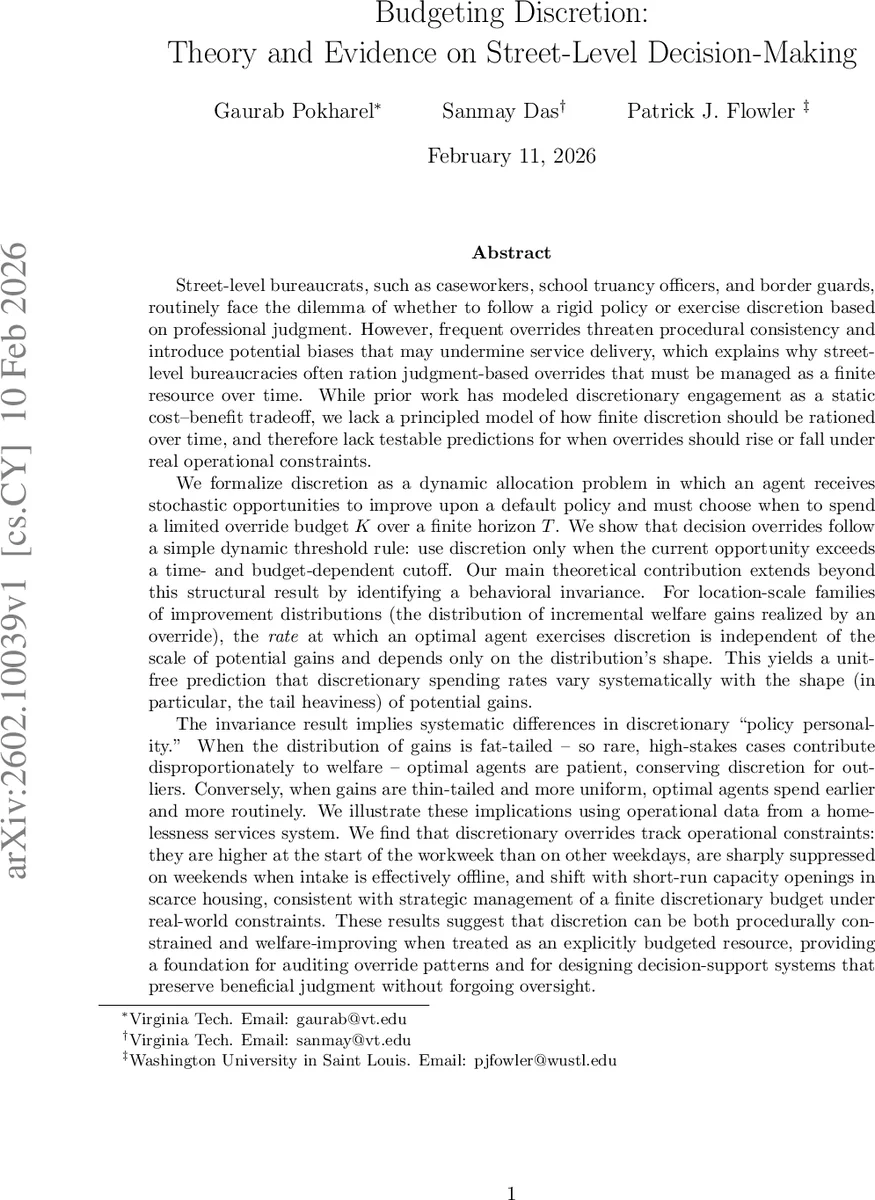
Street-level bureaucrats, such as caseworkers and border guards routinely face the dilemma of whether to follow rigid policy or exercise discretion based on professional judgement. However, frequent overrides threaten consistency and introduce bias, explaining why bureaucracies often ration discretion as a finite resource. While prior work models discretion as a static cost-benefit tradeoff, we lack a principled model of how discretion should be rationed over time under real operational constraints. We formalize discretion as a dynamic allocation problem in which an agent receives stochastic opportunities to improve upon a default policy and must spend a limited override budget K over a finite horizon T. We show that overrides follow a dynamic threshold rule: use discretion only when the opportunity exceeds a time and budget-dependent cutoff. Our main theoretical contribution identifies a behavioral invariance: for location-scale families of improvement distributions, the rate at which an optimal agent exercises discretion is independent of the scale of potential gains and depends only on the distribution’s shape (e.g., tail heaviness). This result implies systematic differences in discretionary “policy personality.” When gains are fat-tailed, optimal agents are patient, conserving discretion for outliers. When gains are thin-tailed, agents spend more routinely. We illustrate these implications using data from a homelessness services system. Discretionary overrides track operational constraints: they are higher at the start of the workweek, suppressed on weekends when intake is offline, and shift with short-run housing capacity. These results suggest that discretion can be both procedurally constrained and welfare-improving when treated as an explicitly budgeted resource, providing a foundation for auditing override patterns and designing decision-support systems.
💡 Research Summary
The paper develops a formal model of “budgeted discretion,” capturing how street‑level bureaucrats—caseworkers, border guards, judges, etc.—manage a finite stock of discretionary overrides over a finite planning horizon. In each period t the default policy prescribes an action; the agent observes the incremental welfare gain Δₜ that would result from overriding. If the agent overrides, one unit of a limited budget K is consumed and the gain is realized; otherwise the budget is conserved for future opportunities. This setting is equivalent to a finite‑horizon stochastic knapsack or online selection problem, but the objective is additive welfare gain rather than a prophet‑type benchmark.
The authors first prove that the optimal policy is a state‑dependent threshold rule: in state (τ, k) (τ periods remaining, k overrides left) there exists a cutoff θ₍τ,k₎ such that an override is taken iff Δₜ ≥ θ₍τ,k₎. The threshold rises as the horizon shortens or the remaining budget shrinks, reflecting the increasing opportunity cost of spending a scarce override.
The central theoretical contribution is the “behavioral invariance theorem.” When the distribution of Δₜ belongs to a location‑scale family (e.g., normal, log‑normal, Pareto), the probability that the optimal policy exercises discretion in a given state is invariant to affine rescaling of payoffs. In other words, the absolute magnitude of potential gains (dollars vs. thousands of dollars) does not affect the override rate; only the shape of the distribution matters. The shape parameter that matters most is tail heaviness.
If the gain distribution is thin‑tailed, large outliers are rare, so waiting yields little additional expected benefit. The optimal agent therefore adopts a relatively low threshold and overrides frequently. Conversely, with a fat‑tailed distribution, rare but extremely valuable cases exist; the continuation value of the budget is high, prompting a higher threshold and a “patient” strategy that conserves overrides for outliers. This dichotomy provides a scale‑free prediction about the “policy personality” of discretionary systems.
Empirically, the authors test these predictions using administrative data from the St. Louis Homeless Management Information System (HMIS). They reconstruct the historical default assignment rule with a short decision tree and define any deviation as an override. Daily aggregates of overrides are regressed on three sets of operational variables: (i) short‑run “capacity openings” measured by recent shelter exits (which increase the marginal value of high‑intensity placements), (ii) workload indicators (recent case assignments), and (iii) timing variables (Monday vs. weekend).
The results align with the theory. Overrides (especially downgrades from transitional housing to emergency shelter) rise when recent exits create openings in high‑intensity housing, indicating agents conserve overrides when capacity is scarce and expend them when it becomes abundant. Override frequency falls during periods of high workload, reflecting strategic rationing under time pressure. Finally, overrides peak on Mondays and collapse on weekends, consistent with a batch‑processing rhythm and reduced intake capacity that raises the effective threshold at the start of the week.
These patterns demonstrate that discretionary behavior behaves like a scarce, dynamically managed resource whose usage adjusts to short‑run shadow values of capacity and to the statistical shape of potential gains. The paper argues that treating discretion as an explicitly budgeted resource enables more transparent auditing (detecting abnormal override patterns) and informs the design of decision‑support tools that embed dynamic thresholds, thereby improving welfare while preserving procedural consistency.
In sum, the study provides a novel, scale‑free theoretical framework for budgeting discretion, validates its core predictions with real‑world street‑level data, and offers practical guidance for policymakers seeking to balance flexibility, fairness, and efficiency in bureaucratic decision‑making.
Comments & Academic Discussion
Loading comments...
Leave a Comment