A Collaborative Safety Shield for Safe and Efficient CAV Lane Changes in Congested On-Ramp Merging
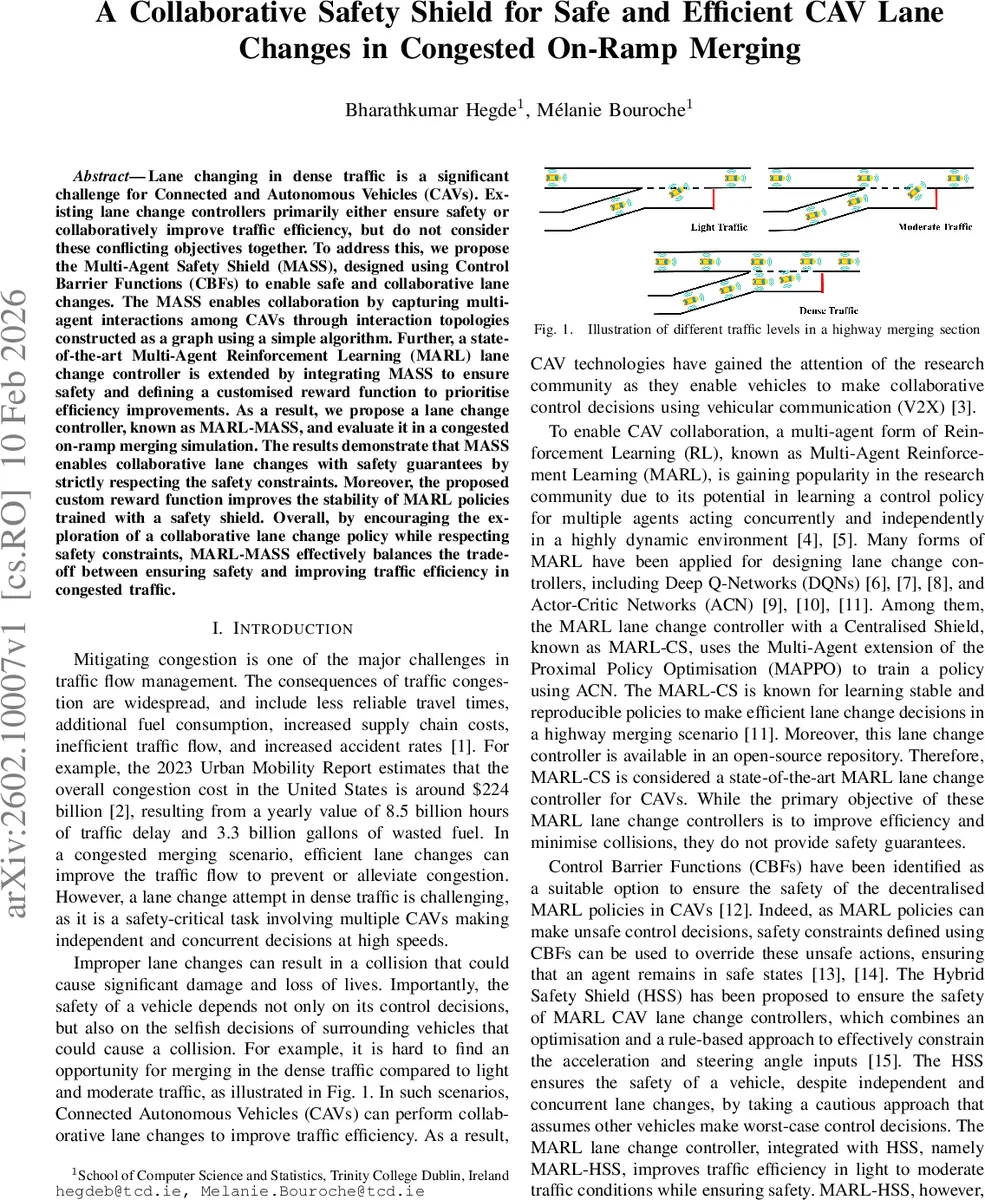
Lane changing in dense traffic is a significant challenge for Connected and Autonomous Vehicles (CAVs). Existing lane change controllers primarily either ensure safety or collaboratively improve traffic efficiency, but do not consider these conflicting objectives together. To address this, we propose the Multi-Agent Safety Shield (MASS), designed using Control Barrier Functions (CBFs) to enable safe and collaborative lane changes. The MASS enables collaboration by capturing multi-agent interactions among CAVs through interaction topologies constructed as a graph using a simple algorithm. Further, a state-of-the-art Multi-Agent Reinforcement Learning (MARL) lane change controller is extended by integrating MASS to ensure safety and defining a customised reward function to prioritise efficiency improvements. As a result, we propose a lane change controller, known as MARL-MASS, and evaluate it in a congested on-ramp merging simulation. The results demonstrate that MASS enables collaborative lane changes with safety guarantees by strictly respecting the safety constraints. Moreover, the proposed custom reward function improves the stability of MARL policies trained with a safety shield. Overall, by encouraging the exploration of a collaborative lane change policy while respecting safety constraints, MARL-MASS effectively balances the trade-off between ensuring safety and improving traffic efficiency in congested traffic. The code for MARL-MASS is available with an open-source licence at https://github.com/hkbharath/MARL-MASS
💡 Research Summary
The paper tackles the challenging problem of lane‑changing for Connected and Autonomous Vehicles (CAVs) in heavily congested on‑ramp merging zones, where safety and traffic efficiency are often at odds. Existing lane‑change controllers based on Multi‑Agent Reinforcement Learning (MARL) improve efficiency but lack formal safety guarantees, while prior safety shields such as the Hybrid Safety Shield (HSS) enforce safety conservatively and struggle to converge under dense traffic. To bridge this gap, the authors introduce the Multi‑Agent Safety Shield (MASS), which leverages Control Barrier Functions (CBFs) to minimally adjust the low‑level control commands (acceleration and steering) while explicitly accounting for the actual safe control inputs of neighboring vehicles.
MASS operates on an interaction topology constructed as a directed graph: each CAV is linked to a set of “parent” vehicles (the immediate leader in its lane, the adjacent‑lane leader, etc.) depending on its current behavioral intent (following, preparing to merge, or executing a lane change). An algorithm automatically identifies these dependencies, ensuring that a vehicle changing lanes considers both its current‑lane leader and the target‑lane leader, thereby enabling collaborative safety decisions without central coordination.
The MARL policy (based on MAPPO, as used in the state‑of‑the‑art MARL‑CS) is augmented with a customized reward function that emphasizes merging wait time, headway maintenance, and speed regulation, while the MASS guarantees that any action violating the CBF constraints is overridden. The resulting controller, MARL‑MASS, is evaluated in a gym‑like simulation of a congested on‑ramp merging scenario. Compared with MARL‑CS (no safety shield) and MARL‑HSS (conservative shield), MARL‑MASS achieves zero safety‑constraint violations, reduces average merging delay by over 30 %, improves average speed, and exhibits smoother learning curves due to the tailored reward.
The contributions are threefold: (1) a novel collaborative safety shield that integrates multi‑vehicle CBF constraints, (2) an efficient graph‑based method for constructing interaction topologies in dynamic merging environments, and (3) a reward design that steers the MARL agent toward efficiency while the shield handles safety. The authors release the full code under an open‑source license, facilitating reproducibility and future extensions to more complex traffic networks, real‑world V2X latency, and hardware‑in‑the‑loop testing.
Comments & Academic Discussion
Loading comments...
Leave a Comment