Drug Release Modeling using Physics-Informed Neural Networks
Accurate modeling of drug release is essential for designing and developing controlled-release systems. Classical models (Fick, Higuchi, Peppas) rely on simplifying assumptions that limit their accura
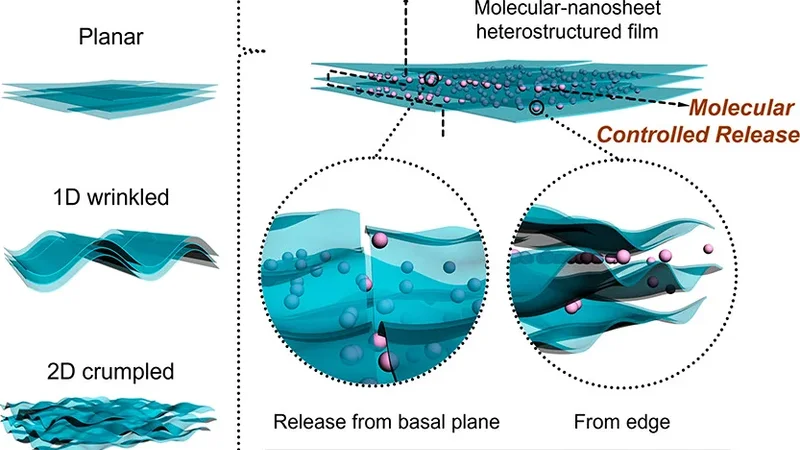
Accurate modeling of drug release is essential for designing and developing controlled-release systems. Classical models (Fick, Higuchi, Peppas) rely on simplifying assumptions that limit their accuracy in complex geometries and release mechanisms. Here, we propose a novel approach using Physics-Informed Neural Networks (PINNs) and Bayesian PINNs (BPINNs) for predicting release from planar, 1D-wrinkled, and 2D-crumpled films. This approach uniquely integrates Fick’s diffusion law with limited experimental data to enable accurate long-term predictions from short-term measurements, and is systematically benchmarked against classical drug release models. We embedded Fick’s second law into PINN as loss with 10,000 Latin-hypercube collocation points and utilized previously published experimental datasets to assess drug release performance through mean absolute error (MAE) and root mean square error (RMSE), considering noisy conditions and limited-data scenarios. Our approach reduced mean error by up to 40% relative to classical baselines across all film types. The PINN formulation achieved RMSE <0.05 utilizing only the first 6% of the release time data (reducing 94% of release time required for the experiments) for the planar film. For wrinkled and crumpled films, the PINN reached RMSE <0.05 in 33% of the release time data. BPINNs provide tighter and more reliable uncertainty quantification under noise. By combining physical laws with experimental data, the proposed framework yields highly accurate long-term release predictions from short-term measurements, offering a practical route for accelerated characterization and more efficient early-stage drug release system formulation.
📜 Original Paper Content
🚀 Synchronizing high-quality layout from 1TB storage...