A Viscosity Framework for Dynamic Programming Principles and Applications
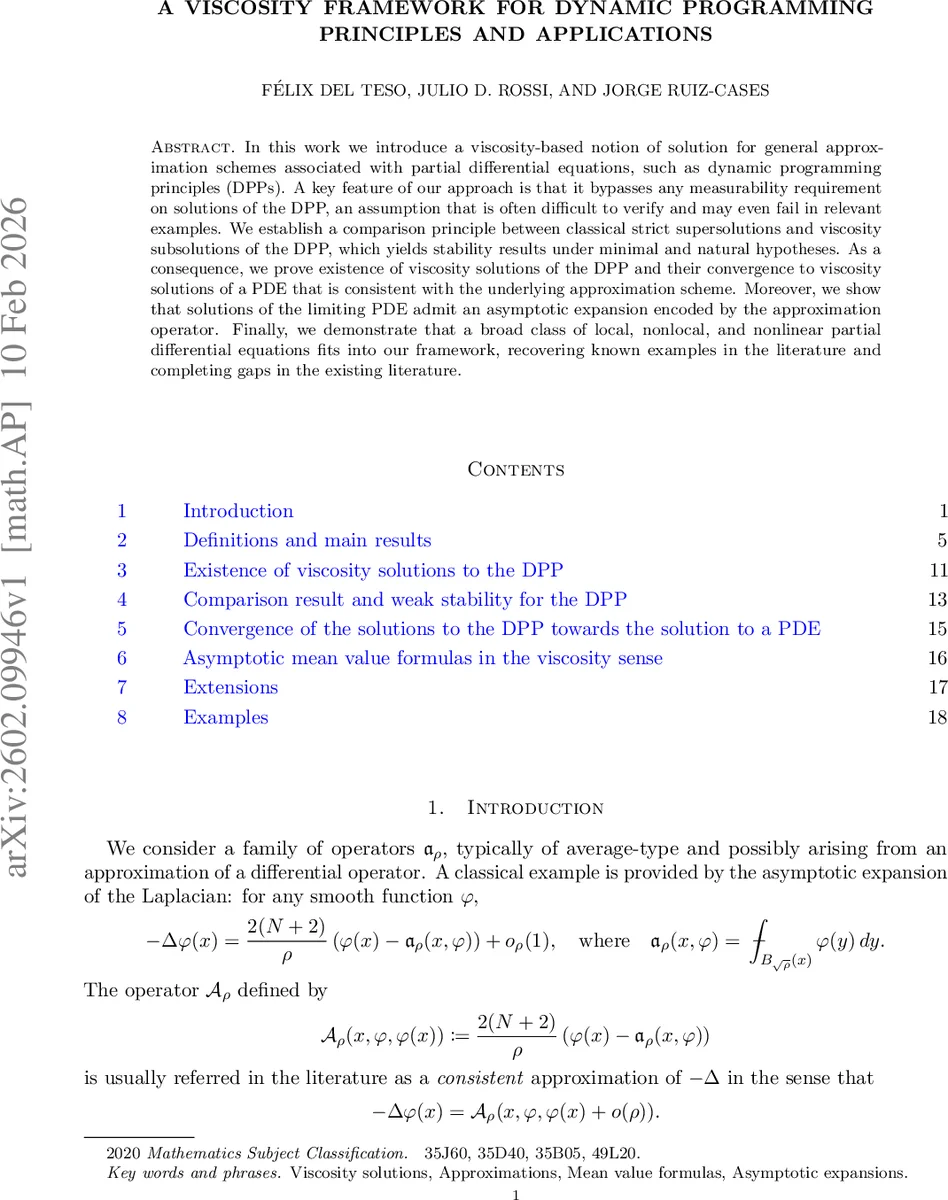
In this work we introduce a viscosity-based notion of solution for general approximation schemes associated with partial differential equations, such as dynamic programming principles~(DPPs). A key feature of our approach is that it bypasses any measurability requirement on solutions of the DPP, an assumption that is often difficult to verify and may even fail in relevant examples. We establish a comparison principle between classical strict supersolutions and viscosity subsolutions of the DPP, which yields stability results under minimal and natural hypotheses. As a consequence, we prove existence of viscosity solutions of the DPP and their convergence to viscosity solutions of a PDE that is consistent with the underlying approximation scheme. Moreover, we show that solutions of the limiting PDE admit an asymptotic expansion encoded by the approximation operator. Finally, we demonstrate that a broad class of local, nonlocal, and nonlinear partial differential equations fits into our framework, recovering known examples in the literature and completing gaps in the existing literature.
💡 Research Summary
The paper develops a comprehensive viscosity‑solution framework for dynamic programming principles (DPPs) associated with a wide class of approximation operators. Traditional approaches to DPPs often require that the solution space be measurable, a condition that can fail for many important examples (e.g., mixed averaging–supremum operators or fractional Laplacian approximations). To eliminate this obstacle, the authors introduce a viscosity notion of sub‑ and supersolution that relies only on smooth test functions, exactly as in the classical theory for second‑order elliptic PDEs.
The central object is an implicit operator (A_\rho(x,\phi,s)) defined on a bounded function space (X). The authors assume three minimal structural properties: (a) monotonicity in the second argument (non‑increasing), (b) monotonicity in the third argument (non‑decreasing), and (c) for each ((x,\phi)) the map (s\mapsto A_\rho(x,\phi,s)) has a unique zero. Under these hypotheses one can define an associated explicit averaging operator (a_\rho(x,\phi)) as the unique root, yielding the equivalent explicit DPP (u(x)=a_\rho(x,u)).
With this setup, a viscosity subsolution (resp. supersolution) of the DPP is a function that, whenever touched from above (resp. below) by a smooth test function, satisfies the appropriate inequality for (A_\rho). The authors prove a comparison principle: any classical strict supersolution dominates any viscosity subsolution (and vice‑versa). This comparison immediately yields existence via a Perron‑type construction, without any measurability assumptions on the candidate solutions.
Stability is addressed by constructing strict supersolutions (or subsolutions) from smooth solutions of the limiting PDE, using the consistency of the scheme: the operator (A_\rho) approximates a given second‑order elliptic operator (F) in the sense that for smooth (\varphi), \
Comments & Academic Discussion
Loading comments...
Leave a Comment