A polynomial upper bound on Reidemeister moves for each link type
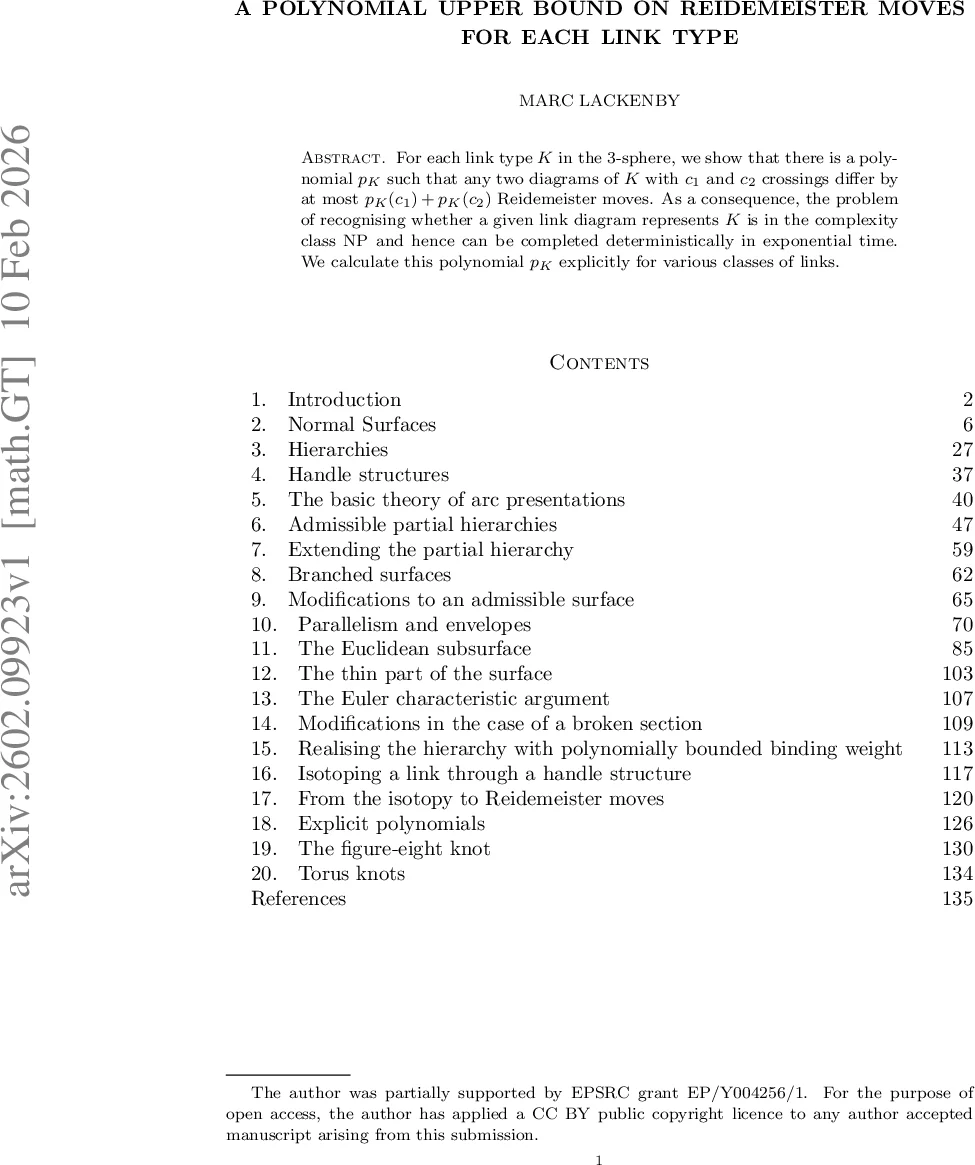
For each link type $K$ in the 3-sphere, we show that there is a polynomial $p_K$ such that any two diagrams of $K$ with $c_1$ and $c_2$ crossings differ by at most $p_K(c_1) + p_K(c_2)$ Reidemeister moves. As a consequence, the problem of recognising whether a given link diagram represents $K$ is in the complexity class NP and hence can be completed deterministically in exponential time. We calculate this polynomial $p_K$ explicitly for various classes of links.
💡 Research Summary
The paper establishes that for any fixed link type K in the 3‑sphere there exists a polynomial p_K such that any two diagrams of K with crossing numbers c₁ and c₂ can be related by at most p_K(c₁)+p_K(c₂) Reidemeister moves. Consequently, the K‑recognition problem (deciding whether a given diagram represents K) lies in the complexity class NP, and therefore can be solved by a deterministic algorithm in exponential time with respect to the number of crossings.
The authors begin by recalling earlier work: Haken‑Hemion‑Matveev proved decidability of link equivalence, while Coward‑Lackenby gave an exponential upper bound on the number of Reidemeister moves needed to pass between two diagrams of the same link. The present work improves this dramatically for a fixed link type, replacing the exponential bound by a polynomial one.
The core of the argument is a sophisticated blend of normal surface theory, branched surfaces, and arc‑presentation techniques. Any diagram D is first converted into a rectangular diagram, which yields an arc presentation of the link. In an arc presentation the link meets a distinguished binding circle in finitely many points and otherwise lies in the pages (open disks) of an open‑book decomposition of S³. The authors define the binding weight of a surface as the number of intersections with the binding circle; this quantity measures the complexity of a surface relative to the arc presentation.
For a non‑split link the spanning surface is replaced by a hierarchy: a finite sequence of properly embedded, incompressible surfaces that cut the link exterior into simpler pieces. Each surface in the hierarchy is placed in admissible form with respect to the arc presentation, and the authors prove that after a polynomial number of elementary moves (exchange moves, cyclic permutations, and the new “w‑edge insertion” moves) every surface can be arranged to have polynomially bounded binding weight. The w‑edge insertion is a novel operation that simultaneously reduces the binding weight of many low‑valence vertices whose “stars” are parallel in the associated branched surface. This parallelism is detected using the branched surface that carries the surface, and a careful complexity measure shows that the branched surface does not become more complicated during the process.
A key technical ingredient is an Euler‑characteristic argument (Section 13) showing that unless the binding weight is already polynomially bounded, the surface must contain many vertices of valence 4 in its double. These vertices give rise to a Euclidean subsurface equipped with a flat metric. If this subsurface were too large, one could extract a large Euclidean rectangle or annulus whose opposite sides are parallel; patching these together would produce a normal torus that is a summand of a multiple of the surface, contradicting the assumption that the hierarchy is exponentially controlled. Hence the Euclidean subsurface must be small, forcing the existence of many low‑valence, parallel vertices, and allowing the w‑edge insertion to reduce the binding weight dramatically.
Having bounded the binding weight of every surface in the hierarchy by a polynomial q(n) (where n is the arc index, itself linearly bounded by the crossing number), the hierarchy induces a handle structure on the link exterior. By attaching a regular neighbourhood of the link, the authors obtain a handle decomposition of the whole 3‑sphere in which each 2‑handle is thin and has polynomially bounded binding weight. They then construct an explicit isotopy that moves the link into a fixed 0‑handle, arranging that its projection onto a horizontal plane coincides with a predetermined diagram D′ of K. The isotopy is realized by a sequence of Reidemeister moves whose total length is bounded by a polynomial p_K(c), where c is the crossing number of the original diagram.
The paper also provides an algorithm that, given a diagram of K, computes the polynomial p_K. The authors implement this algorithm for two families of links. For the figure‑eight knot they obtain
p_K(c) = (10⁸ c)¹⁵⁴⁶⁰⁸⁹⁶,
and for a (p,q) torus knot (with 0 < |p| ≤ q) they obtain
p_K(c) = (10¹¹ c)²⁹⁹⁶⁶⁶.
These explicit bounds illustrate that the constants involved are astronomically large, yet they are polynomial rather than exponential, confirming the theoretical improvement.
From a complexity‑theoretic viewpoint, the existence of a polynomial‑length certificate (the sequence of Reidemeister moves) shows that K‑recognition is in NP. Since NP problems can be solved by exhaustive search in deterministic exponential time, the authors conclude that K‑recognition lies in EXP. Moreover, they discuss the tantalising open question of whether a single universal polynomial works for all links; an affirmative answer would imply that the general link equivalence problem itself is in NP, a major unresolved problem in low‑dimensional topology.
In summary, the paper delivers a deep geometric analysis that translates into a concrete algorithmic bound: for any fixed link type, the number of Reidemeister moves needed to pass between any two diagrams grows at most polynomially with the diagram size. This bridges the gap between topological decidability results and practical computational complexity, opening new avenues for algorithmic knot theory.
Comments & Academic Discussion
Loading comments...
Leave a Comment