Framework for (non-)adiabatic chiral state conversion: from non-Hermitian Hamiltonians to Liouvillians
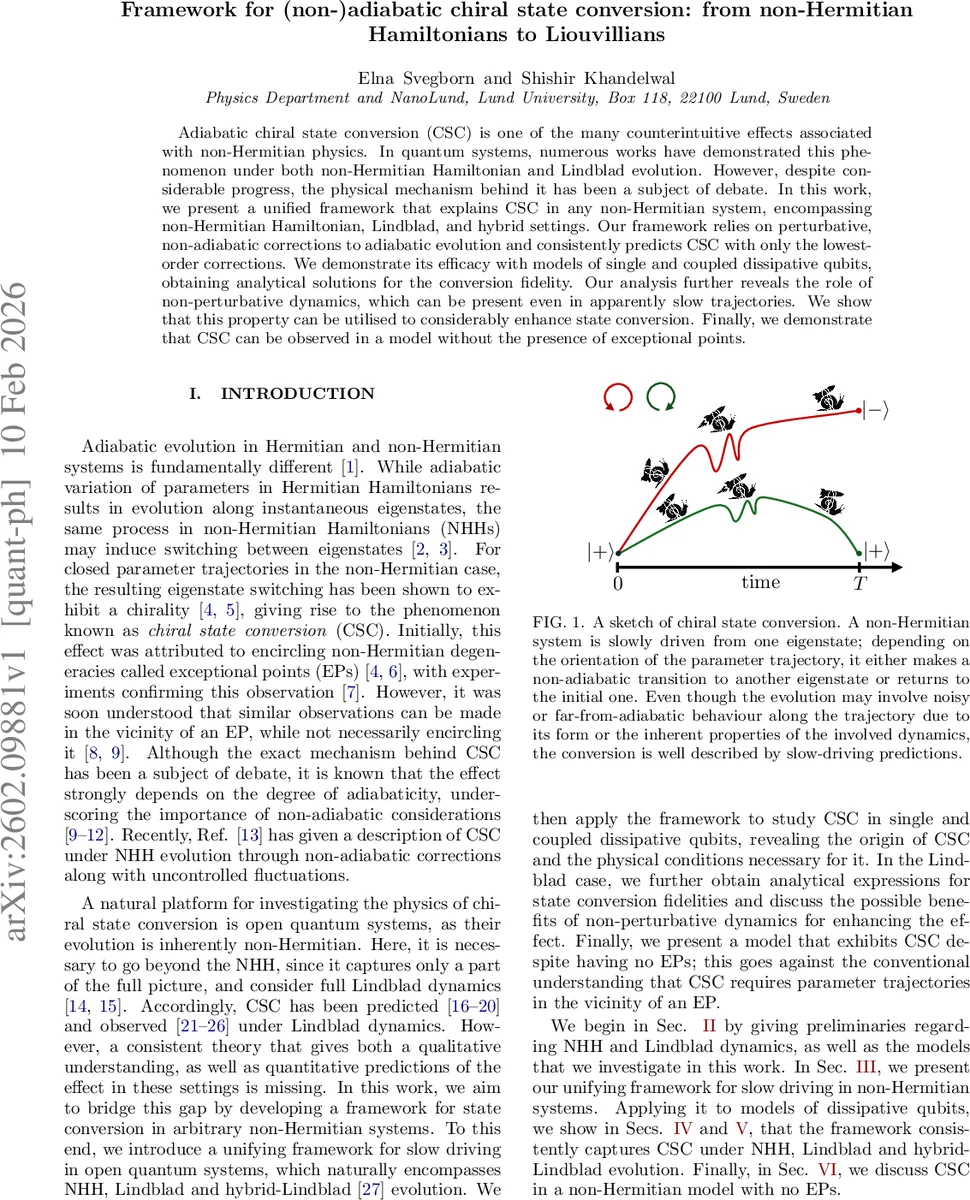
Adiabatic chiral state conversion (CSC) is one of the many counterintuitive effects associated with non-Hermitian physics. In quantum systems, numerous works have demonstrated this phenomenon under both non-Hermitian Hamiltonian and Lindblad evolution. However, despite considerable progress, the physical mechanism behind it has been a subject of debate. In this work, we present a unified framework that explains CSC in any non-Hermitian system, encompassing non-Hermitian Hamiltonian, Lindblad, and hybrid settings. Our framework relies on perturbative, non-adiabatic corrections to adiabatic evolution and consistently predicts CSC with only the lowest-order corrections. We demonstrate its efficacy with models of single and coupled dissipative qubits, obtaining analytical solutions for the conversion fidelity. Our analysis further reveals the role of non-perturbative dynamics, which can be present even in apparently slow trajectories. We show that this property can be utilised to considerably enhance state conversion. Finally, we demonstrate that CSC can be observed in a model without the presence of exceptional points.
💡 Research Summary
This paper presents a unified theoretical framework that explains chiral state conversion (CSC) in any non‑Hermitian quantum system, encompassing pure non‑Hermitian Hamiltonian (NHH) dynamics, full Lindblad master‑equation evolution, and hybrid cases that interpolate between the two. The authors start by introducing a “hybrid‑Liouvillian” L₍q₎(t) = −i
Comments & Academic Discussion
Loading comments...
Leave a Comment