Instantaneous modes in dispersive laser cavities
We develop a unified instantaneous-mode description for lasers with dispersive cavities, exploiting the separation of timescales between fast cavity fields and slow carrier dynamics. The resulting reduced rate equations retain the essential effects of frequency-dependent mirrors through a dynamic modal gain and an effective confinement factor determined directly by the mirror reflectivity. Applied to a Fano laser, the reduced description accurately reproduces the full dynamics and clarifies the physical origin of dispersive instabilities. More generally, the approach provides a transparent framework for reduced modeling and stability analysis of dispersive laser cavities.
💡 Research Summary
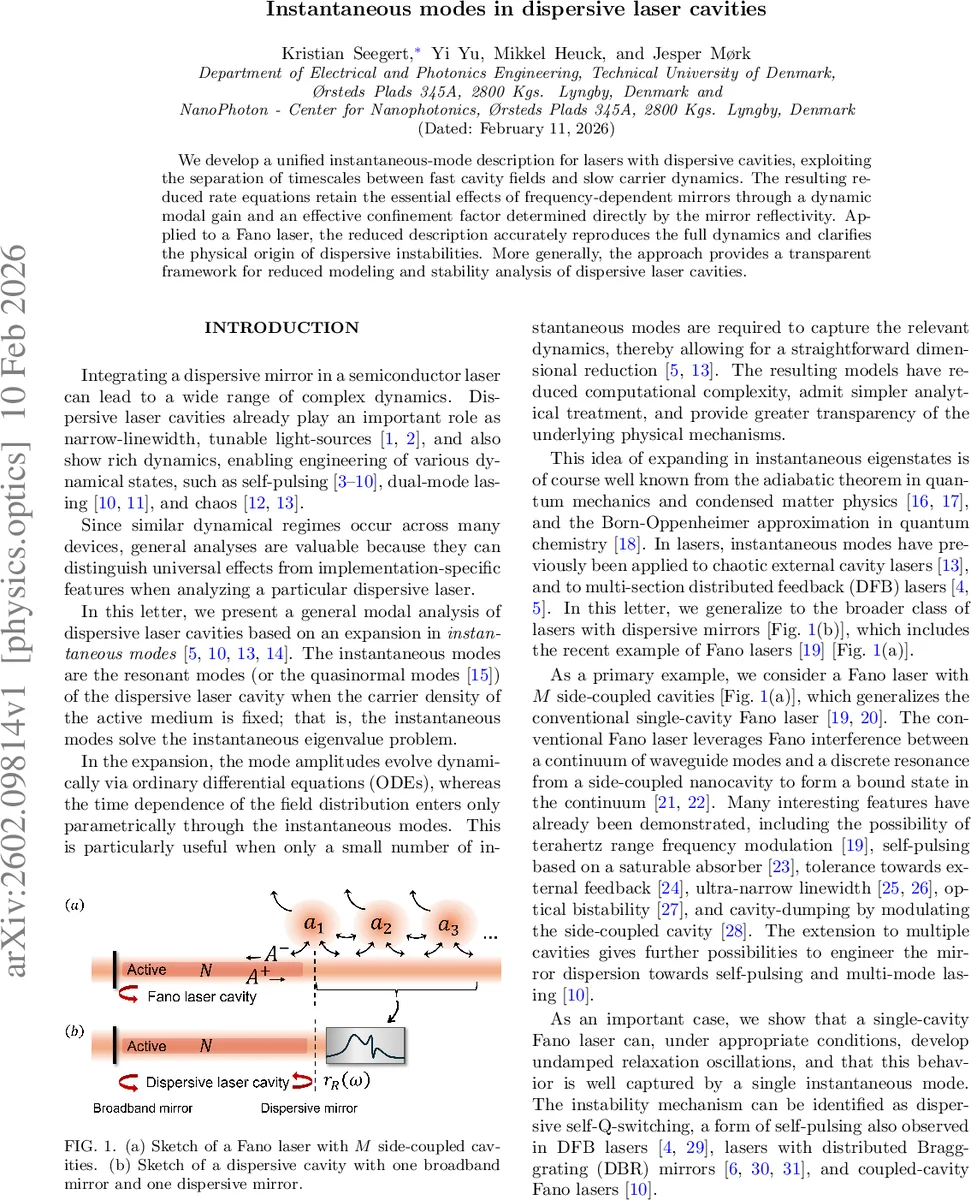
This paper presents a unified theoretical framework for describing lasers that incorporate frequency‑dependent (dispersive) mirrors, by exploiting the natural separation of timescales between the fast optical field dynamics and the slow carrier population dynamics. The authors start from a transmission‑line (ordinary differential equation, ODE) model of a Fano laser consisting of a gain section coupled to one or several side‑cavities. The key variables are the forward‑propagating field amplitude at the dispersive mirror (A⁺), the set of side‑cavity amplitudes (a₁…a_M), and the carrier density N. The total reflectivity of the dispersive mirror is written as r_R(ω)=r_B+r(ω), where r_B is a broadband, frequency‑independent contribution and r(ω) contains the dispersive part.
Because N varies slowly, the linear subsystem governing A⁺ and a can be treated as a parametrically dependent linear system dΨ/dt = –i H(N) Ψ + noise, where Ψ = (A⁺, aᵀ)ᵀ and H(N) is a non‑Hermitian matrix. The authors introduce an “instantaneous‑mode” expansion: they solve the eigenvalue problem H(N) ψₙ(N)=˜ωₙ(N) ψₙ(N) for each fixed N, obtaining right eigenvectors ψₙ and left (adjoint) eigenvectors φ̂ₙ that satisfy bi‑orthogonal normalization ⟨φ̂ₙ,ψ̂_m⟩=δₙm. Expanding the full state as Ψ(t)=∑ₙ fₙ(t) ψ̂ₙ
Comments & Academic Discussion
Loading comments...
Leave a Comment