Darboux first integrals of Kolmogorov systems with invariant $n$-sphere
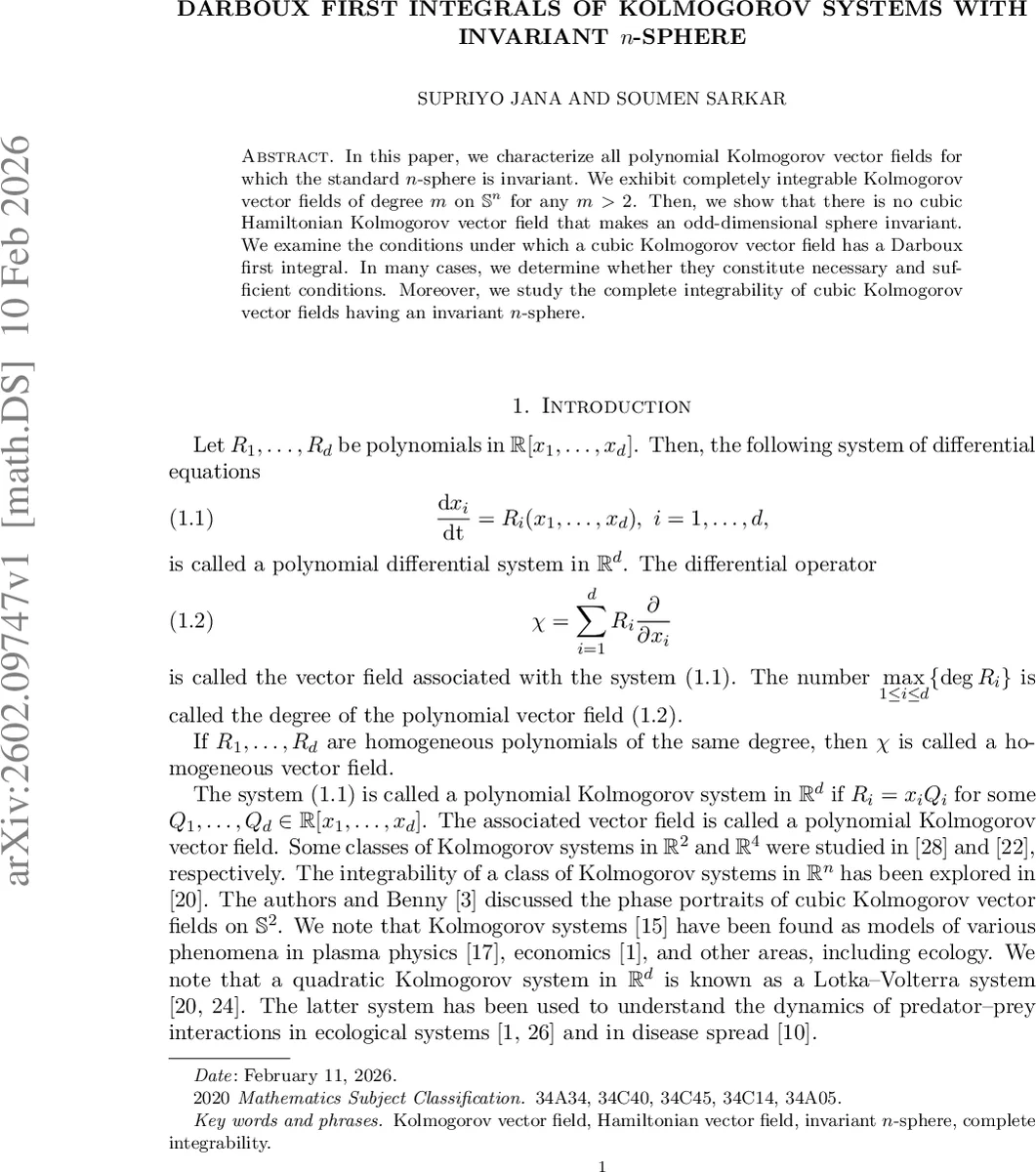
In this paper, we characterize all polynomial Kolmogorov vector fields for which the standard $n$-sphere is invariant. We exhibit completely integrable Kolmogorov vector fields of degree $m$ on $\mathbb{S}^n$ for any $m >2$. Then, we show that there is no cubic Hamiltonian Kolmogorov vector field that makes an odd-dimensional sphere invariant. We examine the conditions under which a cubic Kolmogorov vector field has a Darboux first integral. In many cases, we determine whether they constitute necessary and sufficient conditions. Moreover, we study the complete integrability of cubic Kolmogorov vector fields having an invariant $n$-sphere.
💡 Research Summary
The paper investigates polynomial Kolmogorov vector fields on the standard n‑sphere Sⁿ ⊂ ℝⁿ⁺¹, focusing on the existence of Darboux first integrals and complete integrability. A Kolmogorov system is defined by differential equations ẋ_i = x_i Q_i(x), i = 1,…,n+1, where each Q_i is a polynomial. The authors first give a full algebraic characterization of those Kolmogorov fields that leave the sphere invariant. Theorem 1.1 shows that invariance forces each component to have the form
P_i = x_i ( \tilde f_i + ∑{j=1}^{n+1} \tilde A{ij} x_j² ),
where the \tilde f_i and the entries of the matrix \tilde A are polynomials of degree ≤ m − 3 (m being the degree of the field) and \tilde A is skew‑symmetric. Consequently the whole field admits the cofactor K = −2∑ \tilde f_i x_i², confirming that each coordinate hyperplane x_i = 0 is invariant.
The paper then concentrates on cubic (degree‑3) Kolmogorov fields. Theorem 1.2 proves that no cubic Hamiltonian Kolmogorov field can make an odd‑dimensional sphere S^{2n‑1} invariant. By imposing the Hamiltonian condition ∂P_{2i‑1}/∂x_{2i‑1}+∂P_{2i}/∂x_{2i}=0, the authors derive a set of linear relations among the parameters α_i and the entries of \tilde A that are incompatible with the required skew‑symmetry, leading to a contradiction. Hence cubic Hamiltonian Kolmogorov systems are ruled out on odd‑dimensional spheres.
The Darboux theory of integrability is then applied. Theorem 3.2 gives a sufficient condition for a cubic Kolmogorov field to possess a Darboux first integral: if the \tilde f_i are constants, \tilde A is a constant skew‑symmetric matrix, and there exists a non‑zero vector y such that \tilde A y = 0 and ∑ y_i \tilde f_i = 0, then H = ∑ y_i x_i is a first integral. This exploits the fact that each invariant hyperplane x_i = 0 has cofactor K_i, and the linear combination ∑ y_i K_i vanishes because of the orthogonality of y to the columns of \tilde A.
Proposition 3.3 and Theorem 3.4 extend the construction. Proposition 3.3 shows that any linear polynomial f = a₀+∑ a_i x_i can be made a first integral by appropriately choosing a skew‑symmetric matrix \tilde A that annihilates the vector (a₁x₁,…,a_{n+1}x_{n+1})ᵗ. Theorem 3.4 demonstrates that for every degree m ≥ 3 and any dimension n, one can explicitly build a completely integrable Kolmogorov field on Sⁿ. The construction uses a single non‑zero polynomial \tilde A of degree m‑3 to define P₁ = \tilde A x₁ x₂², P₂ = −\tilde A x₂ x₁², and sets the remaining components to zero. The functions f₁ = ∑ x_i² − 1 and the coordinate functions x₃,…,x_{n+1} then provide n independent first integrals, establishing complete integrability.
The authors also study the situation where a cubic Kolmogorov field admits more than one invariant sphere. Theorem 4.3 proves that if a cubic field has two invariant spheres centered at the origin, the field must be homogeneous and the defining quadratic forms of the spheres are themselves first integrals. Theorem 1.4 (restated as Theorem 4.4) gives a more general criterion: when an invariant hypersurface g_{n+2}=0 with a quadratic cofactor exists, and a certain rank condition (rank B ≤ 2) on a matrix B built from the derivatives of g_{n+2} holds, then the field possesses n functionally independent first integrals of a specific rational type.
Overall, the paper provides a systematic algebraic description of Kolmogorov vector fields preserving the n‑sphere, establishes non‑existence results for cubic Hamiltonian cases, supplies explicit Darboux integrability conditions, and constructs families of completely integrable examples for arbitrary degree. These results deepen the understanding of polynomial dynamical systems with geometric constraints and have potential applications in ecological, economic, and physical models where Kolmogorov‑type interactions are confined to spherical manifolds.
Comments & Academic Discussion
Loading comments...
Leave a Comment