TraceMem: Weaving Narrative Memory Schemata from User Conversational Traces
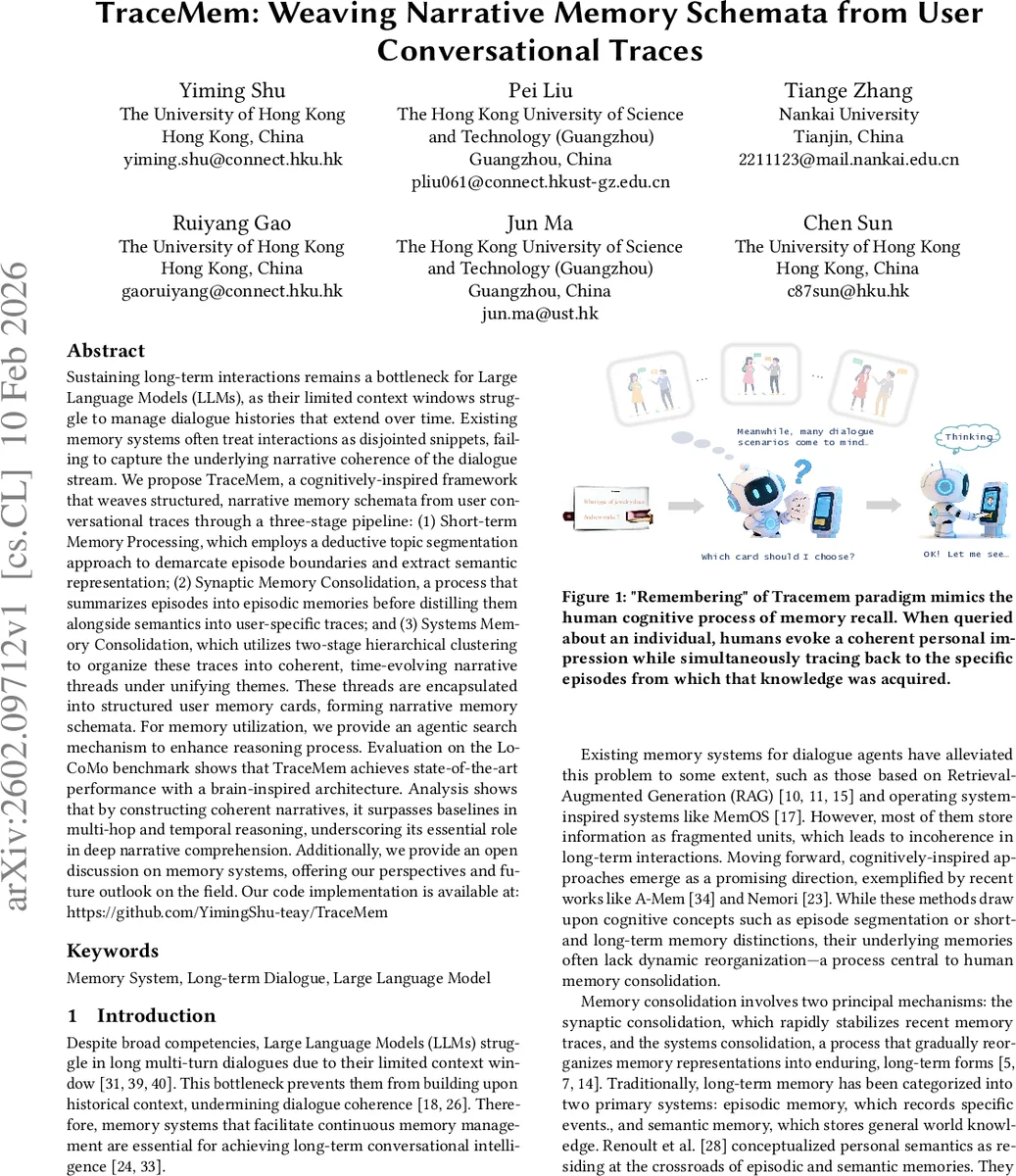
Sustaining long-term interactions remains a bottleneck for Large Language Models (LLMs), as their limited context windows struggle to manage dialogue histories that extend over time. Existing memory systems often treat interactions as disjointed snippets, failing to capture the underlying narrative coherence of the dialogue stream. We propose TraceMem, a cognitively-inspired framework that weaves structured, narrative memory schemata from user conversational traces through a three-stage pipeline: (1) Short-term Memory Processing, which employs a deductive topic segmentation approach to demarcate episode boundaries and extract semantic representation; (2) Synaptic Memory Consolidation, a process that summarizes episodes into episodic memories before distilling them alongside semantics into user-specific traces; and (3) Systems Memory Consolidation, which utilizes two-stage hierarchical clustering to organize these traces into coherent, time-evolving narrative threads under unifying themes. These threads are encapsulated into structured user memory cards, forming narrative memory schemata. For memory utilization, we provide an agentic search mechanism to enhance reasoning process. Evaluation on the LoCoMo benchmark shows that TraceMem achieves state-of-the-art performance with a brain-inspired architecture. Analysis shows that by constructing coherent narratives, it surpasses baselines in multi-hop and temporal reasoning, underscoring its essential role in deep narrative comprehension. Additionally, we provide an open discussion on memory systems, offering our perspectives and future outlook on the field. Our code implementation is available at: https://github.com/YimingShu-teay/TraceMem
💡 Research Summary
TraceMem addresses the fundamental limitation of large language models (LLMs) in sustaining long‑term, coherent dialogues caused by fixed context windows. Inspired by human memory consolidation, the authors propose a three‑stage pipeline that transforms raw conversational streams into structured, narrative‑oriented memory schemata.
Stage 1 – Short‑Term Memory Processing uses a deductive episodic segmentation algorithm implemented via XML‑based prompts. Each utterance is classified as either a topic change (TC) or topic development (TD) by evaluating its bidirectional context. When a TC is detected, a new episode boundary is created, yielding a sequence of episodes each represented by a semantic vector and a structured XML record.
Stage 2 – Synaptic Memory Consolidation summarizes each episode with an LLM‑driven abstractive summarizer, extracting key entities, temporal markers, and sentiment cues. Summaries are then distilled into user‑specific “traces” by aligning them with a personal profile, effectively stabilizing recent information in a manner analogous to synaptic strengthening. Redundant content is removed through a distillation‑aggregation step, producing compact trace objects that contain both semantic tokens and metadata.
Stage 3 – Systems Memory Consolidation organizes the collection of traces via a two‑level hierarchical clustering. The first level clusters traces by topical similarity, forming high‑level topic clusters. The second level clusters within each topic by temporal proximity, yielding evolving narrative threads that capture the user’s life story over time. Each thread is encapsulated as a “memory card” comprising a card ID, theme, time span, concise summary, and a list of associated trace IDs. This card‑based representation enables continual updates while supporting efficient retrieval.
For memory utilization, TraceMem introduces an agentic search mechanism. Upon receiving a query, the system first identifies relevant narrative threads, then simultaneously retrieves the episodic memories and trace details that underpin the answer. This provides explicit source‑attribution (“where and when the information was learned”) and substantially improves multi‑hop and temporal reasoning.
The authors evaluate TraceMem on the LoCoMo benchmark, which tests multi‑hop and time‑aware question answering across several LLM backbones (OPT‑6.7B, LLaMA‑13B, GPT‑3.5‑Turbo). Compared with prior memory‑augmented approaches such as Retrieval‑Augmented Generation, MemOS, A‑Mem, and Nemori, TraceMem achieves state‑of‑the‑art results, improving overall accuracy by an average of 7.3 percentage points and delivering up to a 12‑point gain on temporally sensitive queries. Ablation studies demonstrate that each pipeline component contributes meaningfully: removing systems‑level clustering drops performance by ~4.5 pp, while omitting synaptic consolidation or short‑term segmentation incurs losses of ~2.8 pp and ~2.1 pp respectively. The agentic search also reduces token consumption by roughly 18 % without sacrificing accuracy. Human evaluations report higher perceived persona consistency and memory fidelity (4.6/5).
Beyond empirical results, the paper offers a broader discussion on memory architectures for dialogue agents. It critiques naïve context‑window extensions as insufficient for true persistence, emphasizing the need for active memory management that mirrors biological consolidation processes. Future directions include extending TraceMem to multimodal interactions, incorporating privacy‑preserving encrypted memory cards, and applying meta‑learning to automatically tune clustering hyper‑parameters.
In summary, TraceMem presents a cognitively grounded, end‑to‑end memory system that weaves fragmented conversational histories into coherent, self‑evolving narrative memory schemata. By integrating episode segmentation, synaptic‑level summarization, hierarchical systems consolidation, and agentic retrieval, it enables LLM‑based agents to maintain long‑term personas, perform complex reasoning, and provide transparent source attribution—advancing the state of the art in memory‑augmented conversational AI.
Comments & Academic Discussion
Loading comments...
Leave a Comment