Power with Respect to Generalized Spheres and Radical Surfaces in $\mathbf{H}^n$
This paper presents a unified theory for the power of a point with respect to generalized spheres (spheres, horospheres, and hyperspheres) in $n$-dimensional hyperbolic space $\mathbf{H}^n$. By extending the classical secant theorem, we derive a nove…
Authors: Áron Világi, Jenő Szirmai
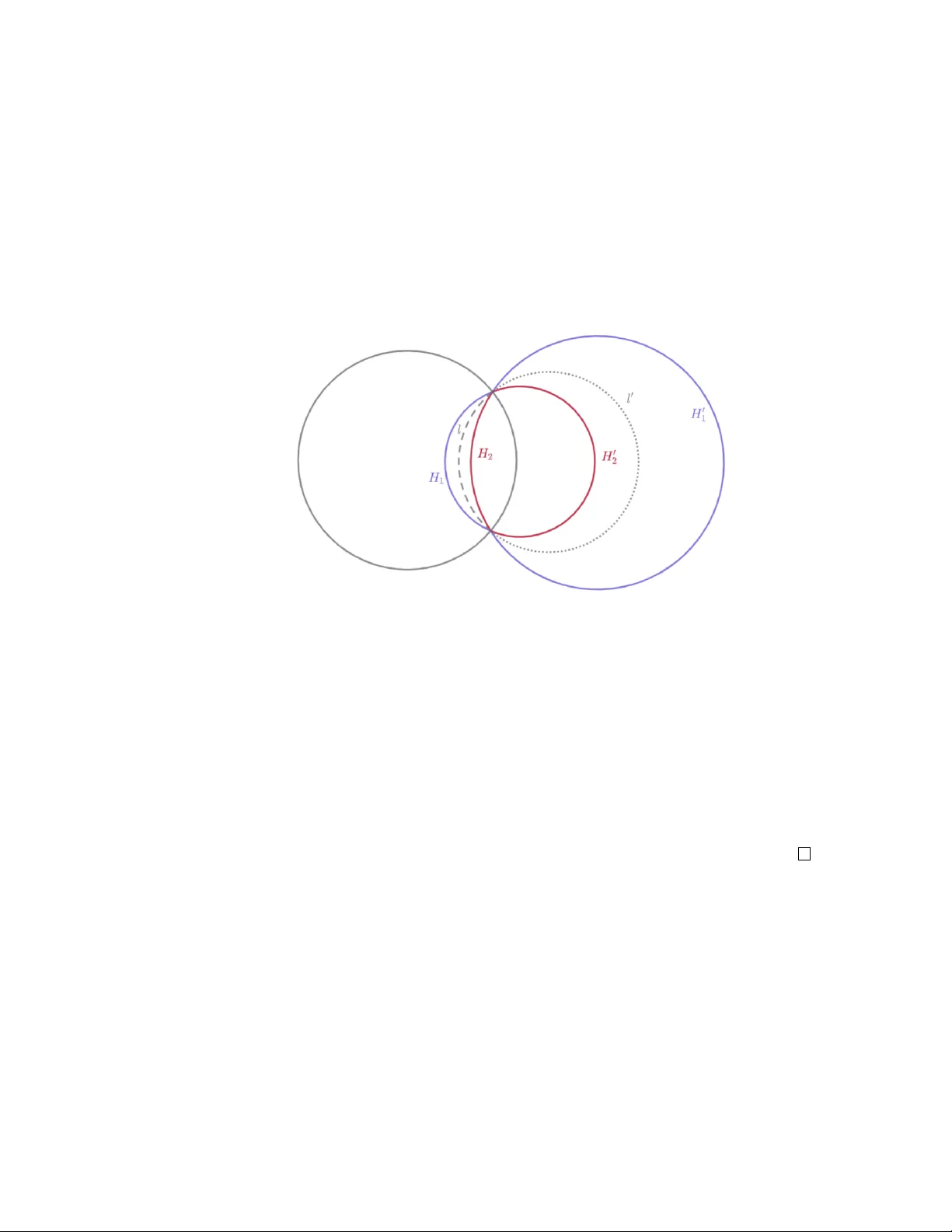
Po wer with Respect to Generalized Spheres and Radical Surfaces in H n * ´ Aron V il ´ agi and Jen ˝ o Szirmai Department of Algebra and Geometry , Institute of Mathematics, Budapest Uni versity of T echnology and Economics, M ¨ uegyetem rkp. 3., H-1111 Budapest, Hungary szirmai@math.bme.hu 2026 Abstract This paper presents a unified theory for the power of a point with respect to generalized spheres (spheres, horospheres, and hyperspheres) in n -dimensional hyperbolic space H n . By extending the classical secant theorem, we deriv e a novel formula for hyperspheres and also prove that the radical surface of any two non-concentric generalized spheres is a hyperplane. These results provide tools for constructing po wer diagrams and studying hyperball packings. 1 Intr oduction The concept of the po wer of a point with respect to a circle, originally introduced by Jakob Steiner in 1826 [8], is one of the cornerstones of classical Euclidean geometry . It reflects the relative position of a gi ven point with respect to a giv en * Mathematics Subject Classification 2010: 51M10, 51M15, 52A20, 52C17, 52C22, 52B15. Ke y w ords and phrases: Hyperbolic geometry , power of a point, radical axis, hyperball packings, packing density . 1 2 ´ Aron V il ´ agi and Jen ˝ o Szirmai circle. While this concept is well-understood in Euclidean space E n and has analo- gies in spherical geometry S n , its generalization to hyperbolic space H n presents unique challenges and deep geometric structures. In n -dimensional hyperbolic space, ”the family of circles and spheres” is richer than in Euclidean geometry . Besides the classical spheres, we must consider g eneralized spher es : horospheres (surfaces orthogonal to a pencil of parallel lines) and hyperspheres (surfaces at a constant distance from a hyperplane). While the geometry of classical hyperbolic spheres is widely discussed in the literature, the properties of hyperspheres — specifically regarding the power of a point and related incidence theorems — have recei ved less attention, despite their growing importance in geometry . The pri- mary aim of this paper is to establis h a unified theory for the power of a point with respect to generalized spheres in H n , with a special focus on the often-neglected case of hypercycles/h yperspheres. Our main contributions ar e as follo ws: 1. Unlike spheres and horospheres, a hypersphere consists of two separate branches. W e formulate and prov e the P ower of a point theor em for hyper cy- cle - and hyperspher e branches (Theorem 4.2). This is a non-tri vial e xten- sion of the classical theorem using secant lines intersecting both branches of a hypersphere, which giv es a beautiful relation in volving both the hy- perbolic tangent ( tanh ) and hyperbolic cotangent ( coth ) functions. Using this theorem, we can define the power of any point with respect to a giv en hypersphere branch. 2. W e pro ve that the radical surface of an y two non-concentric generalized spheres (whether they are spheres, horospheres, or hyperspheres) is always a hyperbolic hyperplane in H n (Lemma 6.3). This result is fundamental for constructing power diagrams (Dirichlet-V oronoi-like cells) in hyperbolic space (see [9, 11]). The moti vation for this study also stems from the theory of ball packings and cov- erings (see [6]). In recent years, determining the upper bound density of hyper - sphere packings in H n has become a central topic of research [10, 11]. T o handle these comple x arrangements, one often employs decomposition methods (e.g., di- viding space into truncated simplices). Such decompositions can be constructed using the radical surfaces of hyperspheres. A striking feature of our approach is its methodology . Rather than relying on lengthy analytic computations or coordinate-hea vy deri vations, we employ syn- thetic geometric r easoning . By utilizing the properties of the Poincar ´ e ball model Po wer with Respect to Generalized Spheres Hyperbolic Geometry 3 and geometric in version, we provide elegant, visual proofs that highlight the in- trinsic beauty of hyperbolic geometry . Structure of paper . Section 2 and 3 revie w the necessary Euclidean prelimi- naries and the connection between the secant theorem and in version. Section 4 presents the main results regarding the po wer of a point in H n , including the new theorem on hypercycle branches. Section 5 discusses the properties of hyper- bolic in v ersion, and in Section 6, we pro ve that the radical surfaces are indeed hyperplanes. Finally , we briefly discuss the implications of these results for non- congruent hyperball packings in H n . 2 Pr eliminaries 2.1 The Euclidean case In the Euclidean plane, the po wer of a point P with respect to a circle C E with center O and radius r is defined as P ( P ) := d E ( P , O ) 2 − r 2 , where d E ( P , O ) denotes the Euclidean distance between P and O . This definition was introduced by Jakob Steiner in [8], and it encodes the relativ e position of P with respect to C E . Theorem 2.1 (Power of a point theorem in E 2 ) . Let a line thr ough a point P intersect the cir cle C E at points A and B . Then, independently of the choice of the line, d E ( P , A ) · d E ( P , B ) = P ( P ) . If the line thr ough P is tangent to the circle C E at point T , then d E ( P , T ) 2 = d E ( P , A ) · d E ( P , B ) . The theorem admits natural analogues in higher dimensions: if P is a point and S E is an n -dimensional sphere in E n , then the po wer of P with respect to S E can be expressed in the same way , and the product of secant segments through P is constant. Remark. The power of a point theorem can be viewed as a unification of two classical results: when P lies inside or on the circle, it becomes the theorem of in- tersecting chords, and when P lies outside, it becomes the theorem of intersecting secants (both theorems can be found in the Elements of Euclid). 4 ´ Aron V il ´ agi and Jen ˝ o Szirmai Figure 1: Power of a point theorem 2.2 Relation with in version The connection between the po wer of a point theorem and in version provides a short proof: Let P ( P ) := d E ( P , C ) · d E ( P , D ) , where C D is the diameter cut out from the circle C E with center O by the line P O . If P lies outside C E , in version with respect to the circle centered at P with radius p P ( P ) leaves the Thales circle of the se gment C D (which is C E ) in variant, since inv ersion maps circles (not passing through the center of inv ersion) to circles. Thus, it holds for e very secant line that the product d E ( P , A ) · d E ( P , B ) is constant (and equals the po wer of point P with respect to C E ), since, for example, the in verse image of A is B under this in version. If P is located inside the circle C E , a proof completely identical to the abov e can be giv en by applying negati ve inv ersion (in this case, a point and its image are located on opposite sides of the center of in version). The proof can be extended to higher dimensions using in version with respect to an n -dimensional sphere. 2.3 The spherical case An analogous statement holds in spherical geometry . Let C S be a circle in the unit sphere S 2 of radius r , and let P be a point not antipodal to any point of C S . Po wer with Respect to Generalized Spheres Hyperbolic Geometry 5 Theorem 2.2 (Po wer of a point theorem in S 2 ) . Let a gr eat cir cle thr ough a point P intersect the circle C S at points A and B . Then, independently of the choice of the line, tan d S ( P , A ) 2 · tan d S ( P , B ) 2 If the great cir cle is tangent to C S at point T , then tan 2 d S ( P , T ) 2 = tan d S ( P , A ) 2 · tan d S ( P , B ) 2 . This establishes the spherical analogue of the power of a point theorem. The earliest works discussing this relationship on the spherical plane date back to the late-18th century (see [5]). Since then, numerous new proofs of the theorem ha ve been de veloped, and it is considered one of the fundamental relations in spherical trigonometry . 3 A uxiliary lemmas In this section, we introduce two Euclidean lemmas that will serve as fundamental tools throughout the paper . Definition 3.1 The radical axis of two circles in the Euclidean plane is the locus of points having equal power with respect to both circles. (This definition can be extended to n dimensions for two n -dimensional spheres.) The name and the definition were giv en by Louis Gaultier 1813 in [4]. It is well kno wn that the radical axis of two non-concentric circles in the Euclidean plane is a line (and a hyperplane in higher dimensions). Lemma 3.1 In vert circles k and l with respect to a circle centered on the radical axis of k and l . Let k ′ and l ′ denote the in verse images. Then the radical axis of k and l coincides with the radical axis of k ′ and l ′ . 6 ´ Aron V il ´ agi and Jen ˝ o Szirmai Figure 2: Illustration of Lemma 3.1 Proof: Let k and l be circles, let e denote their radical axis, and let O be a point on line e . Let ω be the circle of inv ersion with center O and radius r ∈ R + . By definition, O lies on the radical axis of k ′ and l ′ . Connect the centers of k and l with a line f . This line is perpendicular to circles k and l . f ′ (the in verse image of f with respect to ω ) is an open circle passing through O orthogonal to k ′ and l ′ , with its center on e (due to the properties of in version). Due to orthogonality , the center of f ′ lies on the radical axis of k ′ and l ′ . Thus, the radical axis of k ′ and l ′ is the line connecting the center of f ′ and O , which is the line e . Remark. The statement holds in n dimensions for spheres and radical hyperplane s as well. Since in version is well-defined in E n spaces and preserves all its impor- tant properties (see Chapter 2 of [7]), the proof remains valid if k , l , k ′ , l ′ , f ′ and ω are ( n -dimensional) spheres, while e and f are hyperplanes. Thus, we obtain the follo wing lemma: Lemma 3.2 In vert n -dimensional spheres k and l with respect to an n -sphere centered on the radical hyperplane of k and l . Let k ′ and l ′ be the in verse images. Then the radical hyperplane of k and l coincides with the radical hyperplane of k ′ and l ′ . Po wer with Respect to Generalized Spheres Hyperbolic Geometry 7 Lemma 3.3 Let ω 1 and ω 2 be two circles intersecting orthogonally at points A and B . Let c be a circle passing through A and B . Let c ′ and c ′′ denote the in verse images of c with respect to ω 1 and ω 2 , respectiv ely . Then circles c ′ and c ′′ coincide. Proof: The lemma follo ws directly from the conformality of in version. Figure 3: Illustration of Lemma 3.3 4 The notion of power h yperbolic geometry 4.1 The power of a point theor em in hyperbolic geometry Theorem 4.1 (Power of a point theorem for circles in H 2 ) . Let a line thr ough a given point P intersect the cir cle C H at A and B in the hyperbolic plane. Then the following pr oduct is constant for every line that intersects C H : tanh d H ( P , A ) 2 · tanh d H ( P , B ) 2 . 8 ´ Aron V il ´ agi and Jen ˝ o Szirmai Figure 4: Hyperbolic secant theorem in the Poincar ´ e disk model Proof: The proof uses the Poincar ´ e disk model of the hyperbolic plane. It is suf ficient to examine the case where P lies at the center of the model and C H is arbitrary , since any other case can be mapped to this one by a suitable isometry . Placing point P at the center of the model is particularly useful because (Eu- clidean) lines passing through the center in the Poincar ´ e disk model correspond to lines of the hyperbolic plane. Furthermore, if the Euclidean distance of a point from the center is r in the model, its hyperbolic distance in the hyperbolic plane is 2 artanh r . When P lies at the center of the model, it follows that the Euclidean lengths of the secant se gments are d E ( P , A ) = tanh d H ( P,A ) 2 and d E ( P , B ) = tanh d H ( P,B ) 2 . Since the secant theorem holds in the Euclidean plane, and circles of the hyper- bolic plane are represented by circles in the model, the product tanh d H ( P , A ) 2 · tanh d H ( P , B ) 2 is constant for e very line intersecting C H . □ If P lies outside the circle C H , it follows similarly that if the line passing through P is tangent to C H at point T , then tanh d H ( P , A ) 2 · tanh d H ( P , B ) 2 = tanh 2 d H ( P , T ) 2 . Po wer with Respect to Generalized Spheres Hyperbolic Geometry 9 The same theorem applies to horocycles. Since a horocycle appears in the Poincar ´ e disk as a circle tangent to the boundary circle, the proof is identical to the one pre- sented abov e. The relationship remains valid for secant segments intersecting the horocycle ”at infinity” if we consider tanh( ∞ ) to be 1 . Remark. These statements hold for n -dimensional spheres and horospheres as well. The proof is identical to the planar case if we use the n -dimensional Poincar ´ e ball model (for the n -dimensional model, see [2]), since the secant theorem is valid in the n -dimensional Euclidean space. Definition 4.1 The power of a point P with respect to a circle or horoc ycle in the hyperbolic plane is defined by the product: tanh d H ( P , A ) 2 · tanh d H ( P , B ) 2 . The po wer with respect to an n -dimensional sphere or horosphere is defined in t he same way . 4.2 P ower with respect to h ypercycles and h yperspheres Since hypercycles in the Poincar ´ e disk model are circular arcs (or line segments) that are not perpendicular to the boundary circle, it is easy to see that the hyper- bolic power of a point theorem can be extended to a branch of hypercycle, if we can intersect that branch twice with the secant line. (This can be proved similarly to Theorem 4.1). From a gi ven point P , howe ver , a line can intersect a branch of a hypercycle twice only if that branch lies closer to P than the other . 1 . Moreov er , for any point and any hyperc ycle it is possible to draw a secant that intersects the hypercycle on tw o distinct branches. In this case, the hyperbolic po wer of a point theorem no longer holds for the lengths of the secant segments. T o address these dif ficulties, we introduce a v ersion of the hyperbolic po wer of a point theorem generalized for hypercycle branches. In order to construct the theorem, we shall examine an interesting property of the Poincar ´ e disk model: Lemma 4.1 Let H 1 and H 2 be two branches of a hyperc ycle in the hyperbolic plane. In the Poincar ´ e disk model, the in verse of the circular arc representing H 1 with respect to the boundary circle completes the circular arc representing H 2 , 1 except when P lies on the base line. In that case both branches can be intersected twice at their points at infinity , if the secant is the base line itself 10 ´ Aron V il ´ agi and Jen ˝ o Szirmai and the in verse of the arc representing H 2 with respect to the boundary circle completes the arc representing H 1 . Figure 5: Illustration of Lemma 4.1 Proof: Since in version with respect to a circular arc representing a line in the Poincar ´ e disk model models reflection, by the definition of a hypercycle, the in- verse of the arc representing H 1 with respect to the arc of the base line l is the arc representing H 2 . Furthermore, the arc of the base line l in the model is orthogonal to the boundary circle of the model; thus, by Lemma 3.3, the full circles of the arcs modeling H 1 and H 2 are in verses of each other with respect to the boundary circle. Since the arcs corresponding to H 1 and H 2 lie inside the boundary cir- cle, their in verse images with respect to the boundary circle lie outside the model, completing each other’ s arcs into full circles. The lemma naturally e xtends to the n -dimensional Poincar ´ e ball model, where H 1 and H 2 are n -dimensional hyperspheres, as they appear as n -dimensional spher- ical caps in the model. The proof proceeds analogously to the one abov e, since Lemma 3.3 is also true for spheres of higher dimensions. Theorem 4.2 (Po wer of a point theorem with respect to hypercycle-branches) . Let H be a hypercycle in the hyperbolic plane with branc hes H 1 and H 2 . Let P be a point in the hyperbolic plane. Po wer with Respect to Generalized Spheres Hyperbolic Geometry 11 (i) Secant on the same branch: If a hyperbolic line passing thr ough P inter - sects branch H 1 at A and B (pr ovided this is possible), then the pr oduct tanh d H ( P , A ) 2 · tanh d H ( P , B ) 2 is constant, independently of the choice of the secant line passing thr ough P . (ii) Secant on dif ferent branches: If a hyperbolic line passing thr ough P inter - sects branch H 1 at A and the opposite branch H 2 at B , then the pr oduct tanh d H ( P , A ) 2 · coth d H ( P , B ) 2 is constant, independently of the choice of the secant line. Mor eover , this pr oduct equals the pr oduct in case (i) if H 1 can be intersected at two points by a secant line passing thr ough P . Remark. Equiv alently , since coth P B 2 = tanh P B + iπ 2 , to keep tanh in the formula, one can also write: tanh d H ( P A ) 2 · tanh d H ( P B ) + iπ 2 . Proof: Place point P at the center of the Poincar ´ e disk model and consider the full circle of the arc representing H 1 . Let the line drawn from P through A in- tersect this circle at another point A 2 in the Euclidean plane of the model. By Lemma 4.1, the arc completing the arc modeling H 1 outside the model is the in- verse of the arc modeling H 2 with respect to the boundary circle (which is a unit circle). Since coth x and tanh x are reciprocals, coth( d H ( P,B ) 2 ) corresponds to the distance d E ( P , A 2 ) in the Euclidean plane of the model if B lies on H 2 (see Figure 6). Otherwise, A 2 coincides with B . Since the power of a point theorem holds in the Euclidean plane, the statement is prov en. The theorem applies equally to branches of n -dimensional hyperspheres. The proof is identical to the one abov e, as Lemma 4.1 holds in higher dimensions as well. 12 ´ Aron V il ´ agi and Jen ˝ o Szirmai Figure 6: Illustration of Proof for Theorem 4.2 Based on the theorem abov e, we can provide a more general definition for the concept of po wer with respect to hypercycle branches: Definition 4.2 Let P be a point and H a hyperc ycle in the hyperbolic plane with branches H 1 and H 2 . Draw an arbitrary secant line through P intersect- ing branches H 1 and H 2 at points A and B , respectiv ely (such a secant always exists). The power of point P with r espect to H 1 is determined by the follo wing product: tanh d H ( P , A ) 2 · coth d H ( P , B ) 2 . The power with respect to branches of higher-dimensional hyperspheres is defined by the same expression. Remark. By this definition, the po wers of a giv en point P with respect to the two branches of a gi ven hypercycle are reciprocals of each other . Remark. Based on the abov e, it is easy to see that if P lies on the base line of the hypercycle, its power with respect to both branches equals 1 . If P lies on the branch for which the power is being examined, the po wer is 0 . If P lies on the other branch, the power can be considered ∞ , since the right-hand limit of the coth function at 0 is infinity . Follo wing the proof, this also has a nice geometric representation. If the arc representing H 2 passes through the center of the Poincar ´ e disk, the arc representing H 1 appears as a straight line segment. Po wer with Respect to Generalized Spheres Hyperbolic Geometry 13 5 In version in spaces of constant curv ature Definition 5.1 (In version in spherical geometry) The in verse of a point P ∈ S 2 with respect to a circle C S with center O and radius r is the point P ′ ∈ S 2 such that: tan d S ( O , P ) 2 · tan d S ( O , P ′ ) 2 = tan 2 r 2 (where d S ( O , P ′ ) is measured in the direction of P ). This definition is similar to the definition of in version in the Euclidean plane, where the defining equation is d E ( O , P ) · d E ( O , P ′ ) = r 2 . The Euclidean and the spherical in version share all of their most important properties (see [3]). W e will discuss the in version in the hyperbolic plane in more detail, since this case is less well-kno wn than the Euclidean and spherical cases. Definition 5.2 (In version in the hyperbolic plane) The in verse of a point P ∈ H 2 with respect to a circle C H with center O and radius r is the point P ′ ∈ H 2 such that: tanh d H ( O , P ) 2 · tanh d H ( O , P ′ ) 2 = tanh 2 r 2 (where P ′ is lying on the ray from O through P ). This transformation has a domain of definition, since the range of tanh on pos- iti ve values is not all positiv e numbers, only the interval (0 , 1) . Hence, points within a distance less than or equal to 2artanh tanh 2 r 2 from O will not hav e a real image under this transformation. So the transformation is undefined on the closed disk of radius 2artanh tanh 2 r 2 centered at O . (This can be verified algebraically .) 5.3 Properties of the transf ormation The properties of the in version in the hyperbolic plane is v ery similar to the prop- erties of the Euclidean in version: (1.) The domain and codomain are equal, and the mapping is bijecti ve between them. (2.) A circle within the domain is mapped to another circle. 14 ´ Aron V il ´ agi and Jen ˝ o Szirmai (3.) A line is mapped to an arc orthogonal to the boundary circle of the domain of definition. (and vice versa). (4.) A hypercycle is mapped to an arc (non-orthogonally) intersecting the bound- ary circle of the domain of definition. (and vice versa). (5.) Angle-preserving. Proofs: (1.) Follo ws from the commutati vity of multiplication. (2.) Use the Poincar ´ e disk model. Again, it is enough to e xamine the case where O is the center of the model. When O is the center point, the transfor- mation can be modeled as inv ersion in a Euclidean circle centered at O with radius tanh r 2 (this can be verified algebraically). Since circles not passing through the center are mapped to circles under in version, and since Euclidean circles in the model correspond to hyperbolic circles (and vice versa), the statement follo ws. (3.) Follo ws similarly to (2.) from the properties of Euclidean in version. (4.) Follo ws similarly to (2.) from the properties of Euclidean in version. (5.) Follo ws from the conformality of the Poincar ´ e model and Euclidean in ver - sion. Remark. One ke y property of classical in version does not hold here: there do not exist O and r for which any two (non-congruent) circles are mapped into one another . Ho wev er , this statement is true for any two circles whose external common tangents intersect (this can be easily verified). In Euclidean geometry , as mentioned earlier , in version with respect to an n -dimen- sional circle is defined the same way as in the planar case, and has the n -dimensional equi valents of the properties of the planar version. In the n -dimensional Poincar ´ e ball model of hyperbolic geometry , the transformation representing the reflection of a hyperplane is a Euclidean in version with respect to an n -dimensional sphere (which represents the hyperplane in the ball model). W e can define the in version in n -dimensional hyperbolic spaces with respect to an n -dimensional sphere the same way as in the planar case preseving all impor- tant properties. The proofs for these are the same as those gi ven for the planar Po wer with Respect to Generalized Spheres Hyperbolic Geometry 15 case, only using the n -dimensional in version and the n -dimensional Poincar ´ e ball model. Figure 7: Hyperbolic in version with respect to ω in the Poincar ´ e disk model 6 Radical axes and surfaces in hyperbolic geometry As shown previously , the hyperbolic and spherical analogues of the po wer of a point theorem allows us to define the power of a point with respect to a circle in these geometries. (This concept can be extended to generalized circles as well in the hyperbolic case.) Thus, the definition of the radical axis in these geometries coincides with the definition gi ven in Euclidean geometry . In the spherical case, it is well kno wn that the radical axis of two circles is an arc of a great circle, in other words, a spherical line. (See in [1].) In the following we examine the radical axis of circles, hypercycles and horocycles on the hyperbolic plane and also provide a generalization to H n spaces. 6.1 Radical axis of two cir cles in hyperbolic geometry Lemma 6.1 The radical axis of any two circles in hyperbolic geometry is a hy- perbolic line. (Or an empty set of points in concentric cases.) 16 ´ Aron V il ´ agi and Jen ˝ o Szirmai Proof: Let k and l be any two circles in the hyperbolic plane. Naturally , there exist (infinitely man y) points having equal po wer with respect to both. T ake such a point O , and use the Poincar ´ e disk model where O is at the center . Since all lines through the origin are also straight lines in the model, O lies (in the Euclidean sense) on the radical axis of the Euclidean images of k and l . The Euclidean radical axis of these circles, denoted e , is then also a hyperbolic straight line. Choose another point P = O on this line. Using an isometry (e.g. reflection), map P to the center of the model. This transformation in the model is an in version in a circle centered on e and orthogonal to the boundary circle. By Lemma 3.1, the image circles k ′ , l ′ will also ha ve radical axis e . Since P no w lies at the origin, by the reasoning used in the proof of Theorem 4.1, P must also lie on the hyperbolic radical axis of k ′ and l ′ . Therefore, e very point on e has equal power with respect to k and l . By continuity , no other points do. Hence, the radical axis is this line e . In the concentric case the radical axis is tri vially an empty set similarly to eu- clidean geometry . Figure 8: Radical axis of two hyperbolic circles in the Poincar ´ e disk model Remark. If we take the intersection of the radical axis and the hyperbolic line connecting the centers of the two circles and place it at the center of the Poincar ´ e model, we can see by symmetry that the radical axis is perpendicular to this line. 6.2 Generalization to cycles: By extending the reasoning used in the proof of Theorem 4.1 to arbitrary cycles, we can conclude that a point P lies on the radical axis of any two cycles (circle, Po wer with Respect to Generalized Spheres Hyperbolic Geometry 17 horocycle, or h ypercycle branch) if and only if, when placing point P at the center of the Poincar ´ e disk model, P lies on the Euclidean radical axis of the circles modeling the two cycles (circles or circular arcs). Thus, in a completely analogous way to the proof of Lemma 6.1, we obtain the follo wing statement: Lemma 6.2 The radical axis of two non-concentric generalized circles in the hy- perbolic plane is also a hyperbolic line. Remark. It can be easily seen by the methods used above that in cases where two hypercycles ha ve the same baseline, the radical axis is the baseline itself, and that where tw o horocycles ha ve the same infinite point, the radical axis of these c ycles is an empty set of points. Remark. The three radical axes determined by three circles/cycles in the hyper- bolic plane meet is one point. This can be prov ed analougusly to the Euclidean case. Figure 9: Radical axes of a circle, a hypercycle and a horoc ycle 6.3 Generalization to n dimensions: All the statements used in the abo ve proofs e xtend naturally to higher dimensions. The proofs are identical to the proofs for Lemma 6.1 and Lemma 6.2 using the 18 ´ Aron V il ´ agi and Jen ˝ o Szirmai 3.2 version of Lemma 3.1 and the n -dimensional Poincar ´ e ball-model of the H n spaces. So we get: Lemma 6.3 The radical surf ace of two (non-concentric) generalized spheres in the n -dimensional hyperbolic space is a hyperplane. 7 Futur e perspectives on non-congruent h yperball packings In n -dimensional hyperbolic geometry , numerous new questions arise regarding packing and cov ering problems. In the space X n , let d n ( r ) ( n ≥ 2) denote the density of n + 1 mutually tangent spheres or horospheres (in the case of r = ∞ ) of radius r relati ve to the simplex spanned by their centers. L. Fejes T ´ oth and H. S. M. Coxeter conjectured that the packing density of spheres of radius r in X n cannot e xceed d n ( r ) . The conjecture was prov ed by C. A. Rogers for the Euclidean space E n , and the two-dimensional spherical case was solv ed by L. Fejes T ´ oth. The maximum density in H 3 is ≈ 0 . 85328 , which is realized by horosphere pack- ings, the regular tetrahedral tessellation corresponding to the ideal packing is gi ven by the Coxeter -Schl ¨ afli symbol { 3 , 3 , 6 } . Sphere packings in hyperbolic n -space and other Thurston geometries are widely discussed in the literature. Ho wev er , while there are countless open questions currently being in vestigated regarding sphere and horosphere packings and coverings, relativ ely few results are kno wn concerning hyperball arrangements. In the hyperbolic plane H 2 , the univ ersal upper bound for hypercycle packing den- sity is 3 π , proved by I. V ermes. Similarly for hypercycle cov erings, the uni versal lo wer bound for covering density is √ 12 π . The follo wing papers deal with higher -dimensional congruent hyperball packings and cov erings. [9] examines congruent hyperball packings in 3 -dimensional hyperbolic space and presents a decomposition algorithm that ensures the decomposition of H n into truncated tetrahedra for ev ery saturated hyperball packing. Therefore, to obtain the upper bound for the density of hyperball packings, it is suf ficient to determine Po wer with Respect to Generalized Spheres Hyperbolic Geometry 19 the upper bound for the density of congruent hyperball packings within truncated simplices, which is ≈ 0 . 86338 . [11] continues the in v estigation of congruent hyperball packings in higher -dimen- sional hyperbolic spaces H n ( n ≥ 4 ) and shows that for ev ery n -dimensional congruent, saturated hyperball packing, there exists a decomposition of the n - dimensional hyperbolic space into truncated simplices. Furthermore, the paper prov es that the upper bound for the density of saturated congruent hyperball pack- ings associated with the corresponding truncated tetrahedron cells is realized in a regular truncated tetrahedron. In 4 -dimensional hyperbolic space, this density upper bound is ≈ 0 . 75864 (which is larger than the previously conjectured maxi- mum). Moreov er , it refutes the conjecture of A. Prze worski regarding the mono- tonicity of the congruent hyperball packing density function in 4 -dimensional hy- perbolic space. In H n space, cell decompositions defined by the radical hyperplanes of h yperballs provide an opportunity to dev elop methods similar to the abov e and to determine the density upper bound for incongruent hyperball packings. Refer ences [1] Allardice, R.E., Radical Axes in Spherical Geometry , Proceedings of the Edinb urgh Mathematical Society , volume 3, (1884), DOI: 10.1017/S0013091500037305 [2] B ¨ or ¨ oczky , K.J., Cs ´ epai, A., Sagmeister , ´ A., Hyperbolic width functions and characterizations of bodies of constant width in the hyperbolic space, Journal of Geometry , (2024) https://doi.org/10.1007/s00022-024-00714-9 [3] Casey , J. A treatise on spherical trigonometry , and its applica- tion to geodesy and astronomy , with numerous examples, Uni- versity of Michigan Historical Math Digital Collections, (1889), https://name.umdl.umich.edu/ABN7420.0001.001. [4] Gaultier , L. M ´ emoire sur les moyens g ´ en ´ eraux de construire graphiquement les cercles d ´ etermin ´ es par trois conditions, et les sph ´ eres d ´ etermin ´ es par quatre conditions, Journal de l’ ´ Ecole poly- technique, 16 , (1813) 20 ´ Aron V il ´ agi and Jen ˝ o Szirmai [5] Lex ell, A.J. De proprietatibus circulorum in superficie sphaerica descriptorum, Acta Academiae Scientiarum Imperialis Petropoli- tanae, (1786) [6] Fejes T ´ oth, L. - Fejes T ´ oth, G. - Kuperberg, W .: Ball Packings in Hyperbolic Space, In: Lag erungen. Grundlehr en der mathe- matischen W issenschaften , Springer , Cham , 360 (2023), 263–270, https://doi.org/10.1007/978-3-031-21800-2-11. [7] Thurston, W .P ., Three-Dimensional Geometry and T opology , Princeton Uni versity Press, (1997) [8] Steiner , J. Einige geometrischen Betrachtungen [Some geo- metric considerations], Crelle’ s Journal, 1 (1826), 161–184, doi:10.1515/crll.1826.1.161. [9] Szirmai, J. Decomposition method related to saturated hy- perball packings, Ars Math. Contemp., 16 (2019), 349–358. http://eudml.org/doc/97023 [10] Szirmai, J. An upper bound of the density for packing of congruent hyperballs in hyperbolic 3-space, Aequat. Math. 97 , (2023), 453- 466, DOI: 10.1007/s00010-023-00947-0 [11] Y ahya, A. – Szirmai, J. Decomposition method and upper bound density related to congruent saturated hyperball packings in hyper- bolic n − space, Submitted Manuscript (2025), arXi v:2506.11682.
Original Paper
Loading high-quality paper...
Comments & Academic Discussion
Loading comments...
Leave a Comment