Shellability in Clique-Free Complexes of Graphs
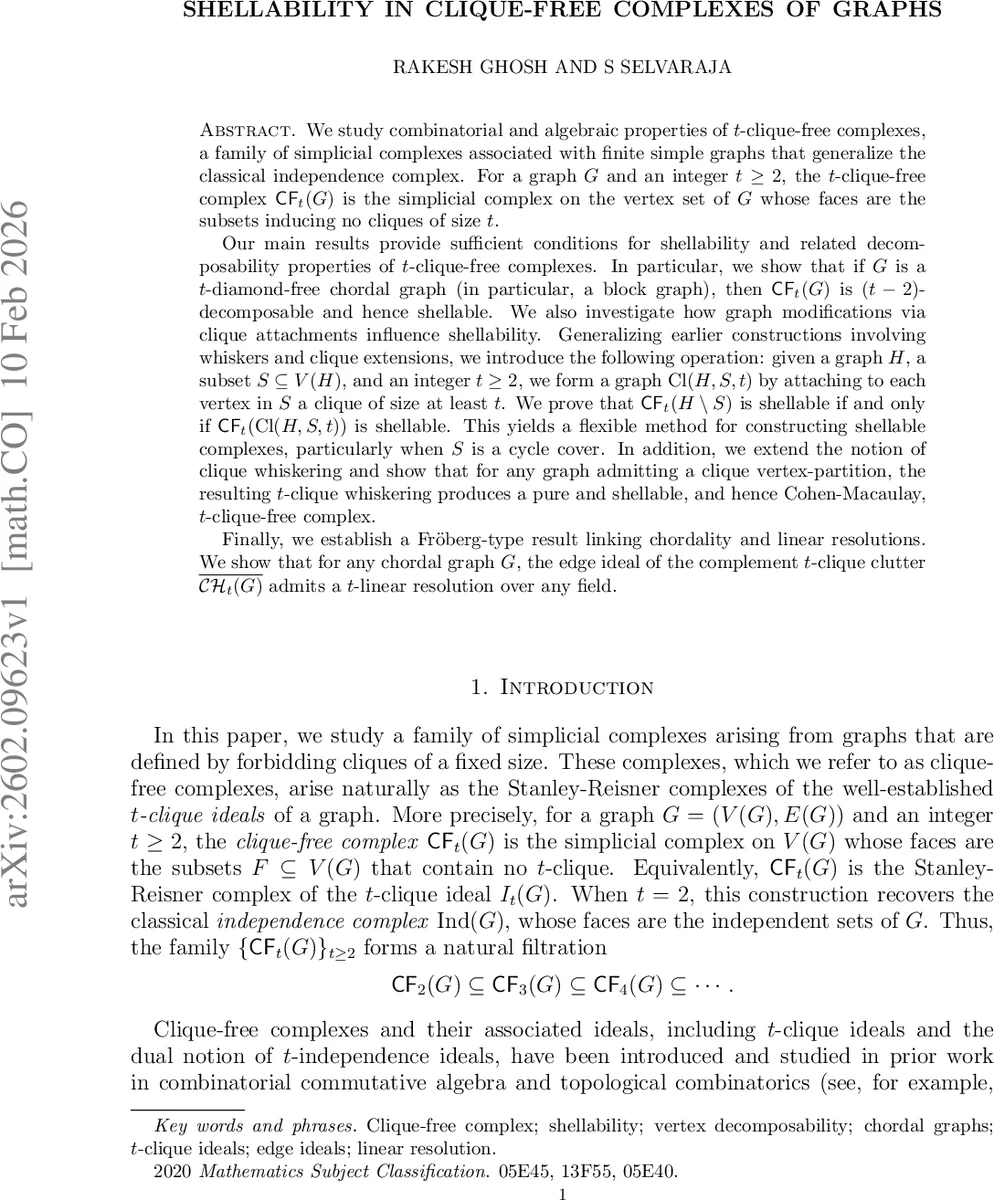
We study combinatorial and algebraic properties of $t$-clique-free complexes, a family of simplicial complexes associated with finite simple graphs that generalize the classical independence complex. For a graph $G$ and an integer $t \ge 2$, the $t$-clique-free complex $\mathsf{CF}_t(G)$ is the simplicial complex on the vertex set of $G$ whose faces are the subsets inducing no cliques of size $t$. Our main results provide sufficient conditions for shellability and related decomposability properties of $t$-clique-free complexes. In particular, we show that if $G$ is a $t$-diamond-free chordal graph (in particular, a block graph), then $\mathsf{CF}_t(G)$ is $(t-2)$-decomposable and hence shellable. We also investigate how graph modifications via clique attachments influence shellability. Generalizing earlier constructions involving whiskers and clique extensions, we introduce the following operation: given a graph $H$, a subset $S \subseteq V(H)$, and an integer $t \ge 2$, we form a graph $\operatorname{Cl}(H,S,t)$ by attaching to each vertex in $S$ a clique of size at least $t$. We prove that $\mathsf{CF}_t(H\setminus S)$ is shellable if and only if $\mathsf{CF}_t(\operatorname{Cl}(H,S,t))$ is shellable. This yields a flexible method for constructing shellable complexes, particularly when $S$ is a cycle cover. In addition, we extend the notion of clique whiskering and show that for any graph admitting a clique vertex-partition, the resulting $t$-clique whiskering produces a pure and shellable, and hence Cohen-Macaulay, $t$-clique-free complex. Finally, we establish a Fröberg-type result linking chordality and linear resolutions. We show that for any chordal graph $G$, the edge ideal of the complement $t$-clique clutter $\overline{\mathcal{CH}_t(G)}$ admits a $t$-linear resolution over any field.
💡 Research Summary
The paper investigates a family of simplicial complexes that arise from forbidding cliques of a fixed size in a finite simple graph. For a graph G and an integer t ≥ 2, the t‑clique‑free complex CFₜ(G) consists of all vertex subsets that do not contain a t‑clique; equivalently, CFₜ(G) is the Stanley–Reisner complex of the t‑clique ideal Iₜ(G). When t = 2 this reduces to the classical independence complex Ind(G). The authors aim to understand when CFₜ(G) enjoys desirable combinatorial and algebraic properties such as vertex‑decomposability, shellability, and (sequential) Cohen–Macaulayness.
The central combinatorial tool is k‑decomposability, a graded generalization of vertex‑decomposability introduced by Provan–Billera and later extended to non‑pure complexes. A complex is t‑decomposable if it either is a simplex or possesses a shedding face of dimension ≤ t whose deletion and link are both t‑decomposable. This notion interpolates between vertex‑decomposability (t = 0) and shellability (t equal to the dimension of the complex).
Main structural result (Theorem 3.3).
If G is a t‑diamond‑free chordal graph (i.e., G contains no induced subgraph consisting of a t‑clique together with an extra vertex adjacent to all vertices of the clique), then for every t ≥ 3 the complex CFₜ(G) is (t − 2)‑decomposable and therefore shellable. Since block graphs are a subclass of t‑diamond‑free chordal graphs, the theorem immediately yields shellability for all block graphs and any t ≥ 3. The proof proceeds by induction on the number of vertices, selecting a vertex that serves as a shedding face; the forbidden t‑diamond condition guarantees that both the deletion and the link inherit the same forbidden‑subgraph property, allowing the inductive step.
Graph modification preserving shellability (Theorem 4.2).
Given a graph H, a vertex subset S ⊆ V(H), and an integer t ≥ 2, construct Cl(H,S,t) by attaching to each v ∈ S a new clique Kᵥ of size at least t that contains v. The theorem states that CFₜ(H \ S) is shellable if and only if CFₜ(Cl(H,S,t)) is shellable. The argument uses the fact that the newly attached cliques are complete subgraphs, which do not interfere with the shedding‑face structure of the original complex. As a corollary, when S forms a cycle cover (hence a vertex cover) of H, the complex CFₜ(Cl(H,S,t)) is always shellable. This unifies earlier results on whiskering (attaching pendant vertices) and on clique extensions.
Clique‑vertex‑partition and t‑clique whiskering (Theorems 4.8 and 4.9).
If a graph G admits a partition of its vertex set into cliques Π = {W₁,…,Wₚ}, then for any t ≥ 2 one can form the t‑clique‑whiskered graph G(Π,t) by attaching to each part Wᵢ a new clique of size t that shares exactly the vertices of Wᵢ. The authors prove that CFₜ(G(Π,t)) is pure (all maximal faces have the same dimension) and shellable, which consequently implies that it is Cohen–Macaulay over any field. This construction generalizes the vertex‑clique‑whiskered graphs introduced by Cook II and Nagel and provides a systematic method for producing pure, shellable, and Cohen–Macaulay t‑clique‑free complexes.
Higher‑degree Fröberg‑type theorem (Theorem 5.2).
Fröberg’s classical theorem characterizes graphs whose edge ideals have a linear resolution: the complement must be chordal. The authors extend this to higher degrees by considering the t‑clique clutter CHₜ(G) (the set of all t‑cliques of G) and its complement clutter \overline{CHₜ(G)}. They prove that for any chordal graph G and any t ≥ 2, the edge ideal I(\overline{CHₜ(G)}) has a t‑linear resolution over any field. The proof adapts Fröberg’s original argument to the uniform clutter setting, exploiting the chordality of G to control the combinatorial structure of the minimal non‑faces of the associated Stanley–Reisner complex.
Overall contributions and significance.
- Provides a clean sufficient condition (t‑diamond‑free chordality) guaranteeing shellability of CFₜ(G) for all t ≥ 3, thereby extending the known vertex‑decomposability of independence complexes of chordal graphs.
- Introduces a versatile graph operation (clique attachment) that preserves shellability, yielding a flexible toolkit for constructing new shellable complexes from arbitrary graphs.
- Develops the notion of t‑clique whiskering based on clique vertex partitions, producing pure, shellable, and Cohen–Macaulay complexes in a systematic way.
- Extends Fröberg’s linear‑resolution theorem to higher‑degree uniform clutters, linking chordality to t‑linear resolutions of complement t‑clique clutter ideals.
The paper thus bridges combinatorial graph theory, simplicial topology, and commutative algebra, offering both structural theorems and constructive methods that are likely to stimulate further research on higher‑order independence complexes, uniform clutters, and their algebraic invariants.
Comments & Academic Discussion
Loading comments...
Leave a Comment